

Capture-Recapture GCSE Maths: Mock Revision Guide
Capture-recapture GCSE maths made clear with a simple method, two exam-style questions, common mock mistakes and a focused plan for every Year 11.
December mocks have a habit of making small gaps in your knowledge feel much larger. Capture-recapture is a good example. You may remember something about tagging fish, but not which numbers belong in the calculation.
The reassuring answer is that capture-recapture GCSE maths questions are built around one proportion. Once you can identify the first capture, the second sample and the number found with marks, the arithmetic is usually manageable. Your revision should focus on setting up that proportion, explaining the assumptions and interpreting the estimate.
Your capture-recapture mock revision checklist
Before your mock, make sure you can:
- explain why capture-recapture is used
- identify the three important values in a question
- form and solve the correct proportion
- round a population estimate appropriately
- state realistic assumptions
- explain whether a broken assumption creates an overestimate or underestimate
- show enough working to earn method marks
Begin with the MathsGenie capture-recapture lesson, then move from guided examples to independent questions. That order matters. Watching a method can create familiarity, but answering questions reveals whether you can retrieve it without help.
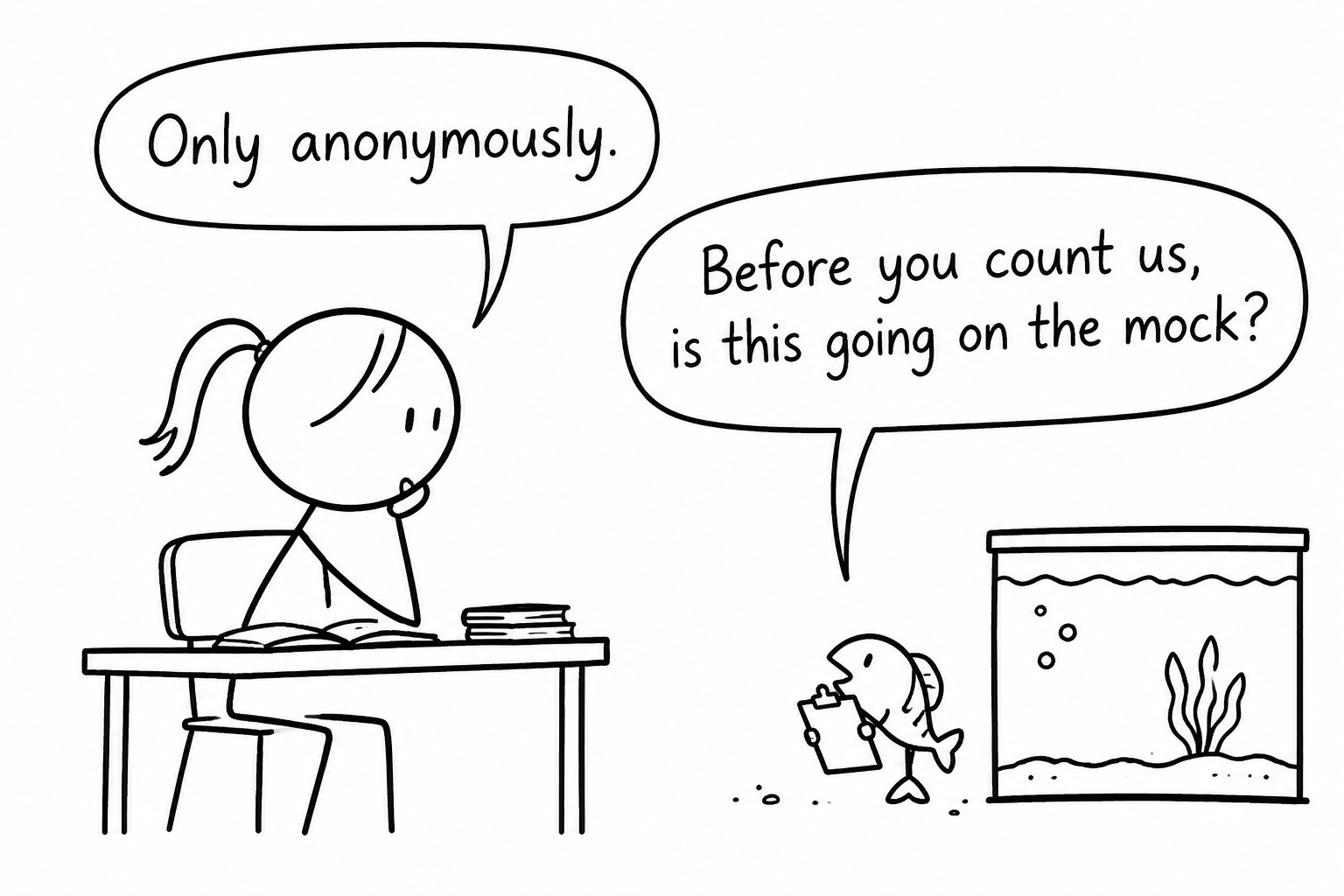 A fish negotiates whether it will appear in a Year 11 mock
What is capture-recapture?
Capture-recapture is a sampling method used to estimate the size of a population that would be difficult to count directly. A researcher might use it for fish in a lake, insects in a habitat or animals in a large area.
The process has four stages:
- Capture an initial sample.
- Mark each member of that sample harmlessly.
- Release the marked individuals and allow them to mix with the population.
- Capture a second sample and count how many are already marked.
The key idea is that the proportion of marked individuals in the second sample should be approximately equal to the proportion of marked individuals in the whole population.
Let:
| Symbol | Meaning |
|---|---|
| MMM | number marked in the first capture |
| CCC | total number in the second sample |
| RRR | marked individuals recaptured |
| NNN | estimated population size |
The proportion is:
MN≈RC\frac{M}{N} \approx \frac{R}{C}NM≈CRRearranging gives the formula most students use:
N≈M×CRN \approx \frac{M \times C}{R}N≈RM×CYou do not have to memorise the formula as an isolated rule. Think about the story. If only a small proportion of the second sample is marked, the marked group must represent a relatively small part of a large population.
Worked exam-style question: estimating a population
A conservation team captures 727272 fish from a lake. The fish are marked and released. Later, the team captures a second sample of 555555 fish. Of these, 999 are marked.
Estimate the number of fish in the lake.
Identify the values first:
M=72,C=55,R=9M=72, \qquad C=55, \qquad R=9M=72,C=55,R=9Substitute them into the formula:
N≈72×559N \approx \frac{72 \times 55}{9}N≈972×55Calculate:
N≈440N \approx 440N≈440The estimated population is 440440440 fish.
A strong exam response includes the substitution, calculation and conclusion. Writing only 440440440 may earn the accuracy mark, but clear working protects you if a small arithmetic slip occurs.
Notice that the calculation produces an estimate, not an exact count. The symbol ≈\approx≈ is therefore more informative than ===, although mark schemes will usually accept a correctly evaluated calculation.
For more varied practice, use the Edexcel GCSE Maths question bank, where questions are organised by topic. Printable Edexcel exam booklets are useful when you want to practise writing complete solutions away from the screen.
Worked exam-style question: analysing an unreliable estimate
A researcher marks 909090 beetles and releases them. In a second sample of 606060 beetles, 121212 are marked.
Estimate the beetle population. Some of the marks fell off before the second sample was collected. Explain how this could affect the estimate.
First calculate the estimate:
N≈90×6012N \approx \frac{90 \times 60}{12}N≈1290×60 N≈450N \approx 450N≈450The estimated population is 450450450 beetles.
Now consider the lost marks. If marks fall off, the researcher records fewer marked beetles in the second sample. This makes RRR smaller. Since RRR is the denominator in
N≈M×CR,N \approx \frac{M \times C}{R},N≈RM×C,a smaller denominator produces a larger estimate.
Therefore, lost marks could cause the population to be overestimated.
This second part is where understanding becomes more valuable than memory. Instead of learning a sentence for every possible scenario, ask what happens to the number of marked individuals recaptured. Then follow the effect through the formula.
Assumptions you need for the mock
The method works only when the two samples reasonably represent the same population. Common assumptions include:
- marked individuals mix fully back into the population
- each individual is equally likely to be captured
- marking does not change an individual's chance of being recaptured
- marks remain visible and are recorded correctly
- the population does not change significantly through births, deaths, arrivals or departures
- the first and second samples are large enough to be representative
You may be asked to state one assumption or explain why a particular estimate is unreliable. Make your answer specific to the context. For fish, you could say that marked fish must mix back into the lake before the second sample. Saying only that the experiment must be fair is too vague.
Marking should also be harmless. If the marking process changes behaviour or survival, marked individuals may no longer have the same chance of appearing in the second sample.
The slips that most often cost marks
Reversing the proportion
A common incorrect setup mixes unlike quantities, such as comparing the first capture with the second sample on one side but reversing the corresponding groups on the other.
Keep the order consistent:
marked in populationwhole population≈marked in second samplewhole second sample\frac{\text{marked in population}}{\text{whole population}} \approx \frac{\text{marked in second sample}}{\text{whole second sample}}whole populationmarked in population≈whole second samplemarked in second sampleUsing the wrong recapture number
The denominator in the final formula is the number of marked individuals found in the second sample, not the total second sample.
Underline phrases such as “of these, 999 were marked” before calculating.
Giving an impossible decimal answer
A population contains whole individuals. If your estimate is not an integer, round sensibly to a whole number unless the question gives a different instruction. Keep the unrounded calculator value until the final step.
Treating the estimate as exact
Sampling involves uncertainty. Use language such as “the estimated population is” rather than claiming the calculation proves the precise number present.
Naming an assumption without explaining it
“The population stays the same” is a useful start. A stronger answer explains that there should be no significant births, deaths, immigration or emigration between samples.
Forgetting the direction of bias
If a question asks how a problem affects the estimate, do not stop after saying it is unreliable. Decide whether the recapture number becomes too large or too small, then use the formula to identify an underestimate or overestimate.
A focused revision plan before December mocks
Start with one complete lesson and make a short method card containing the proportion, the formula and three assumptions. Then answer a small set of questions without notes. Mark them immediately, because delayed feedback allows an incorrect setup to settle into memory.
Students following Edexcel can use the main Edexcel GCSE Maths revision area. If you follow AQA, use the AQA GCSE Maths revision guides and AQA exam booklets alongside your teacher's specification guidance. Topic placement and tier requirements can vary, so revise from resources matched to your exam board.
Finish by placing capture-recapture among other topics. A real mock does not announce which formula you need before every question. Build a targeted practice paper in the MathsGenie Mock Exam Builder, adding capture-recapture and the topics you currently find hardest. Sit it under timed conditions, check the marked responses and return to any weak method.
Capture-recapture becomes far less intimidating when the story and the proportion connect. Learn what each value represents, practise explaining the assumptions and show every step. Then use MathsGenie's free revision resources to turn one understood question into a method you can trust when the mock paper opens.















