

Bounds Calculations GCSE Maths: Examples and Practice
Bounds calculations GCSE maths explained through clear worked examples, common mistakes and exam-style questions. Learn which bounds to use and practise.
Bounds calculations GCSE maths: why the choices matter
Bounds calculations GCSE maths questions ask you to find the limits of a calculation when its measurements have been rounded. First find each measurement’s lower and upper bounds. Then choose the combination that makes the final answer as small or as large as possible.
Imagine a student who can find individual bounds but keeps losing marks when a formula appears. They choose both upper bounds whenever the question says ‘upper bound’. Multiplication works. Division does not.
The turning point is understanding that an upper bound describes the answer you want, not necessarily every number you substitute.
Your bounds calculation checklist
Before touching your calculator:
- Identify the rounding accuracy of each measurement.
- Find half the rounding unit.
- Write the lower and upper bounds.
- Write the formula connecting the measurements.
- Decide which combination makes the result smallest or largest.
- Substitute, calculate and include units.
If finding the intervals is still uncertain, MathsGenie’s error intervals explanation covers that first step. Its error intervals lessons provide another way to revisit the idea before combining measurements.
What lower and upper bounds mean
Suppose a length is recorded as 8.4 cm8.4\text{ cm}8.4 cm, correct to the nearest 0.1 cm0.1\text{ cm}0.1 cm.
Half the rounding unit is:
0.1÷2=0.050.1\div 2=0.050.1÷2=0.05Subtract this from the recorded value for the lower bound, and add it for the upper bound:
8.35≤l<8.458.35\leq l<8.458.35≤l<8.45The actual length could be 8.35 cm8.35\text{ cm}8.35 cm, but it cannot be 8.45 cm8.45\text{ cm}8.45 cm under the usual GCSE rounding convention: that would round to 8.5 cm8.5\text{ cm}8.5 cm.
The upper bound is therefore a boundary, not necessarily an attainable measurement. In calculations, you still substitute the upper-bound value to find the corresponding limiting result.
Always read the stated accuracy. Rounding to the nearest whole number gives a half-unit of 0.50.50.5; rounding to the nearest 101010 gives a half-unit of 555. Decimal places and significant figures are not interchangeable.
Choosing bounds for each operation
For positive measurements, use the following combinations. Here, aLa_LaL and aUa_UaU are the lower and upper bounds of aaa, with equivalent notation for bbb.
| Calculation | Lower bound of result | Upper bound of result |
|---|---|---|
| a+ba+ba+b | aL+bLa_L+b_LaL+bL | aU+bUa_U+b_UaU+bU |
| a−ba-ba−b | aL−bUa_L-b_UaL−bU | aU−bLa_U-b_LaU−bL |
| ababab | aLbLa_Lb_LaLbL | aUbUa_Ub_UaUbU |
| ab\frac{a}{b}ba | aLbU\frac{a_L}{b_U}bUaL | aUbL\frac{a_U}{b_L}bLaU |
For division, the denominator must remain positive. If negative values, intervals containing zero, or repeated uses of the same variable appear, these shortcuts need more careful reasoning.
The subtraction and division rows explain our hypothetical student’s mistakes. Taking away a larger number makes a difference smaller. Dividing by a larger positive number makes a quotient smaller.
Ask: ‘What change makes the answer move in the direction I need?’ That question is more reliable than remembering ‘upper means upper’.
Use this checklist alongside MathsGenie’s Bounds lesson resources, then practise choosing the combinations in its Question Bank.
Bounds calculations worked examples
Finding bounds for an area
A rectangle has length 8.4 cm8.4\text{ cm}8.4 cm and width 5.2 cm5.2\text{ cm}5.2 cm, both correct to the nearest 0.1 cm0.1\text{ cm}0.1 cm. Find the lower and upper bounds for its area.
Find the intervals. Half the rounding unit is 0.05 cm0.05\text{ cm}0.05 cm:
8.35≤l<8.458.35\leq l<8.458.35≤l<8.45 5.15≤w<5.255.15\leq w<5.255.15≤w<5.25Write the formula.
A=lwA=lwA=lwFind the lower bound. Both dimensions are positive, so the smallest area comes from the smallest length and width:
AL=8.35×5.15=43.0025 cm2A_L=8.35\times5.15=43.0025\text{ cm}^2AL=8.35×5.15=43.0025 cm2Find the upper bound. Use both upper bounds:
AU=8.45×5.25=44.3625 cm2A_U=8.45\times5.25=44.3625\text{ cm}^2AU=8.45×5.25=44.3625 cm2Therefore:
43.0025≤A<44.362543.0025\leq A<44.362543.0025≤A<44.3625where AAA is measured in square centimetres.
Notice that multiplying the recorded dimensions would give an estimate, not either bound. Also, the uncertainty in area is not found simply by adding the uncertainties in the dimensions.
Finding an upper bound for speed
A cyclist travels 150 m150\text{ m}150 m, correct to the nearest 10 m10\text{ m}10 m, in 12 s12\text{ s}12 s, correct to the nearest second. Find the upper bound for the average speed.
Find the intervals. The rounding units are different, so calculate each separately:
145≤d<155145\leq d<155145≤d<155 11.5≤t<12.511.5\leq t<12.511.5≤t<12.5Write the formula.
v=dtv=\frac{d}{t}v=tdChoose the combination. A greater distance increases speed. A shorter time also increases speed. Therefore use the upper distance bound and lower time bound:
vU=15511.5=31023 m/sv_U=\frac{155}{11.5}=\frac{310}{23}\text{ m/s}vU=11.5155=23310 m/s vU≈13.4783 m/sv_U\approx13.4783\text{ m/s}vU≈13.4783 m/sThe fraction gives the exact upper bound; the decimal is an approximation. Follow any rounding instruction in the question, and keep full calculator accuracy until the final step.
This is where the student’s approach changes. Instead of matching the word ‘upper’ to both measurements, they explain what would make the cyclist faster. The formula starts making sense before the calculator is involved.
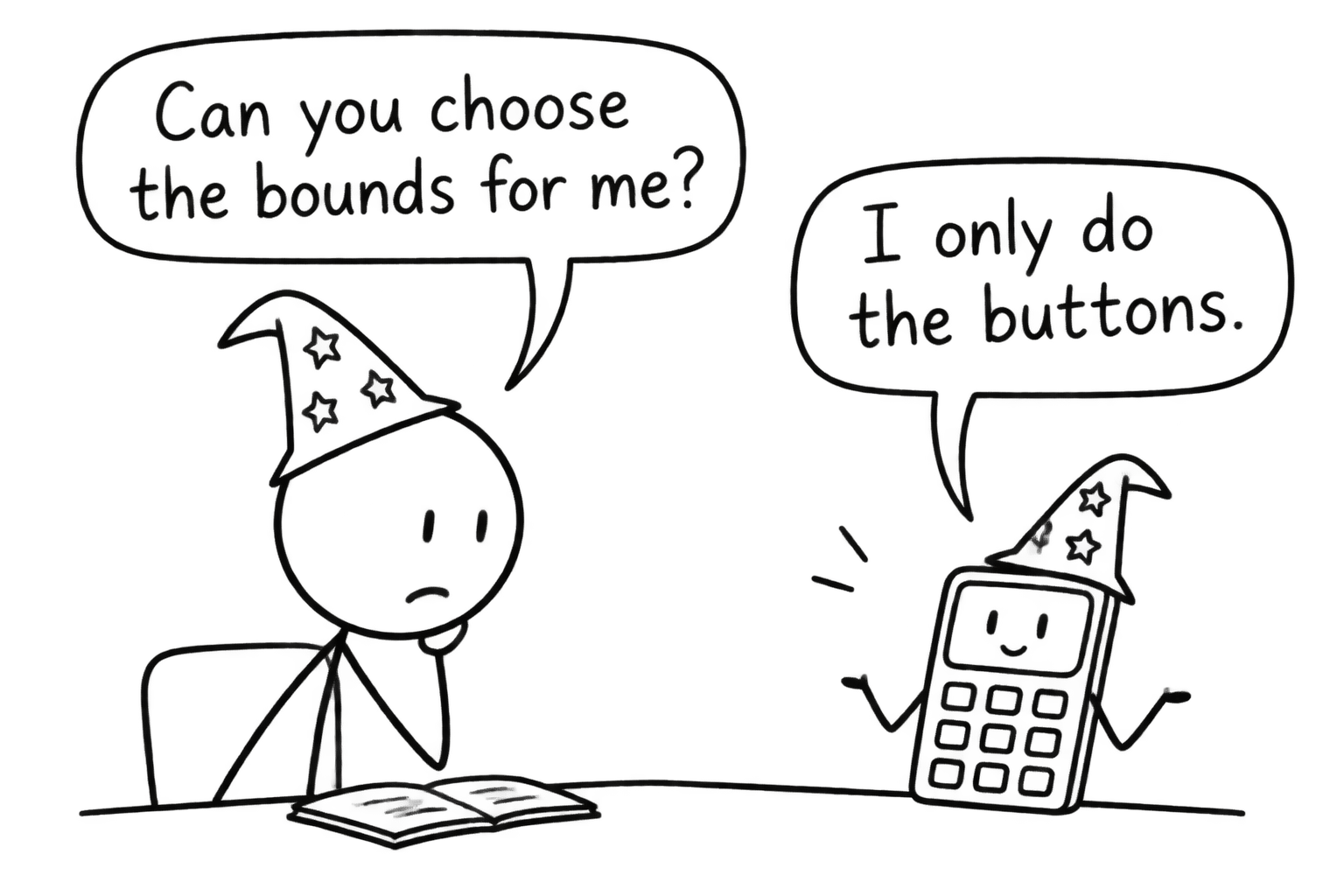 A stick-figure student asks a calculator in a wizard hat to choose the bounds; it replies that it only does the buttons.
Common mistakes that cost marks
Using both upper bounds for every upper-bound answer
This works for adding or multiplying positive measurements, but not generally for subtraction or division. Write the intended combination before calculating.
Halving the measurement instead of the rounding unit
For a value rounded to the nearest 101010, halve 101010, not the recorded measurement. The adjustment is 555 in either direction.
Rounding intermediate values
Premature rounding can change the final result. Keep exact terminating bounds and use the calculator’s full quotient until you reach the requested answer.
Assuming a rounded answer is guaranteed
To justify a stated degree of accuracy, calculate both bounds and check that every value between them rounds to the same answer. The recorded measurements alone do not establish this.
Forgetting units or working
An area needs squared units; a speed needs distance per unit time. Show the intervals and substitution so your reasoning is visible, even if a calculator handles the arithmetic.
Bounds calculations questions: try them yourself
Write the intervals and chosen combination before checking each answer.
Area: A rectangle measures 6 cm6\text{ cm}6 cm by 4 cm4\text{ cm}4 cm, both rounded to the nearest centimetre. Find the upper bound for its area.
Speed: A runner covers 80 m80\text{ m}80 m, correct to the nearest metre, in 10 s10\text{ s}10 s, correct to the nearest second. Find the lower bound for the average speed.
Difference: Two lengths are 9.2 cm9.2\text{ cm}9.2 cm and 3.6 cm3.6\text{ cm}3.6 cm, both correct to the nearest 0.1 cm0.1\text{ cm}0.1 cm. Find the upper bound for their difference.
Answers and reasoning
Area: Multiply both upper bounds:
6.5×4.5=29.25 cm26.5\times4.5=29.25\text{ cm}^26.5×4.5=29.25 cm2Speed: Divide the lower distance bound by the upper time bound:
79.510.5=537 m/s≈7.57143 m/s\frac{79.5}{10.5}=\frac{53}{7}\text{ m/s}\approx7.57143\text{ m/s}10.579.5=753 m/s≈7.57143 m/sDifference: Subtract the lower bound of the shorter length from the upper bound of the longer length:
9.25−3.55=5.70 cm9.25-3.55=5.70\text{ cm}9.25−3.55=5.70 cmIf you chose the wrong combination, revisit the direction of the calculation rather than repeating the arithmetic. For board-specific materials, MathsGenie also provides Eduqas Bounds resources.
Turn understanding into reliable working
Our hypothetical student’s breakthrough is a repeatable habit: intervals first, formula second, reasoning before substitution. You now have that method, but choosing correctly without prompting takes practice. Your turn: start with MathsGenie’s Bounds Lessons, then use the Question Bank to practise explaining each choice before you calculate.















