

BIDMAS GCSE Maths: Worked Examples and Questions
BIDMAS GCSE maths explained with clear worked examples, common mistakes and exam-style questions. Learn the correct order of operations and practise today.
BIDMAS starts with choosing what to do first
Knowing the letters is easy. Knowing which calculation to do next can feel less obvious. BIDMAS GCSE maths questions become clearer when you remember that multiplication and division share one priority, while addition and subtraction share another. Within either pair, work from left to right.
Imagine a student who keeps starting every calculation at the left. They can multiply, divide and subtract correctly, yet their answers still disagree with the mark scheme. The turning point comes when they pause before calculating and ask: which operation has priority?
That pause is the habit this guide will help you build. For a matching explanation alongside your revision, use the MathsGenie BIDMAS topic page.
What does BIDMAS mean?
BIDMAS describes the order of operations: the agreed order for evaluating an expression.
| Letter | Meaning | What to do |
|---|---|---|
| B | Brackets | Evaluate expressions inside brackets first |
| I | Indices | Evaluate powers |
| D and M | Division and multiplication | Work from left to right |
| A and S | Addition and subtraction | Work from left to right |
The acronym has six letters, but it is more useful to think of four priority levels. Division does not automatically come before multiplication. Addition does not automatically come before subtraction.
If brackets contain several operations, apply the same order inside them. With nested brackets, begin with the innermost pair.
Before each question, use this short checklist:
- Find any brackets.
- Look for powers.
- Complete multiplication and division from left to right.
- Complete addition and subtraction from left to right.
- Rewrite the expression after each step.
That last habit matters. Keeping the untouched parts visible makes it easier to follow your own reasoning and spot a copied sign.
BIDMAS worked examples
Multiplication before addition
Evaluate:
7+4×37 + 4 \times 37+4×3Our imagined student might begin by adding the first two numbers. But position alone does not decide priority: multiplication comes before addition.
First calculate:
4×3=124 \times 3 = 124×3=12Then rewrite and finish:
7+12=197 + 12 = 197+12=19The useful question is not “What comes first on the page?” It is “What comes first in the order of operations?”
Brackets and indices
Evaluate:
3+2×(7−4)23 + 2 \times (7 - 4)^23+2×(7−4)2Start inside the brackets:
7−4=37 - 4 = 37−4=3The expression becomes:
3+2×323 + 2 \times 3^23+2×32Evaluate the power:
3+2×93 + 2 \times 93+2×9Then multiply, and finally add:
3+18=213 + 18 = 213+18=21Notice how each new line preserves everything that has not yet been calculated. You can find further explanations in the BIDMAS revision guide.
Multiplication and division have equal priority
Evaluate:
24÷6×224 \div 6 \times 224÷6×2Both operations belong to the same priority level, so begin on the left:
24÷6=424 \div 6 = 424÷6=4Then:
4×2=84 \times 2 = 84×2=8Multiplying the last two numbers first would change the expression's meaning. The letters D and M are a reminder of the operations, not separate instructions to finish every division before every multiplication.
Subtraction and addition have equal priority
Evaluate:
15−8+315 - 8 + 315−8+3Work from left to right:
15−8=715 - 8 = 715−8=7Then:
7+3=107 + 3 = 107+3=10This is where the rule may click for our student: the acronym needs its left-to-right instruction. Memorising the letters alone leaves something important out.
Use the BIDMAS Lessons to rehearse choosing the next operation before trying questions independently.
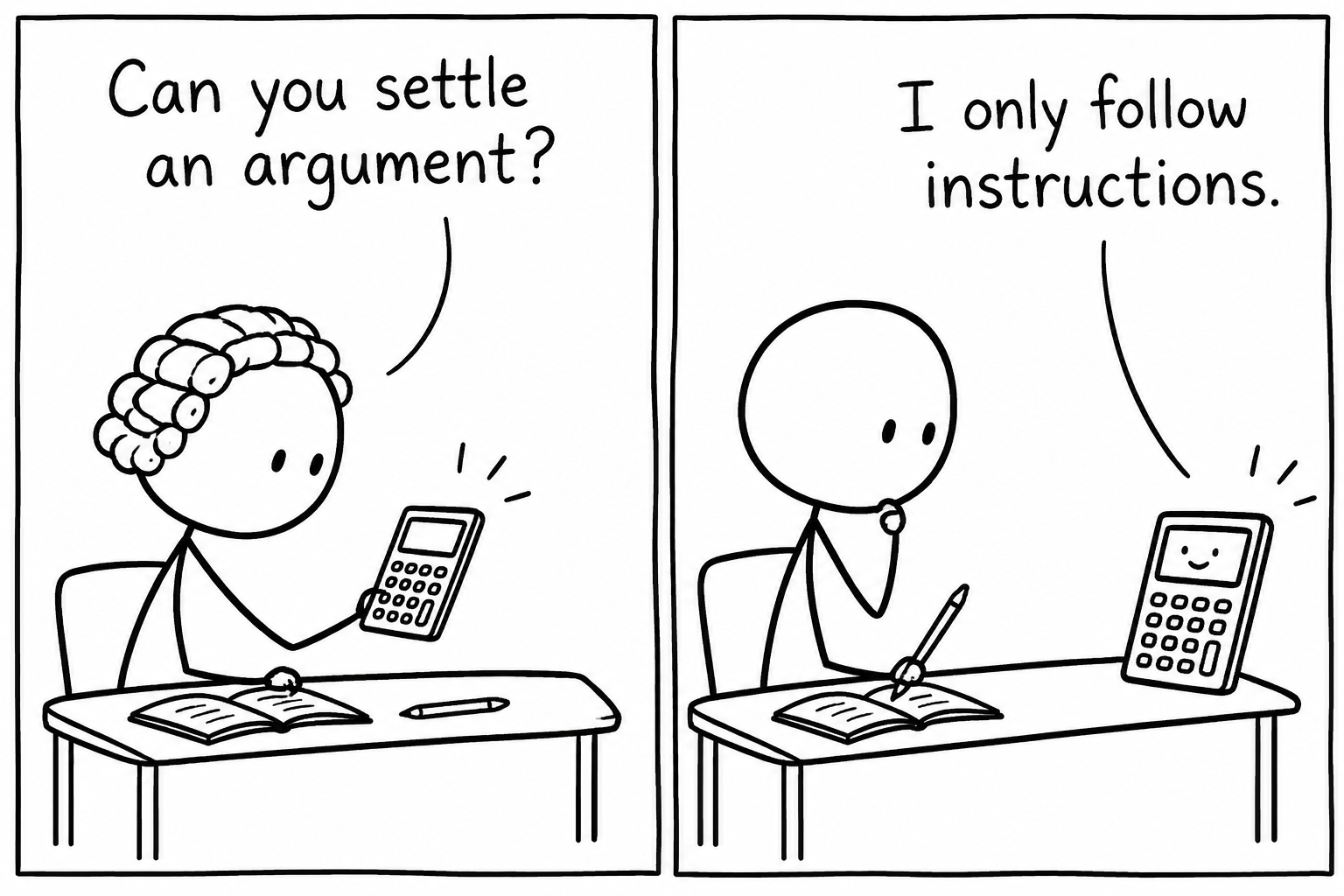 A stick-figure student asks a calculator wearing a judge’s wig to settle an argument; the calculator replies that it only follows instructions.
Common BIDMAS mistakes
Working from left to right too soon
Left to right applies within the same priority level. It does not allow an addition to jump ahead of a multiplication elsewhere in the expression.
Before writing an answer, mark the operation you will perform first. This small decision helps interrupt an automatic habit.
Treating a power as multiplication by the exponent
A square means multiplying a number by itself:
52=5×5=255^2 = 5 \times 5 = 2552=5×5=25It does not mean multiplying the base by the exponent. If indices are the sticking point, resolve that before practising longer expressions.
Losing a negative sign
Brackets affect what a power applies to:
(−3)2=9(-3)^2 = 9(−3)2=9Without brackets, the power applies to the number before the leading negative sign is applied:
−32=−9-3^2 = -9−32=−9Copy brackets and signs carefully. They carry meaning, even when they look small.
Skipping too many steps
Mental arithmetic can be accurate while the overall order is wrong. If you repeatedly lose your place, write one operation per line until the sequence feels secure.
When checking with a calculator, enter the original expression carefully, including its brackets. If the answers differ, compare your intermediate steps rather than simply replacing your answer.
Exam-style BIDMAS questions
Try these without a calculator. For each expression, identify the first operation before evaluating it.
- A: 9+5×49 + 5 \times 49+5×4
- B: (18−6)÷3(18 - 6) \div 3(18−6)÷3
- C: 30÷5×230 \div 5 \times 230÷5×2
- D: 16−7+216 - 7 + 216−7+2
- E: 4+3×(6−2)24 + 3 \times (6 - 2)^24+3×(6−2)2
Cover the answers below while you work. If you want a printable follow-up, the BIDMAS exam booklet provides another way to practise the topic.
Answers and checks
- A: 9+20=299 + 20 = 299+20=29. Multiply first.
- B: 12÷3=412 \div 3 = 412÷3=4. Evaluate the brackets first.
- C: 6×2=126 \times 2 = 126×2=12. Division and multiplication go left to right.
- D: 9+2=119 + 2 = 119+2=11. Subtraction and addition go left to right.
- E: 4+3×16=4+48=524 + 3 \times 16 = 4 + 48 = 524+3×16=4+48=52. Use brackets, then the power, then multiplication, then addition.
For every mistake, write down the decision that caused it. “Added before multiplying” gives you something specific to change next time. Redo the question with the answer covered, then try a fresh question that tests the same decision.
Turn the rule into a reliable habit
For our imagined student, progress begins when the first mark on the page identifies the next operation; following that decision consistently takes practice. Your turn: knowing BIDMAS is the starting point, and using it reliably is the goal. Start with MathsGenie's BIDMAS Lessons above, then practise choosing the correct operation in the BIDMAS Question Bank.















