

BIDMAS Exam Questions: A GCSE Worked Guide
BIDMAS exam questions explained through three GCSE examples, with mark-focused working, common mistakes and targeted practice for greater exam confidence.
BIDMAS exam questions can feel strangely unforgiving. You may understand every individual operation, yet one calculation performed too early changes the whole answer. The solution is not to calculate faster. It is to slow the expression down and decide what must happen next.
This guide follows a hypothetical student, Sam, through three GCSE questions of rising difficulty. You will see the working an examiner needs, where method marks may come from, and how to avoid the mistakes that make BIDMAS questions harder than they are.
The BIDMAS order you need to know
BIDMAS gives the order of operations:
- B: Brackets
- I: Indices, including powers and roots
- D and M: Division and multiplication, working from left to right
- A and S: Addition and subtraction, working from left to right
The most important detail is that division does not automatically come before multiplication. They have equal priority. Likewise, addition and subtraction have equal priority.
For example, in
18÷3×2, 18 \div 3 \times 2, 18÷3×2,you work from left to right:
18÷3×2=6×2=12. 18 \div 3 \times 2 = 6 \times 2 = 12. 18÷3×2=6×2=12.You can review the rule through the Maths Genie BIDMAS lesson or use the BIDMAS revision guide for concise topic notes.
A reliable exam checklist
Before touching the calculator, ask:
- Are there brackets to simplify?
- Are there indices or roots?
- Which divisions and multiplications come next from left to right?
- Which additions and subtractions remain from left to right?
- Have I written enough working to show my method?
The final question matters. Exact marking varies between papers, but a correct intermediate line can provide evidence of a valid method when a question carries more than one mark. A single unexplained answer cannot show where your reasoning was correct if the final calculation goes wrong.
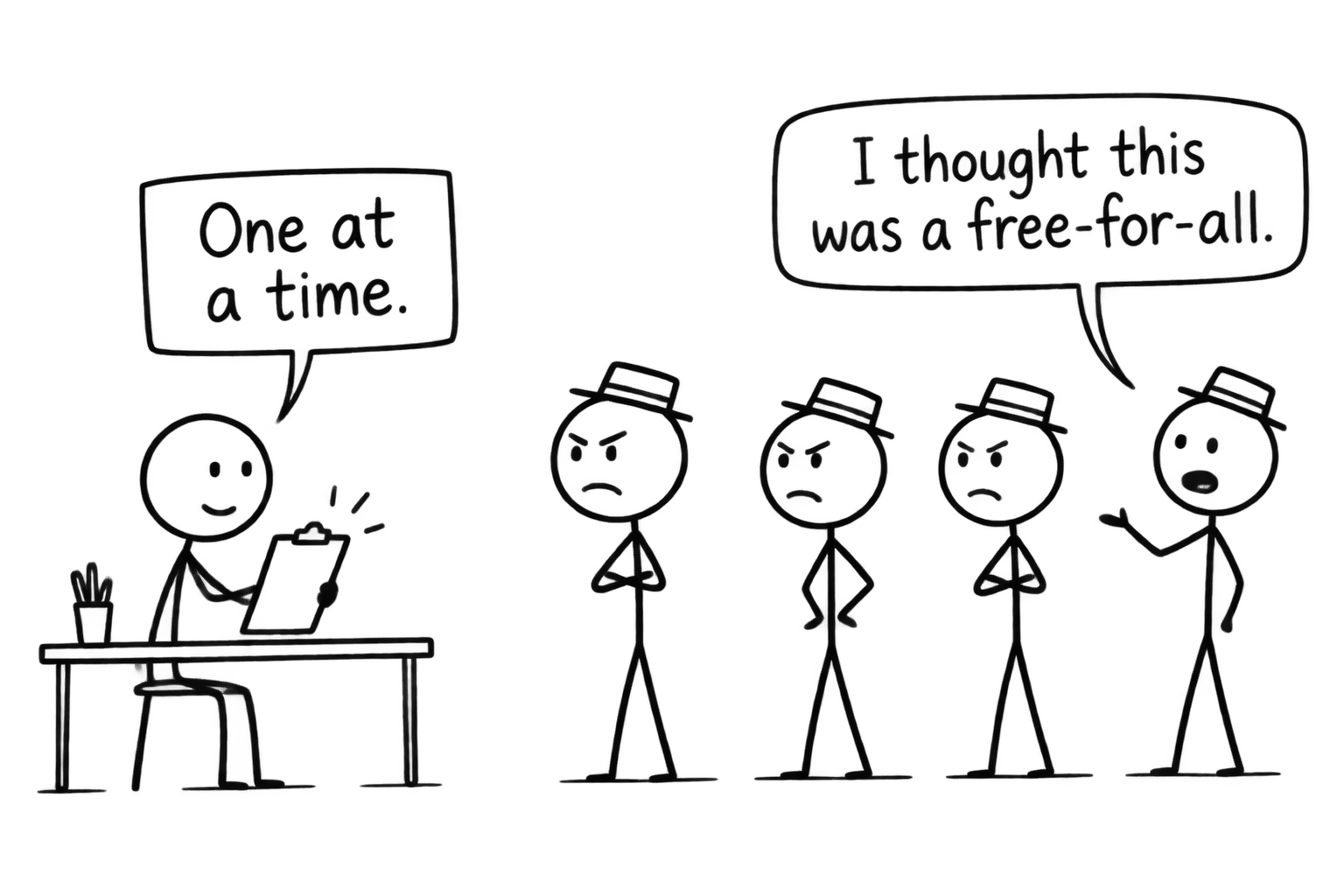 A student calmly organises a queue of impatient arithmetic operators
Question one: multiplication before subtraction
Sam begins with a familiar-looking question.
Work out:
19−4×3. 19 - 4 \times 3. 19−4×3.The temptation is to read from left to right and calculate 19−419-419−4 first. BIDMAS says multiplication must happen before subtraction.
Step one: complete the multiplication
4×3=12. 4 \times 3 = 12. 4×3=12.Rewrite the full expression:
19−12. 19 - 12. 19−12.Step two: subtract
19−12=7. 19 - 12 = 7. 19−12=7.Therefore, the answer is
7. \boxed{7}. 7.For an illustrative two-mark allocation, the intermediate line 19−1219-1219−12 could demonstrate the correct method, with the second mark awarded for the accurate answer. However, some short BIDMAS GCSE exam questions may be worth only one mark. Always use the mark scheme for the particular paper.
Sam's useful habit is simple: rewrite the whole expression after each operation. This prevents completed numbers from becoming mixed with the next step.
Question two: brackets and indices
The next question contains two operations that take priority.
Work out:
27÷(8−5)+23. 27 \div (8-5) + 2^3. 27÷(8−5)+23.Step one: simplify the brackets
8−5=3. 8-5=3. 8−5=3.The expression becomes
27÷3+23. 27 \div 3 + 2^3. 27÷3+23.Step two: evaluate the index
23=8. 2^3=8. 23=8.Now write
27÷3+8. 27 \div 3 + 8. 27÷3+8.Step three: divide before adding
27÷3=9, 27 \div 3=9, 27÷3=9,so
9+8=17. 9+8=17. 9+8=17.Therefore,
17. \boxed{17}. 17.On an illustrative multi-mark question, simplifying the bracket and index correctly would show the first stage of the method. Completing the division before addition would show that the order of operations has been applied throughout. The accurate final answer would then earn the accuracy mark where the mark scheme separates method and accuracy.
Sam does not try to hold every result in his head. Each line contains a slightly simpler version of the original expression. That is safer, clearer and easier to check.
If you want to repeat this method without arranging questions yourself, use the BIDMAS Lessons alongside the GCSE Maths Question Bank to move from guided steps to independent practice.
Question three: equal-priority operations
The final question tests the detail students often miss.
Work out:
40−24÷3×(22−1). 40 - 24 \div 3 \times (2^2-1). 40−24÷3×(22−1).Step one: deal with the bracket
Inside the bracket, the index comes before subtraction:
22−1=4−1=3. 2^2-1=4-1=3. 22−1=4−1=3.The calculation is now
40−24÷3×3. 40 - 24 \div 3 \times 3. 40−24÷3×3.Step two: divide and multiply from left to right
Division and multiplication have equal priority. The first operation from the left is
24÷3=8. 24 \div 3=8. 24÷3=8.This gives
40−8×3. 40-8 \times 3. 40−8×3.Now multiply:
8×3=24. 8 \times 3=24. 8×3=24.Step three: subtract
40−24=16. 40-24=16. 40−24=16.Therefore,
16. \boxed{16}. 16.A plausible mark structure for a multi-mark version would reward simplifying the bracket, handling division and multiplication in the correct left-to-right order, and reaching the correct answer. This is illustrative rather than an official mark scheme. In a real paper, follow the published allocation exactly.
This question reveals why memorising the letters is not quite enough. Sam knows that DDD appears before MMM in BIDMAS, but he also needs to know that division and multiplication share a level. Working from left to right is the deciding rule.
You can practise the same progression on the main Edexcel BIDMAS revision page, in the BIDMAS exam booklet, or through an individual BIDMAS question with worked solution and mark scheme. Students following AQA can use the corresponding AQA BIDMAS resources.
Common mistakes in BIDMAS exam questions
Treating BIDMAS as a strict letter-by-letter list
The letters help you remember the levels, but DDD and MMM are equal. Work from left to right. The same applies to AAA and SSS.
For example:
15−7+2=8+2=10, 15-7+2=8+2=10, 15−7+2=8+2=10,not
15−9=6. 15-9=6. 15−9=6.Completing addition before multiplication
In
6+5×4, 6+5 \times 4, 6+5×4,calculate 5×45 \times 45×4 first:
6+20=26. 6+20=26. 6+20=26.Do not begin with 6+56+56+5.
Ignoring operations inside brackets
Brackets come first, but the calculation inside them still follows BIDMAS. In
(3+22), (3+2^2), (3+22),the index is evaluated before the addition:
3+4=7. 3+4=7. 3+4=7.Entering everything into a calculator without checking
A scientific calculator normally follows the order of operations, but an incorrectly entered bracket or power still produces a wrong answer. Write one or two intermediate lines, then use the calculator to check arithmetic rather than replace reasoning.
Showing only the answer
Some questions award only an answer mark, while others allow credit for a correct process. Clear working protects your method when the final arithmetic slips. It also makes your own checking much faster.
BIDMAS GCSE exam practice
Try these without looking at the answers. Write a new line after each completed stage.
- 14+6×514+6 \times 514+6×5
- (17−9)÷2+3(17-9) \div 2+3(17−9)÷2+3
- 52−18÷35^2-18 \div 352−18÷3
- 36÷6×4−736 \div 6 \times 4-736÷6×4−7
- 50−32÷(23)×350-32 \div (2^3) \times 350−32÷(23)×3
The answers are:
- 444444
- 777
- 191919
- 171717
- 383838
If one answer is wrong, do not immediately attempt ten more. Find the first line where your work differs, identify the rule involved, and then retry a similar question. Afterwards, use Maths Genie GCSE past papers to recognise how order of operations appears inside broader number, algebra and formula questions. BIDMAS past paper questions are not always labelled as BIDMAS, which is why recognising the structure matters.
Turn the method into exam practice
Sam's progress comes from replacing one rushed line with a sequence he can inspect: brackets, indices, equal-priority operations from left to right, then a final check. Knowing that routine is useful, but following it across enough questions is what makes it dependable under exam conditions.
Start your BIDMAS practice with the Maths Genie Lessons and Question Bank.















