Best GCSE English Literature Revision Apps for 2026
Best GCSE English Literature revision apps for 2026, compared honestly. Find free tools for quotes, analysis, essays, videos and exam practice.
Revision apps solve one problem brilliantly: they make it easy to begin. Unfortunately, beginning is not the same as preparing well. You can complete quizzes, watch explanations and collect impressive streaks without ever writing the kind of analytical essay your examiner will mark.
The best GCSE English Literature revision apps for 2026 are BBC Bitesize for dependable free coverage, Seneca for structured recall and Quizlet for quotations. YouTube channels such as Mr Bruff, Mr Salles Teaches English, Stacey Reay and First Rate Tutors can deepen your understanding. But no single platform does everything. The strongest approach combines one content resource, one recall tool and regular written exam practice.
Here is the short version:
- Check your exam board and exact set texts first.
- Use BBC Bitesize or Seneca to organise knowledge.
- Use carefully checked flashcards to retrieve quotations.
- Watch videos selectively when an idea needs another explanation.
- Write plans, paragraphs and timed essays away from the app.
- Compare your work with mark schemes and teacher feedback.
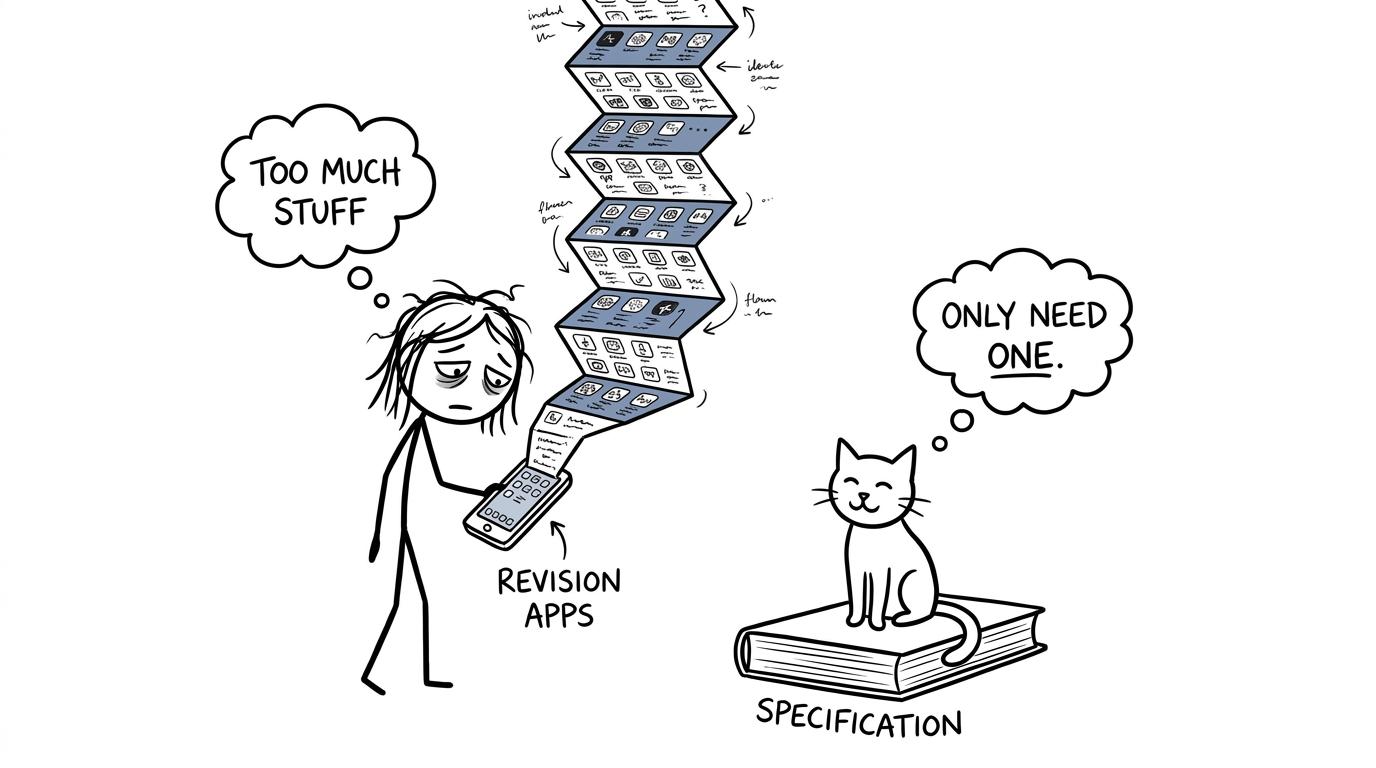 A GCSE student discovers that choosing one useful resource is better than collecting endless apps
The best GCSE English Literature revision apps at a glance
| Resource | Best for | Cost position | Main limitation |
|---|---|---|---|
| BBC Bitesize | Trusted study guides, quizzes and flashcards | Free | Coverage depends on the board and set text |
| Seneca | Structured courses and rapid knowledge checks | Free core access, with optional paid features | Short answers do not replace essay writing |
| Quizlet | Learning quotations and terminology | Free features, with optional paid features | Public sets may contain errors |
| YouTube | Alternative explanations and deeper interpretation | Generally free | Watching can become passive revision |
| Exam-board materials | Specifications, past papers and mark schemes | Free | Mark schemes need careful interpretation |
| Your annotated text | Detailed evidence, patterns and personal interpretation | Usually already available | Less convenient than an app |
Prices and platform features can change, so check the current app listing before downloading or subscribing. Most students can build an effective system without paying for several overlapping services.
BBC Bitesize: the best free starting point
BBC Bitesize remains the safest first recommendation for most students. Its GCSE English Literature resources include study guides, quizzes, flashcards and exam-practice materials, while the free mobile app supports revision on phones and tablets.
Its main strength is clarity. If you need to refresh a character, theme, plot development or important quotation, Bitesize usually gives you a sensible overview without burying the answer beneath unnecessary detail. That makes it particularly useful at the start of a session or when diagnosing what you have forgotten.
Select the correct exam board wherever that option is available. AQA, Edexcel, OCR and Eduqas do not use identical text lists, poetry anthologies or paper structures. A beautifully revised poem earns little if it does not belong to your specification.
Bitesize is less suitable as your only resource. Knowing a plot summary is not the same as analysing how language, form and structure create meaning. Use its quizzes as a knowledge check, then close the screen and produce something: a theme map, essay plan or analytical paragraph.
Seneca: best for structured recall
Seneca is useful when a large subject feels shapeless. Its courses divide content into shorter sections and test understanding as you progress. English Literature coverage includes major set texts, quotations, themes, characters and contextual knowledge, with courses organised around different specifications.
The immediate feedback makes Seneca valuable for identifying gaps. It is also convenient for short sessions between other subjects. A ten-minute knowledge check is better than waiting for the mythical afternoon when you feel ready to revise an entire novel.
The danger is mistaking completion for mastery. Selecting or typing a short response involves a different level of thinking from constructing a sustained interpretation under timed conditions. Treat Seneca as the lesson and recall layer, not the finished exam preparation.
This distinction matters across GCSE subjects. MathsGenie's guide to stopping forgotten content through active recall explains a transferable principle: retrieve knowledge, check it and return to it later. In Literature, the retrieved knowledge might be a quotation, its location and two possible interpretations.
Quizlet: best for quotations, with one warning
Quizlet makes it easy to create and review digital flashcards. For English Literature, cards work well for short quotations, character links, structural terms and contextual details that genuinely inform interpretation.
Creating your own set is usually more valuable than immediately adopting somebody else's. The act of selecting a quotation forces you to decide why it matters. If you use a public set, check every card against your text, class notes or a trusted guide. Student-created sets can contain misquotations, confused speakers and context presented as fact when it is only an interpretation.
Keep each card focused. One side might name a theme and character; the reverse can contain a short quotation, its location and a concise analytical prompt. Avoid copying complete model paragraphs. Flashcards should trigger thought rather than become tiny pages you repeatedly reread.
YouTube channels worth your revision time
YouTube is most useful when you already know what you need. Search for your board, text and precise problem rather than opening the homepage and hoping revision happens.
Mr Bruff
Mr Bruff offers extensive GCSE English Language and Literature coverage, including set-text analysis, poetry, exam technique and discussions of student responses. The depth of the archive is a strength, although using playlists or channel search is more efficient than watching whatever appears next.
Mr Salles Teaches English
Mr Salles Teaches English is known for detailed interpretation, quotation choices and approaches aimed at improving analytical responses. It can be especially useful when you understand the story but need to develop a more thoughtful argument.
Stacey Reay
Stacey Reay's videos cover characters, themes, quotations and close analysis across popular GCSE texts. The explanations can help students who need ideas presented slowly and explicitly before converting them into their own notes.
First Rate Tutors and Mr Everything English
First Rate Tutors provides accessible text and exam guidance, while Mr Everything English covers both knowledge and practical exam skills. As with every channel, check that the video matches your specification and current set text.
Do not copy a creator's interpretation word for word. Examiners reward an informed personal response supported by textual evidence. A video should give you a doorway into the text, not a script to memorise.
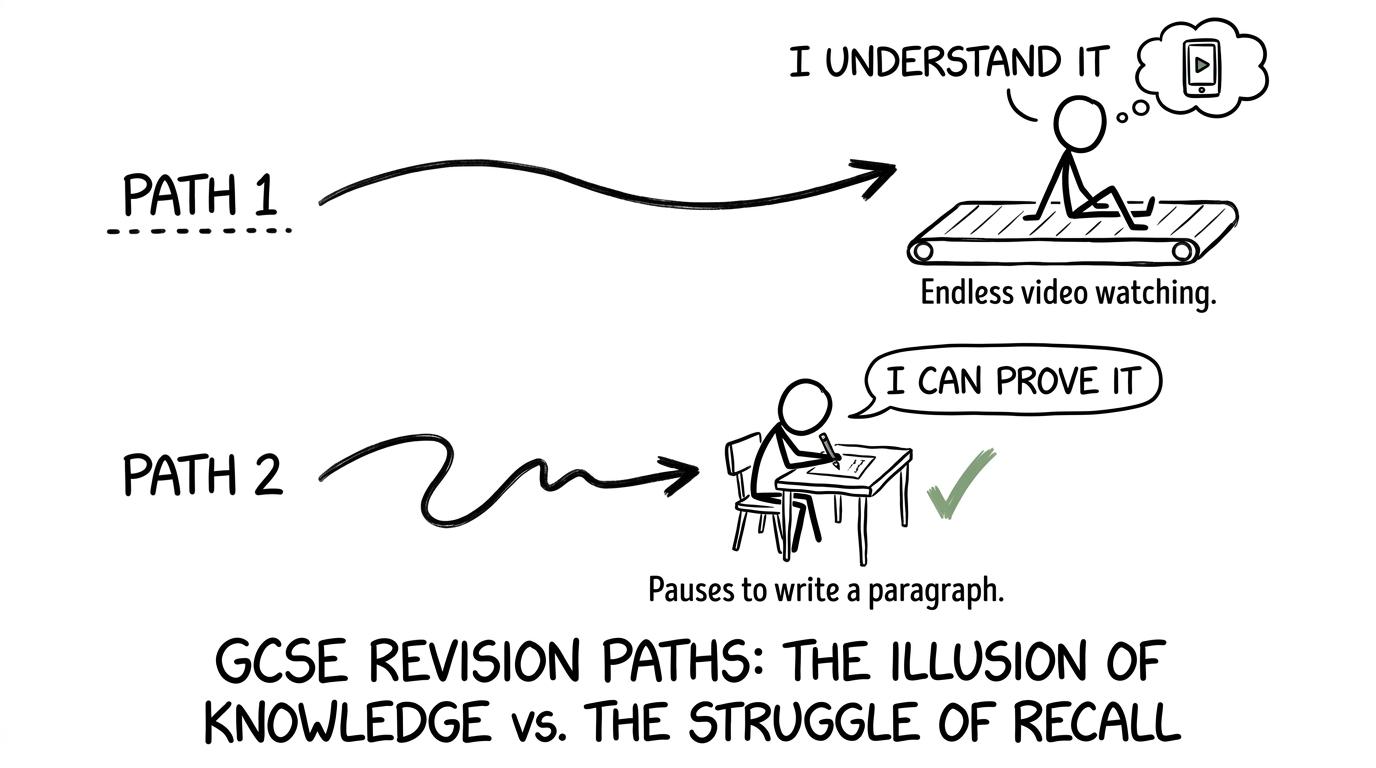 One student watches revision forever while another pauses to practise writing
Free resources that matter more than another app
Your specification
The specification tells you what can be assessed. GCSE English Literature subject content includes Shakespeare, a nineteenth-century novel, poetry and post-1914 fiction or drama, alongside unseen material. Your board then determines the approved texts and exact assessment structure.
Check the current specification rather than relying on an old video title or inherited revision folder. This is particularly important around specification updates. For example, Eduqas states that its replacement poetry anthology will be assessed for the first time in 2027, so students sitting in 2026 must use the anthology specified for their exam series.
Past papers and mark schemes
Past papers reveal the real task: interpreting a question, selecting evidence and sustaining an argument within limited time. Mark schemes show the assessment objectives, but they are not model essays or lists of compulsory phrases.
Across GCSE English Literature specifications, the core assessment objectives reward understanding and response, textual references, analysis of language, form and structure, and relevant understanding of context. Accuracy of written expression is also assessed in designated parts of the qualification. An app that teaches quotations but never asks what the writer is doing only prepares part of the job.
The same principle applies in maths. MathsGenie's guide to using GCSE past papers properly recommends a cycle of attempting, marking, diagnosing and retesting. For English Literature, follow the equivalent cycle: write, compare with the criteria, identify one weakness, improve the response and revisit the skill.
Your text, exercise book and teacher
The least exciting resource may be the most useful. Your annotated text contains the ideas developed through months of lessons. Your exercise book shows recurring feedback. Your teacher knows the exact board, anthology and set texts your class is following.
Apps are broad by design. Teacher feedback is specific. If several essays say that your analysis needs development, downloading another quotation app will not solve the underlying problem.
How to combine English Literature and maths revision
Students preparing for English Literature are usually balancing maths, science and several other subjects. The answer is not to find an app that occupies every spare minute. It is to give each tool a defined job.
A balanced Literature session might contain:
- closed-book recall of quotations and themes;
- a short lesson or video for one weak area;
- an essay plan or written paragraph;
- checking against assessment objectives;
- a note of what to revisit next time.
Then switch subjects deliberately. The free GCSE maths revision hub organises lessons, practice questions and papers by exam board, so you do not lose time searching. For full-paper practice, MathsGenie's past-paper library brings papers and mark schemes together.
If you take Edexcel maths, the no-waste Edexcel revision routine offers a useful model: learn, practise, mark, fix and retest. Literature needs the same honesty, even though the finished response is an essay rather than a calculation.
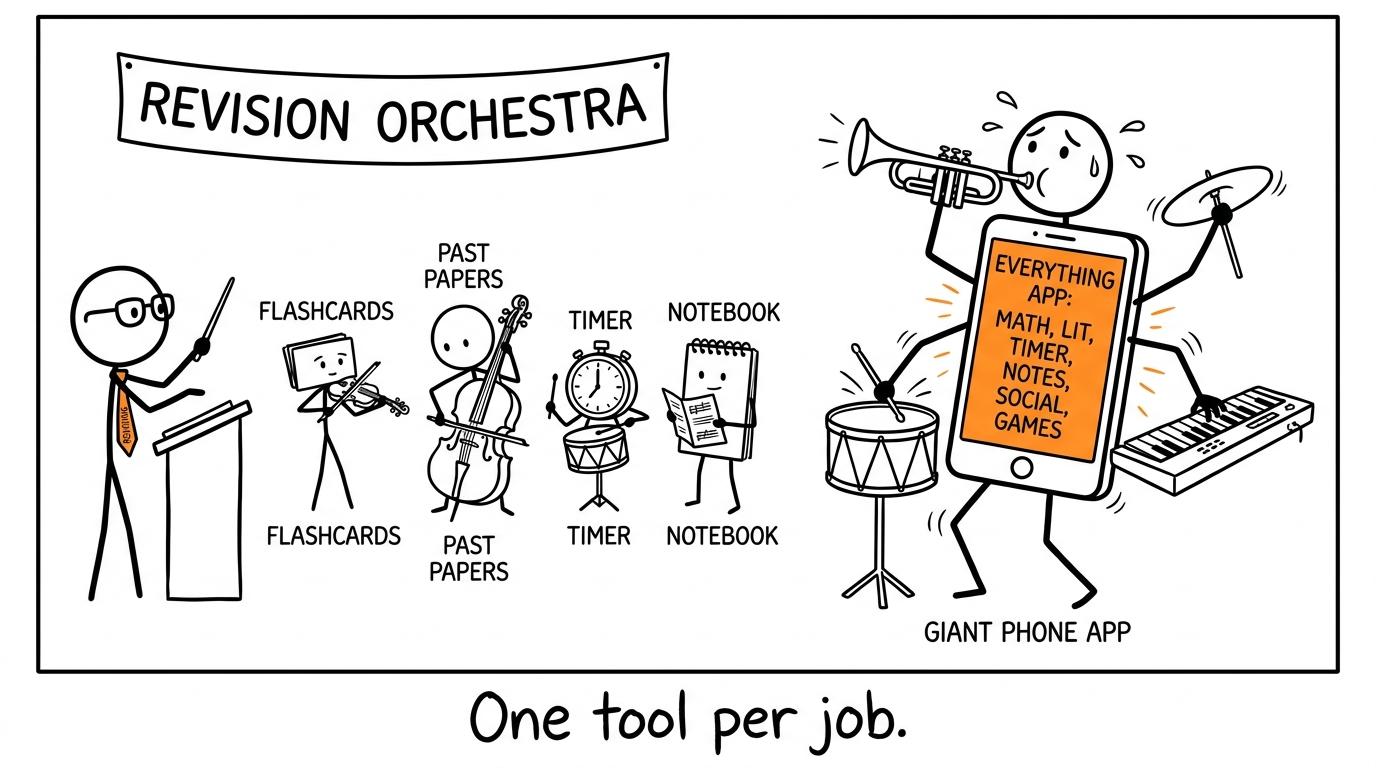 A student conducts an orchestra of revision tools while one overloaded app tries to do everything
Common mistakes when using Literature revision apps
Using the wrong exam-board course
Confirm your board, specification and set texts before investing time. Do not assume that an AQA poetry course applies to Edexcel, OCR or Eduqas.
Revising plot instead of analysis
Plot knowledge is necessary, but retelling events rarely demonstrates close analysis. Ask how the writer uses language, form and structure, and connect each choice to your interpretation.
Memorising too many long quotations
A smaller bank of accurate, flexible quotations is usually more manageable. Learn where each quotation appears, who says it and how it can support more than one argument.
Watching without producing anything
Pause the video. Retrieve the idea without looking. Write an essay plan or paragraph. If nothing leaves your pen, the session may have created familiarity rather than usable knowledge.
Treating context as a separate history paragraph
Relevant context should illuminate the text and argument. Avoid forcing in memorised facts that do not answer the question.
Paying for several similar subscriptions
Start with free resources and identify the missing function. Paying may be reasonable if a platform solves a specific problem, but three content apps often provide more duplication than improvement.
Choose a small system and use it well
The best revision system is not the one with the most features. It is the one that repeatedly moves you from knowledge to recall, from recall to writing, and from writing to useful feedback.
Begin with BBC Bitesize or Seneca, create a checked quotation set, use YouTube for targeted explanations and complete regular written practice with official materials. Keep the system small enough to repeat.
For the maths half of your timetable, make MathsGenie your free revision base. Use revision lessons and practice questions to repair weak topics, then move into mini tests, past papers and predicted papers. Mark your work carefully with the available mark schemes and video solutions. If an exam is close, the GCSE night-before revision plan will help you choose focused practice without turning the evening into a panic-driven marathon.