

Best Buys GCSE Maths: A Simple Method
Best buys GCSE maths explained with a unit-price method, worked examples, common mistakes and exam-style questions for more confident revision.
A best buys question can look almost too ordinary. Two packets, two prices, one decision. Yet many students divide the wrong way, compare different quantities or assume the largest packet must be better value.
Imagine a student called Sam. Each time Sam sees best buys GCSE maths, the numbers seem easy but the final answer keeps slipping away. The turning point comes with one simple rule: compare like with like. Work out the cost of the same quantity for every option, then choose the lower cost.
That is the whole method. The skill lies in applying it carefully.
The best buys method
Best buy questions ask you to identify which option offers better value for money. You will normally compare prices per item, per gram, per kilogram, per litre or another common unit.
Use this checklist:
- Decide on a common unit.
- Convert quantities if necessary.
- Divide the price by the quantity.
- Use the same calculation for every option.
- Compare the unit prices.
- State which option is the better buy and support your answer.
The calculation is usually:
unit price=total pricequantity\text{unit price}=\frac{\text{total price}}{\text{quantity}}unit price=quantitytotal priceIf you prefer to compare the cost per 100 g100\text{ g}100 g, multiply the price per gram by 100100100. Either method is valid provided you compare the same quantity.
Sam's earlier mistake was not difficult algebra. It was inconsistency. One packet was being measured per gram and the other per 100 g100\text{ g}100 g. Once both options used the same unit, the answer became visible.
You can see the method taught from the beginning in the Best Buy Questions lesson, or use the equivalent AQA Best Buy Questions lesson for your exam board.
Best buys worked examples
Comparing different weights
A small bag of rice weighs 750 g750\text{ g}750 g and costs £2.70£2.70£2.70. A large bag weighs 1.2 kg1.2\text{ kg}1.2 kg and costs £4.08£4.08£4.08. Which is the better buy?
First convert 1.2 kg1.2\text{ kg}1.2 kg to grams:
1.2 kg=1200 g1.2\text{ kg}=1200\text{ g}1.2 kg=1200 gFind the price per 100 g100\text{ g}100 g for the small bag:
£2.70÷750×100=£0.36£2.70\div 750\times 100=£0.36£2.70÷750×100=£0.36The small bag costs 36 p36\text{ p}36 p per 100 g100\text{ g}100 g.
Now calculate the same unit price for the large bag:
£4.08÷1200×100=£0.34£4.08\div 1200\times 100=£0.34£4.08÷1200×100=£0.34The large bag costs 34 p34\text{ p}34 p per 100 g100\text{ g}100 g, so the large bag is the better buy.
Notice that the answer includes a conclusion. Calculations alone may not fully answer a question that asks you to decide which option is best.
Comparing a multipack with one large container
A 1.5 litre1.5\text{ litre}1.5 litre bottle of juice costs £2.25£2.25£2.25. A pack containing four 330 ml330\text{ ml}330 ml bottles costs £1.80£1.80£1.80. Which offers better value?
Convert the large bottle to millilitres:
1.5 litres=1500 ml1.5\text{ litres}=1500\text{ ml}1.5 litres=1500 mlIts cost per 100 ml100\text{ ml}100 ml is:
£2.25÷1500×100=£0.15£2.25\div 1500\times 100=£0.15£2.25÷1500×100=£0.15The multipack contains:
4×330=1320 ml4\times 330=1320\text{ ml}4×330=1320 mlIts cost per 100 ml100\text{ ml}100 ml is:
£1.80÷1320×100=£0.13636…£1.80\div 1320\times 100=£0.13636\ldots£1.80÷1320×100=£0.13636…That is approximately 13.6 p13.6\text{ p}13.6 p per 100 ml100\text{ ml}100 ml, compared with 15 p15\text{ p}15 p for the large bottle. The multipack is the better buy.
At this point, Sam stops guessing from the size of the packaging and starts writing the common unit beside every answer. If you want to build the same habit, use the Best Buy Questions Lessons and resources, then apply the method in the GCSE Question Bank.
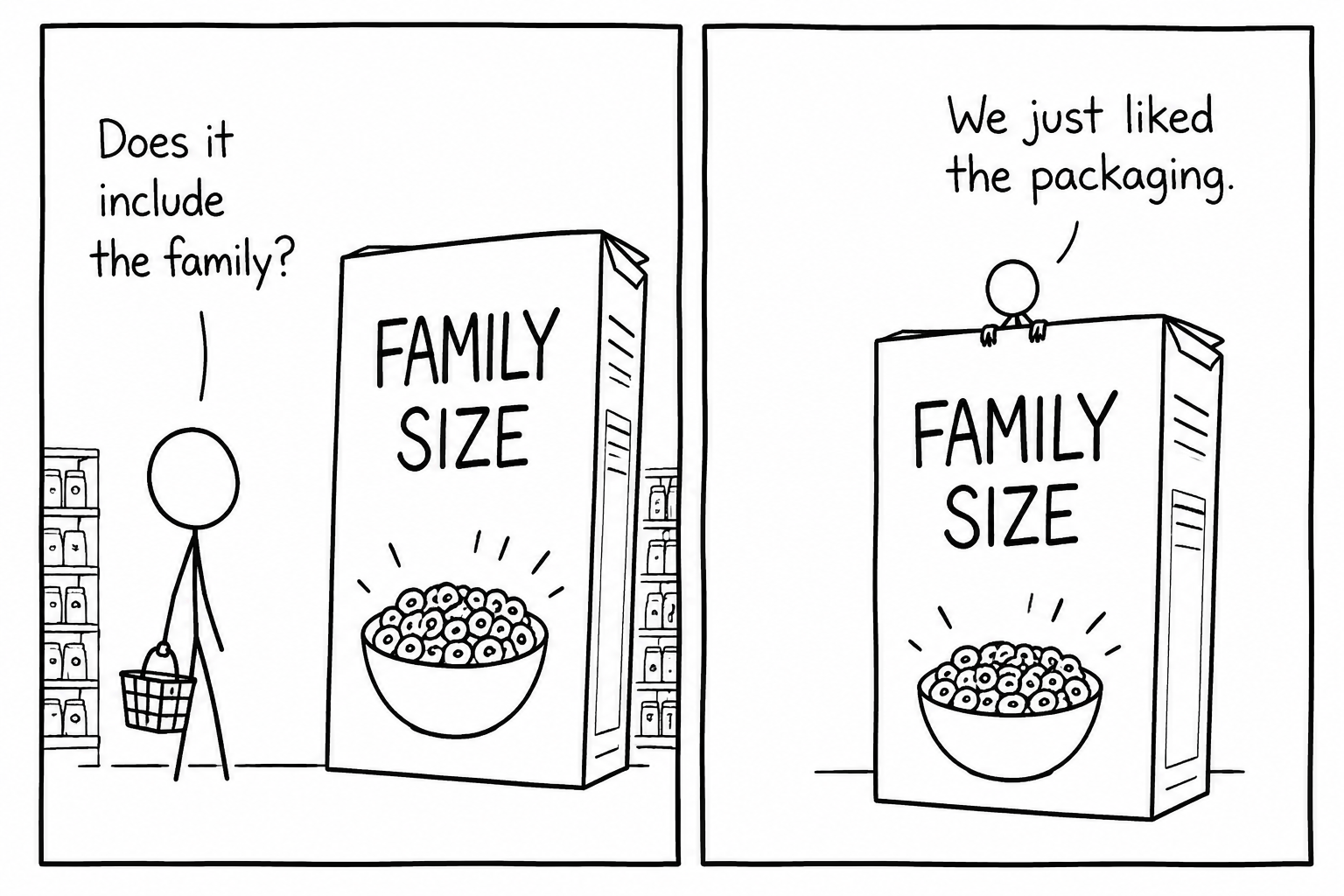 A student discovers that family-size packaging may be taking the label too literally
When the cheapest unit price is not the answer
Some best buys questions ask for enough items to meet a particular need. In that situation, calculate how many complete packs must be purchased. You cannot usually buy part of a pack.
Suppose a club needs at least 181818 bottles. Shop A sells packs of 666 for £4.50£4.50£4.50. Shop B sells packs of 101010 for £7.20£7.20£7.20.
At Shop A, the club needs three packs:
3×6=183\times 6=183×6=18 3×£4.50=£13.503\times £4.50=£13.503×£4.50=£13.50At Shop B, two packs are required:
2×10=202\times 10=202×10=20 2×£7.20=£14.402\times £7.20=£14.402×£7.20=£14.40Shop A is cheaper for this purchase because £13.50<£14.40£13.50<£14.40£13.50<£14.40.
Interestingly, Shop B has the lower price per bottle:
£7.20÷10=£0.72£7.20\div 10=£0.72£7.20÷10=£0.72Shop A costs:
£4.50÷6=£0.75£4.50\div 6=£0.75£4.50÷6=£0.75This is why reading the wording matters. If the question asks for the lowest unit price, Shop B wins. If it asks for the cheapest way to buy at least 181818 bottles, Shop A wins.
Common mistakes with best buys questions
Dividing in the wrong order
Use price divided by quantity when finding a unit price:
price per item=pricenumber of items\text{price per item}=\frac{\text{price}}{\text{number of items}}price per item=number of itemspriceA quick sense check helps. If several items cost a few pounds altogether, one item should normally cost less than the full pack.
Comparing different units
Do not compare a price per kilogram with a price per 100 g100\text{ g}100 g. Convert both options to the same unit before deciding. Remember:
1 kg=1000 g1\text{ kg}=1000\text{ g}1 kg=1000 g 1 litre=1000 ml1\text{ litre}=1000\text{ ml}1 litre=1000 mlRounding too early
Keep the calculator value during your working and round only when presenting the final unit price. Early rounding can change the comparison when two offers are close.
Choosing the lowest displayed price
A smaller pack may cost less at the till while still costing more per item. Best value and lowest total price are not always the same idea.
Ignoring the amount required
When a question specifies a minimum quantity, work out the number of whole packs needed. The MathsGenie Best Buy Questions revision guide is useful for reviewing this distinction before attempting longer questions.
Exam-style best buys questions
Try these without looking at the answers first. Show the common unit and finish with a written conclusion.
Question one
A 500 g500\text{ g}500 g bag of rice costs £1.65£1.65£1.65. An 800 g800\text{ g}800 g bag costs £2.48£2.48£2.48. Which is the better buy?
Per 100 g100\text{ g}100 g:
£1.65÷500×100=£0.33£1.65\div 500\times 100=£0.33£1.65÷500×100=£0.33 £2.48÷800×100=£0.31£2.48\div 800\times 100=£0.31£2.48÷800×100=£0.31The 800 g800\text{ g}800 g bag is the better buy.
Question two
A pack of 666 pens costs £2.70£2.70£2.70. A pack of 101010 costs £4.20£4.20£4.20. Which pack offers better value?
£2.70÷6=£0.45£2.70\div 6=£0.45£2.70÷6=£0.45 £4.20÷10=£0.42£4.20\div 10=£0.42£4.20÷10=£0.42The pack of 101010 offers better value.
Question three
A café needs at least 242424 cans. Packs of 666 cost £3.30£3.30£3.30, while packs of 101010 cost £5.20£5.20£5.20. Find the cheaper way to buy enough cans.
Four packs of 666 give exactly 242424 cans:
4×£3.30=£13.204\times £3.30=£13.204×£3.30=£13.20Three packs of 101010 give 303030 cans:
3×£5.20=£15.603\times £5.20=£15.603×£5.20=£15.60The packs of 666 are cheaper for the required purchase.
For further practice, work through the Best Buy Questions exam booklet and compare your method with the worked solution to an exam-style question.
Turn the method into a reliable habit
Sam's breakthrough is modest but important: stop judging the packaging, choose one common unit and write every step. Knowing that method is different from remembering to use it under exam pressure, so deliberate practice matters.
Your turn. Start with the matching Best Buy Questions Lesson, then practise best buys questions in the MathsGenie Question Bank.















