

Below Grade 4 Maths: What Happens Next?
Below grade 4 maths: understand resits, college choices, grade boundaries and the practical next steps students and parents can take after GCSE results day.
Results day can shrink an entire summer into one number. If you receive below grade 4 maths, the immediate questions are practical: can you still go to college, and will you need to resit?
In England, students on relevant post-16 programmes who have not achieved grade 4 usually need to continue studying maths. Full-time students with grade 3 normally study GCSE Maths; those with lower grades may take an approved stepping-stone qualification.
Your next step depends on your course, result and provider. A disappointing grade does not automatically close every door.
What to do after getting below grade 4 maths
- Contact the college, sixth form or training provider holding your offer.
- Check its entry requirements and whether you can continue maths alongside your course.
- Ask which maths qualification you will study and when you might resit.
- Request your marks and the correct published grade boundary.
- Discuss any possible review of marking with your school.
- Identify the topics where you lost marks and begin focused revision.
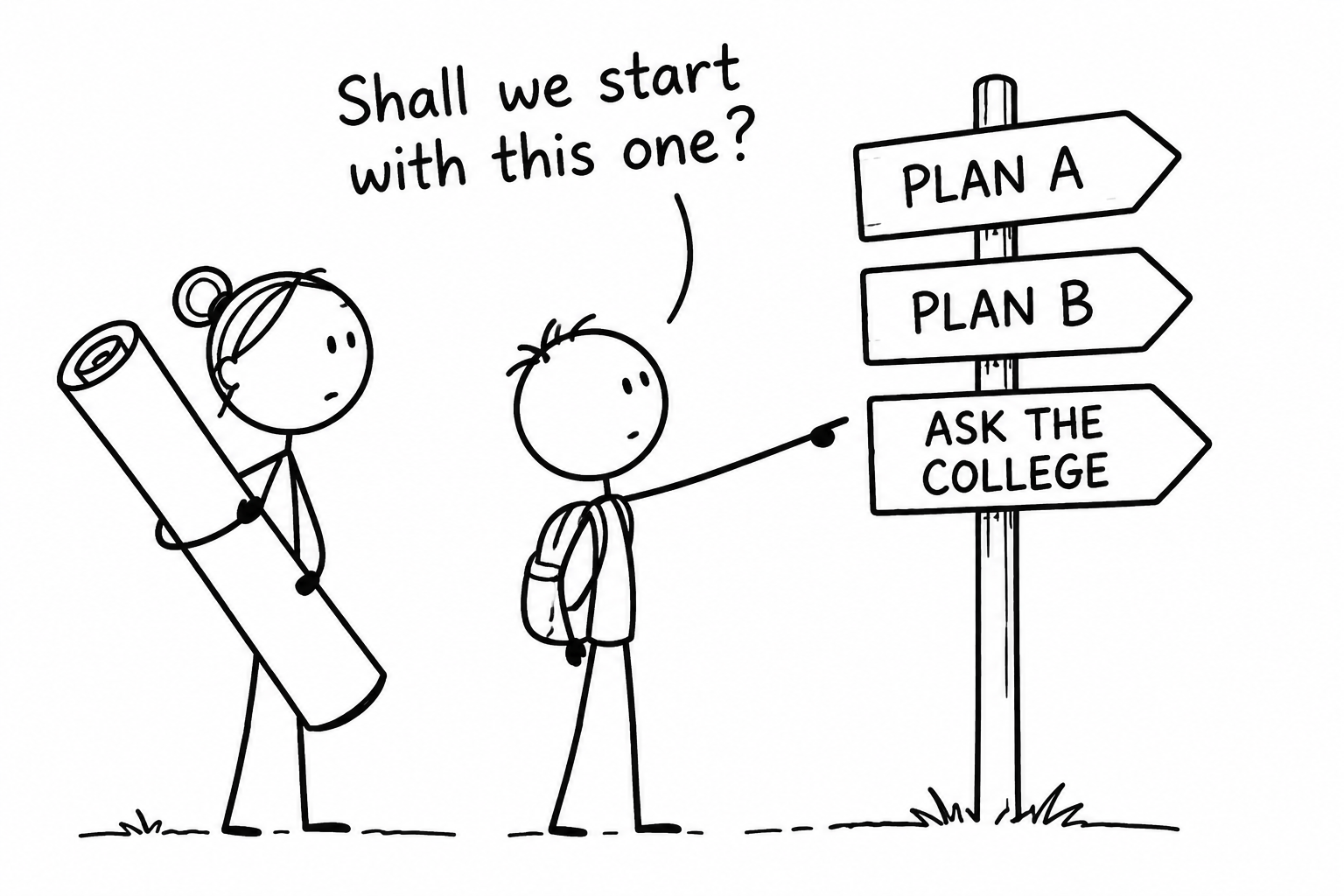 A student and parent choose the sensible next step after an uncertain GCSE result
What does a result below grade 4 mean?
In England's GCSE grading system, grade 4 is commonly described as a standard pass and grade 5 as a strong pass. A lower result does not cancel your other GCSEs or prevent you from continuing in education.
However, individual courses, apprenticeships and employers set their own requirements. Some require grade 4 in GCSE Maths; mathematically demanding courses may ask for more.
If your offer depended on grade 4, contact the provider before assuming the place is lost. It may confirm its requirement, suggest another course or allow you to continue maths alongside your main programme.
Will you have to resit GCSE Maths?
Under England's 2026-27 maths and English condition of funding, students on relevant 16-19 study programmes without grade 4 must continue studying an approved maths qualification.
For full-time students with grade 3, this normally means GCSE Maths. Students with lower prior attainment may study an approved stepping-stone qualification, such as Functional Skills. The institution decides the route within the funding rules.
Continued study does not mean automatic entry for the next exam. GCSE Maths resit opportunities are usually available in November and the following summer, but providers consider readiness when arranging entries.
A student who narrowly missed grade 4 may be ready for November. Someone with larger gaps may benefit from rebuilding their skills first. Ask your provider what evidence of progress it expects before entering you.
How GCSE maths grade boundaries work
Grade boundaries are not fixed percentages. Exam boards set them after marking, considering paper difficulty and other evidence. Boundaries can therefore change between examination series.
Always check the correct exam board, tier and series. Edexcel, AQA, OCR and Eduqas have different papers, so another student's raw mark may be an unhelpful comparison.
Foundation tier offers grades 111-555. Higher tier principally targets grades 444-999, with grade 333 available for candidates who narrowly miss grade 444. Below that threshold, higher-tier candidates may receive an unclassified result.
Your school can provide component marks. The Edexcel GCSE Maths revision hub organises resources by grade, helping you connect the result with suitable practice.
Should you request a review of marking?
Being close to a boundary makes a review tempting. However, a review checks whether marking was correct; it is not another attempt at the exam.
Marks can rise, remain unchanged or fall. Ask your school to examine the available evidence before deciding. Check deadlines, fees and consent arrangements with the exams officer.
A predicted grade alone is not evidence of incorrect marking. Keep planning your next steps while any review is considered.
Turning a grade 3 into a grade 4
Start with a paper or mini test, then separate errors into three groups: topics you did not understand, methods you applied inaccurately, and answers where your working was unclear.
This makes revision specific. Fractions, percentages, ratio, proportion, algebra, graphs, angles and measures connect to many questions, but your own marked work should determine priorities.
Use GCSE Maths topic lessons to revisit methods. If number skills are a weakness, begin with fractions, decimals and percentages.
Build a repeatable routine: learn a method, answer questions independently, mark them, explain mistakes and revisit the topic several days later. Include mixed questions so you practise recognising which method to use.
The guide to finding your weakest GCSE Maths topics helps with diagnosis. A GCSE Maths revision timetable or one-month revision plan can turn priorities into manageable sessions.
Use past papers to check progress after repairing gaps. MathsGenie's practice questions, mini tests, mark schemes and video solutions help you understand why an answer earned marks. Predicted papers provide extra practice, but avoid relying on topic spotting. The guide to commonly appearing GCSE Maths topics supports broader preparation.
Common mistakes after a disappointing result
Assuming your college offer has disappeared. Ask the provider directly before changing plans.
Rushing into a resit. Choose an entry date with your provider, based on preparation and progress.
Only completing full papers. Papers reveal weaknesses; focused lessons and questions help repair them.
Treating every lost mark as missing knowledge. Misreading scales, omitting units, rounding early and unclear working can also cost marks.
Comparing different years' raw marks. Use the boundary for your actual board, tier and series.
Make the next step manageable
A result below grade 4 describes one examination performance. It gives you information about what needs attention, while your provider can explain which routes remain available.
Confirm your place, understand your marks and choose one topic to repair. Then return to MathsGenie's free lessons, practice questions and past papers regularly. Small improvements become more useful when you check them through independent work.















