AI Tools to Revise GCSE English Language: Do They Work?
AI tools for GCSE English Language can support quizzes, planning and feedback. Learn where ChatGPT helps, where it fails and how to revise safely.
The blank page is often the hardest part of English revision. You know you should practise analysing an unseen text or planning a persuasive response, but there is no teacher beside you to ask the next question. That is why students searching for “ai tools revise gcse english language” are usually looking for something practical: can ChatGPT act as a tutor, marker or revision partner?
The short answer is yes, with limits. AI can generate quizzes, question your interpretations, suggest revision activities and provide preliminary feedback. It cannot reliably replace your teacher, an official mark scheme, genuine reading or timed writing. Most importantly, it must not produce work that you submit as your own.
Used well, AI makes practice easier to begin. Used badly, it removes the very thinking the exam is designed to assess.
A quick checklist for using AI safely
Before opening ChatGPT or another generative AI tool, keep these rules nearby:
- Use AI to create practice, not to avoid it.
- Write your response before requesting feedback.
- Tell the tool your exam board, paper and assessment objective.
- Check advice against your specification, teacher guidance and official mark schemes.
- Never assume an AI-generated mark or grade is accurate.
- Do not upload personal information, confidential assessment material or content your school has told you not to share.
- Never submit AI-generated writing as your own assessed work.
- Finish with independent, timed practice without AI.
That final point matters. You will sit the written examination without ChatGPT. Revision must eventually resemble the conditions in which your skill will be tested.
What GCSE English Language actually assesses
Although AQA, Edexcel, OCR and Eduqas arrange their papers differently, GCSE English Language is built around nationally defined assessment objectives. Broadly, the qualification gives equal weight to reading and writing.
The reading objectives assess whether you can:
- identify explicit and implicit information;
- select and synthesise evidence;
- analyse language and structure;
- compare ideas and perspectives;
- evaluate texts using appropriate references.
The writing objectives assess communication, organisation, tone, style and register, alongside vocabulary, sentence structure, spelling and punctuation. Technical accuracy under AO6 accounts for 20%20\%20% of the qualification as a whole. Spoken Language is reported separately and does not contribute to the final GCSE mark.
This gives AI a useful but narrow role. It can create opportunities to practise these skills. It cannot demonstrate them on your behalf.
Different boards use different question sequences, mark allocations and timings, so generic advice such as “always write three paragraphs” should make you suspicious. Give the AI the exact board and paper, then verify what it says using your current specification or materials supplied by your teacher.
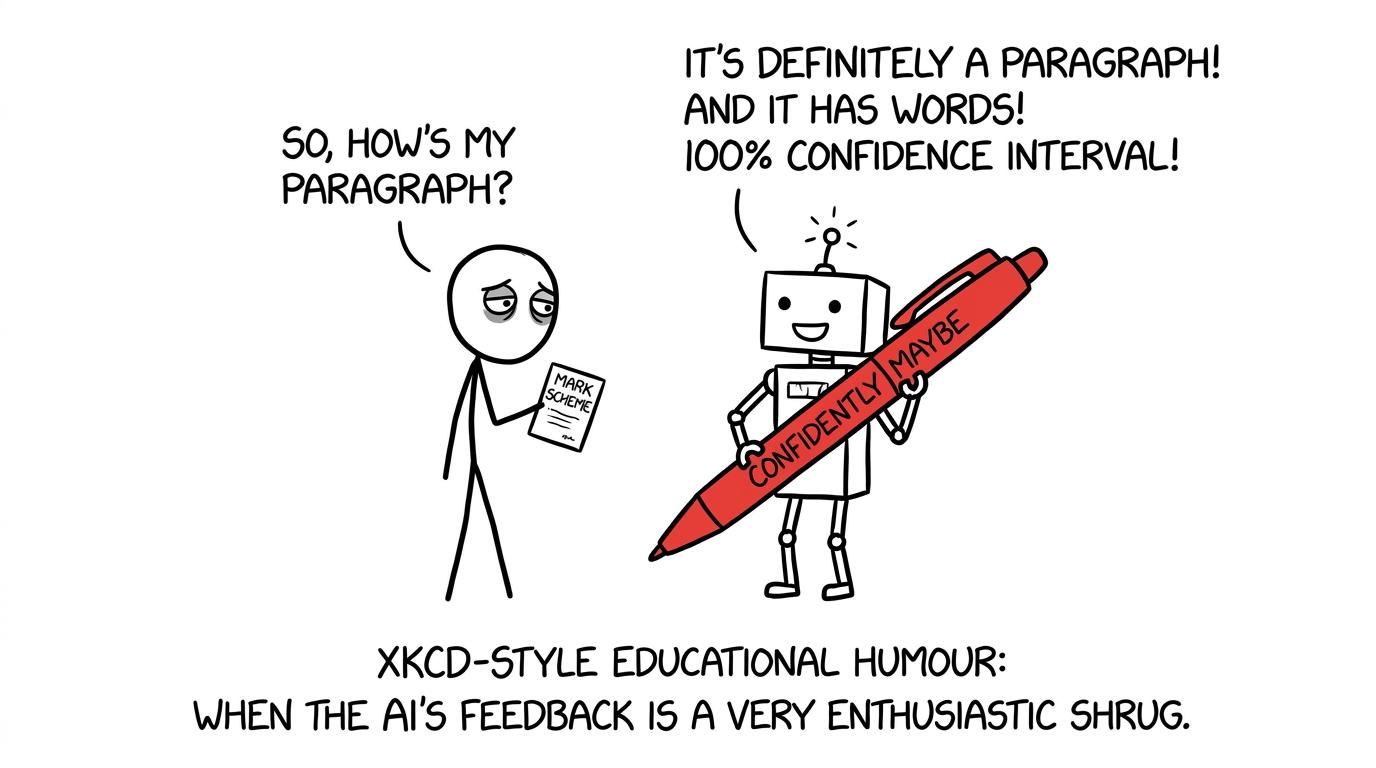 A student checks an overconfident robot's feedback against a mark scheme
Where AI tools genuinely help with English revision
Turning a topic into active recall
AI is useful when you need someone to ask questions rather than provide a lecture. You can ask it to quiz you on terms such as narrative perspective, juxtaposition, semantic fields or cyclical structure. Request one question at a time and make it wait for your answer.
A strong prompt might say:
Quiz me on GCSE English Language reading terminology. Ask one question at a time, do not reveal the answer immediately, and ask me to explain the effect of each technique rather than merely name it.
This matters because recognising a term is not the same as analysing a writer’s choice. The exam rewards an explanation grounded in the text, not a collection of impressive labels.
Acting as a questioning partner
After reading an unseen extract, you can give AI your own interpretation and ask it to challenge you. Ask questions such as:
- What evidence would make this interpretation more convincing?
- Is there another reasonable reading of this quotation?
- Have I explained the writer’s method and its effect?
- Where have I made an assertion without supporting it?
This is stronger than asking, “What does this quotation mean?” The first approach keeps you responsible for the interpretation. The second encourages you to borrow one.
Giving preliminary feedback on your writing
AI can identify possible problems in a practice response: repeated sentence openings, an inconsistent register, unclear paragraphing or punctuation that deserves another look. It can also compare your response with an assessment objective if you paste the relevant wording into your prompt.
Ask for specific diagnostic comments, not a rewritten answer. For example:
Read my practice response as a critical reviewer. Identify one strength and three priorities linked to AO5 and AO6. Quote short phrases from my response as evidence. Do not rewrite any sentences for me and do not estimate a grade.
You should then decide whether the feedback is sensible. If the tool recommends changing something, ask why. Compare important advice with teacher feedback and the official mark scheme.
Creating manageable revision sessions
AI can turn a broad intention such as “revise Paper 2” into a short checklist. It can suggest a sequence involving retrieval, planning, timed writing and reflection. This can be especially helpful when English sits beside several maths and science tasks on your timetable.
The principle transfers well across subjects. MathsGenie’s guide to building a GCSE maths revision timetable uses the same dependable rhythm: identify weaknesses, practise actively, check the result and return to errors. If your exams are close, the one-month GCSE revision plan can help you organise maths around your English practice without allowing either subject to disappear.
Where ChatGPT and AI tend to lead students astray
Confident feedback can still be wrong
The Department for Education warns that generative AI can produce inaccurate, biased or fabricated information presented convincingly. This is often called hallucination. In English revision, that might mean inventing a quotation, misidentifying a technique, misunderstanding a question or claiming that an exam board requires a structure it does not require.
AI does not become reliable simply because its explanation sounds polished. Treat it like an enthusiastic revision partner with an unreliable memory.
AI marking is not official marking
A chatbot may give the same response different marks on different attempts. It may reward sophisticated vocabulary while overlooking whether the answer actually addresses the question. It also lacks the professional judgement, standardisation and full assessment context used by examiners.
Use an AI score only as an unverified opinion. Teacher feedback and official mark schemes carry more weight. The same discipline improves maths revision: complete an authentic paper, use its mark scheme and investigate every lost mark. MathsGenie’s guide to using GCSE past papers properly explains that process clearly.
Model answers can create an illusion of progress
Reading an elegant AI response feels productive because everything makes sense once it is complete. But recognition is not recall. The exam asks you to select evidence, form an interpretation and control your writing independently under time pressure.
A useful rule is: attempt first, consult second, rewrite independently third. If AI produces the original ideas, structure and sentences, you are reviewing its skill rather than developing yours.
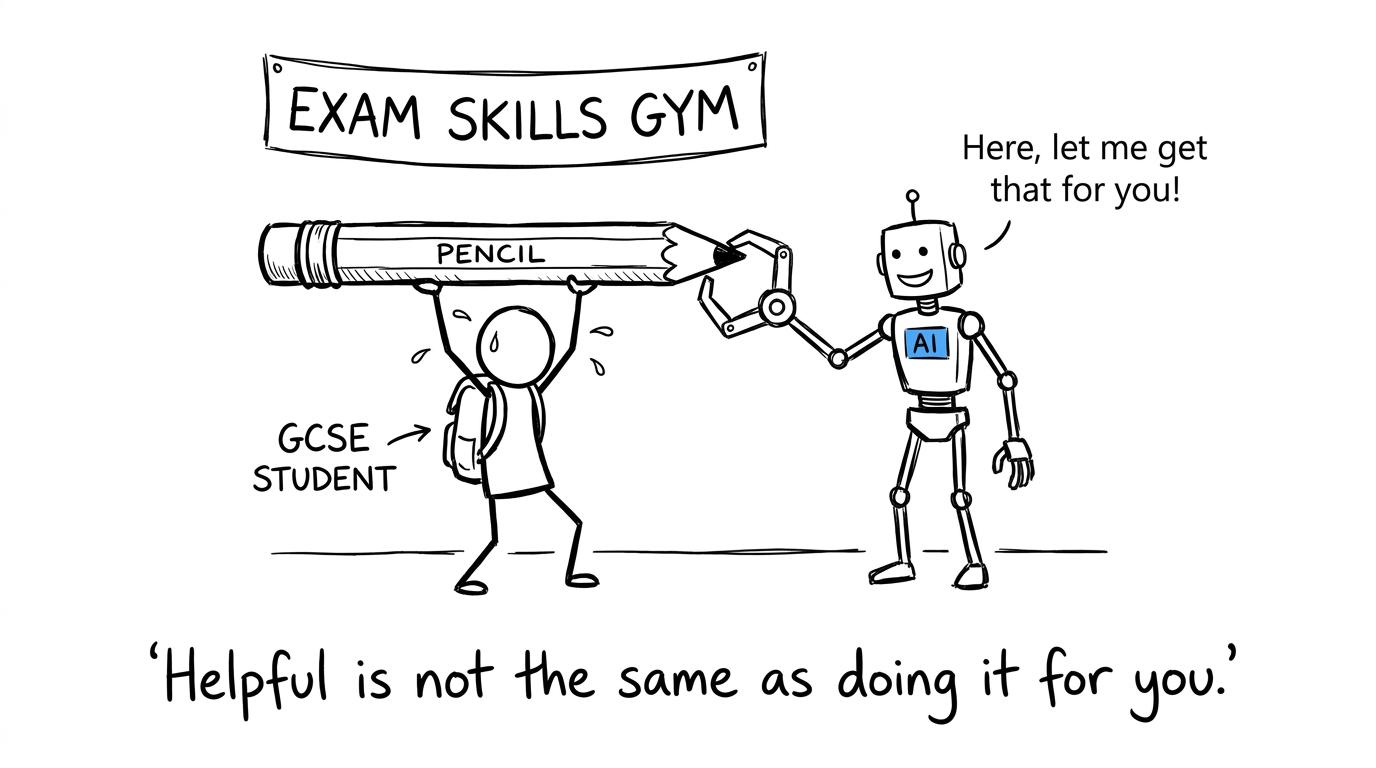 A robot offers to lift the revision pencil for a student
Generic formulas can flatten good writing
Rigid acronyms may help you remember the components of analysis, but no universal paragraph formula guarantees a high mark. AI often produces repetitive comments about how a technique “makes the reader want to read on” or “creates an image in the reader’s mind”. These comments are too broad unless they explain the precise effect in context.
Creative and transactional writing can suffer too. A generated list of ambitious words may produce unnatural sentences, while an elaborate structure may not suit the purpose or audience. Clarity and control are more valuable than decoration.
A better AI revision routine
Use AI inside a wider cycle rather than making it the entire method.
Choose one assessable skill
Start with something precise: selecting evidence, analysing structure, comparing perspectives, adapting register or checking punctuation. Avoid vague sessions labelled only “English revision”.
Complete an independent attempt
Write a paragraph, plan a response or answer several retrieval questions without assistance. If you are practising exam performance, set a realistic time limit and remove access to AI completely.
Request narrow feedback
Ask the tool to focus on one or two assessment objectives. Tell it not to rewrite your work, invent a grade or add ideas you could simply copy. Narrow prompts usually produce more useful feedback than “make this better”.
Verify and improve
Check the advice against your notes, specification, mark scheme or teacher feedback. Make your own changes, then explain what you improved and why. That explanation is evidence that you understand the decision.
Retest without help
Return to a similar task several days later. If the skill survives without the chatbot, the revision has worked.
This mirrors effective maths practice. You can diagnose gaps with the GCSE maths self-assessment sheet, rebuild skills through the free GCSE maths revision hub, and then test them independently. For shorter timed checks, use the Edexcel GCSE maths mini tests.
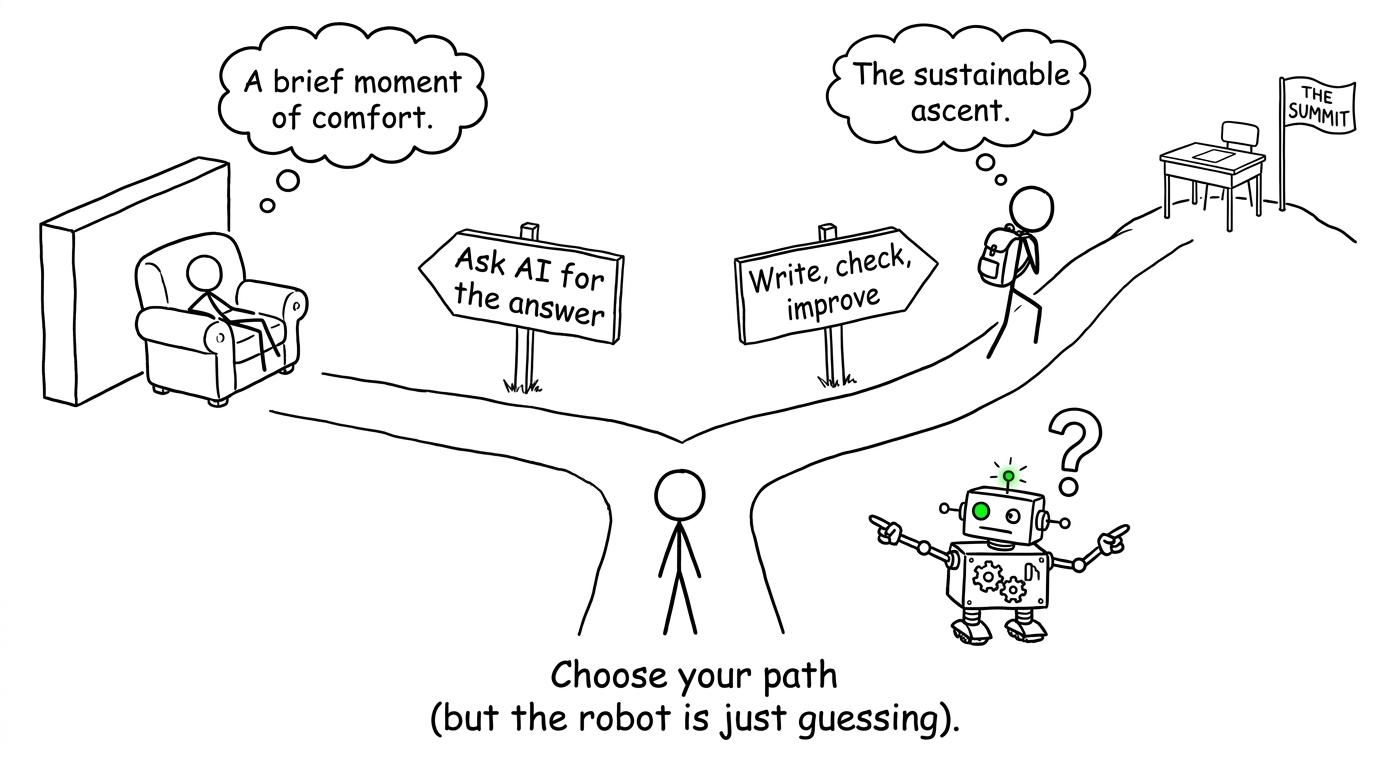 Two revision paths show the difference between receiving an answer and building a skill
AI rules for assessed work
Revision practice at home is different from work submitted for assessment. Current JCQ guidance requires submitted assessment work to be the student’s own. Using AI so extensively that submitted work no longer reflects your independent knowledge, analysis or writing can constitute malpractice.
Where AI use is permitted in assessed work, its use may need to be acknowledged, with the prompts and outputs retained for authentication. AI-generated sections cannot earn credit as evidence of your own achievement. Exact requirements depend on the task and your centre’s rules, so ask your teacher before using AI for anything that may be submitted, authenticated or assessed.
For the written GCSE English Language papers, the practical distinction is straightforward: AI may support revision beforehand, but it will not be available in the examination. For Spoken Language preparation or any centre-managed task, follow your school’s instructions rather than assuming that home-use rules apply.
Common mistakes when revising with AI
Asking for a complete response immediately: this removes the difficult thinking that creates improvement. Start with your own attempt.
Trusting invented quotations or paper details: verify extracts, timings, question formats and assessment objectives against current official materials.
Requesting a grade without context: AI grading is inconsistent. Ask for evidence-based feedback on a specific criterion instead.
Copying polished phrases: borrowed language may not match your voice or understanding. Learn why a choice works, then write independently.
Uploading personal or confidential information: remove names, school details and other identifying information. Follow your school’s data and safeguarding rules.
Using AI instead of reading: English Language rewards close attention to unfamiliar texts. Summaries cannot replace regular reading and annotation.
Never practising under exam conditions: supported practice builds understanding, but independent timed writing builds performance.
The sensible verdict
AI can be a useful GCSE English Language revision assistant. It can quiz you, challenge an interpretation, organise a session and offer a first layer of feedback. It becomes harmful when it supplies the thinking, pretends to be an examiner or encourages you to trust fluent answers without verification.
Keep the ownership of the work. Write first. Question the feedback. Check authoritative materials. Then practise again without help.
And while AI supports selected English tasks, let MathsGenie give your maths revision a reliable foundation. Start with the GCSE maths revision resources, practise authentic questions, and build towards Edexcel GCSE maths past papers and GCSE predicted papers. With free revision lessons, practice questions, mini tests, mark schemes and video solutions, every session can end with something more valuable than an AI answer: evidence that you can do it yourself.