

AI Quiz GCSE Astronomy: A Safe Revision Guide
AI quiz GCSE astronomy tools can sharpen recall. Learn how to prompt, verify answers, avoid hallucinations and connect space questions to GCSE maths revision.
A chatbot can produce ten questions about stars before you have found the right page in your revision guide. That speed is appealing, especially when revision time feels scarce. So, can you use an AI quiz GCSE astronomy tool productively? Yes, but only if you treat it as a question generator, not an unquestionable source of astronomical truth.
The safest method is simple: define the exact specification content, answer without assistance, ask for feedback, and verify every disputed fact or calculation against an authoritative source. AI is useful for active recall and adapting questions. It is much less reliable when identifying what is examinable, quoting precise data or imitating a mark scheme.
For students preparing for GCSE maths as well as astronomy, there is another benefit. Astronomy naturally exercises standard form, units, graphs, angles, proportional reasoning and formula manipulation. The subject may look towards the sky, but many of its marks are built on calm mathematical habits.
Your AI astronomy quiz checklist
Before opening a chatbot, keep this short checklist beside you:
- Choose one Pearson Edexcel GCSE Astronomy specification topic.
- Tell the AI the qualification code, which is
1AS0. - Request one question at a time without revealing the answer.
- State the question style and approximate mark value.
- Write your answer before asking for feedback.
- Make the AI separate factual feedback from writing advice.
- Verify facts, formulae and accepted terminology independently.
- Record weak areas and revisit them without AI.
- Never enter personal, confidential or identifying information.
- Follow your school’s rules on AI and assessed work.
That last point matters. AI can support private revision, but work submitted for assessment must remain your own.
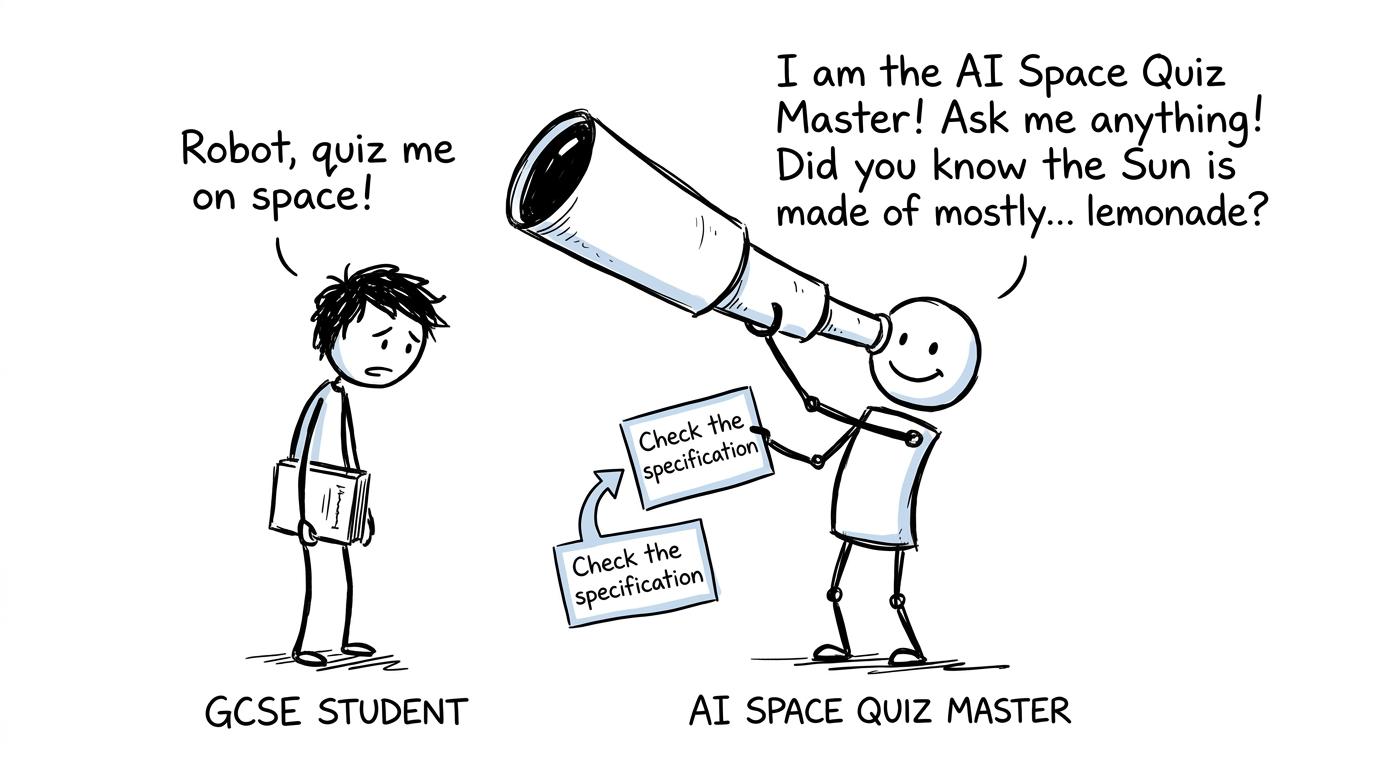 A student asks an AI robot for an astronomy quiz while the robot uses a telescope backwards
What an AI quiz can do well
A good quiz creates a small gap between knowing and remembering. Notes can feel familiar because the answer is visible. A question removes that comfort. You have to retrieve the idea yourself.
AI is particularly useful for changing the form of that retrieval. You can ask for:
- quick definitions and factual recall;
- multiple-choice questions with plausible distractors;
- short-answer questions;
- questions based on unfamiliar astronomical contexts;
- calculation questions using data supplied in the prompt;
- graph interpretation prompts;
- extended-response planning questions;
- a later retest containing only previous errors.
Pearson’s current GCSE Astronomy specification contains two externally examined papers. Paper 111, Naked-eye Astronomy, covers Topics 111 to 888. Paper 222, Telescopic Astronomy, covers Topics 999 to 161616. Each paper lasts 111 hour 454545 minutes, carries 100100100 marks and contributes 50%50\%50% of the qualification. Questions can include multiple-choice, short-answer, calculation, graphical and extended-open-response tasks.
That variety gives an AI tool a useful job: switching question type while keeping the topic fixed. You might recall a definition perfectly but struggle to apply it to unfamiliar information. A mixed quiz exposes that difference.
How to prompt an AI quiz GCSE astronomy tool
Vague prompts create vague revision. “Quiz me on space” may bring in university physics, general science or facts that are fascinating but absent from the GCSE specification.
A stronger reusable prompt is:
Act as a cautious quiz partner for Pearson Edexcel GCSE Astronomy (
1AS0). Quiz me on [insert specification topic]. Ask one question at a time and do not reveal the answer until I respond. Mix recall, application, data interpretation and calculation questions. State the approximate mark value. After each answer, explain what is correct, what needs improving and which claims I should verify against the current Pearson specification or mark scheme. Do not invent quotations, specification statements or observational data.
The phrase “one question at a time” is important. If the AI produces twenty questions and their answers together, the page becomes another set of notes. Retrieval disappears.
Set the boundaries before the quiz
Give the tool a narrow topic, such as planetary motion and gravity, exploring starlight or cosmology. If possible, paste a short teacher-approved topic checklist rather than asking the AI to reconstruct the whole specification from memory.
Do not paste copyrighted textbooks, confidential school materials or personal information into a public tool. Department for Education guidance warns that generative AI output can be inaccurate, biased, unsafe, out of date or taken out of context. It also recommends avoiding personal data in prompts.
Make the AI wait for your answer
Ask the question, close other notes and write a complete response. For calculations, show your method and units. For longer answers, build a logical chain rather than listing isolated facts.
Only then request feedback. This protects the difficult part of revision: thinking before seeing.
Ask for diagnosis, not just a score
A bare mark is not enough. Ask the AI to classify the problem as one of these:
- missing knowledge;
- incorrect terminology;
- weak application;
- mathematical error;
- missing unit or premature rounding;
- unsupported conclusion;
- unclear written communication.
Keep the diagnosis in an error log. A useful follow-up prompt is: “Ask me a different question testing the same weakness, but do not copy the original wording.”
Where AI tends to give bad astronomy information
Generative AI produces plausible language. Plausibility and accuracy are not the same thing. Government guidance describes fabricated but convincing output as hallucination, and recommends testing AI responses against trusted knowledge.
Specification coverage
An AI may confidently claim that a topic is required when it is merely related, or overlook a detail that is explicitly examinable. It may also mix GCSE Astronomy with GCSE Physics, A Level Physics or material from a different curriculum.
Use the current Pearson Edexcel specification as the boundary. Edexcel is the awarding body for the GCSE Astronomy qualification discussed here; references to AQA, OCR or Eduqas astronomy papers should immediately prompt a check.
Precise values and changing scientific knowledge
Distances, periods, dates, classifications and mission details are vulnerable to errors. Some values depend on definitions or rounding conventions. Astronomy also develops as observations improve, while an AI’s knowledge may be incomplete or out of date.
If an answer depends on a precise value, use the value supplied in the exam question or an approved specification resource. Never assume that a chatbot’s number is the one an examiner expects.
Diagrams, directions and observational claims
AI can reverse east and west, confuse the apparent movement of objects with their physical motion, or describe a diagram that does not match its labels. It may also invent observations it did not make.
GCSE Astronomy includes observational skills. A chatbot cannot replace planning, carrying out and evaluating your own required observations. Use your teacher’s instructions and Pearson’s current guidance for that work.
Marking extended responses
AI feedback can improve clarity, but it is not an official examiner. It may reward scientific detail that does not answer the question, penalise a valid alternative or invent rigid marking requirements.
For authentic assessment practice, official questions and mark schemes take priority. The same principle strengthens maths revision: use Edexcel GCSE Maths past papers to see how genuine marks are awarded, rather than asking AI to imitate an examiner from scratch.
Use astronomy to strengthen GCSE maths
The two qualifications are separate, but the mathematical habits overlap. The GCSE maths topics by exam board and tier provide a useful checklist for finding those links.
Standard form and scale
Astronomical quantities are often extremely large or small, making standard form essential. A correctly written value has the structure
a×10n,1≤a<10,a \times 10^n, \qquad 1 \leq a < 10,a×10n,1≤a<10,where nnn is an integer. An AI quiz can test conversions or comparisons, but use MathsGenie’s standard form revision guide and standard form practice questions to secure the examinable maths method.
Graphs, angles and proportional reasoning
Astronomy questions may require you to interpret trends, estimate from graphs, work with angular measurements or rearrange relationships. These tasks reward labelled working, sensible scales and careful units.
Students on higher tier may also recognise links with trigonometric and exponential graphs. Do not ask AI to decide which GCSE maths content belongs to your tier. Confirm that through your exam board resources and teacher.
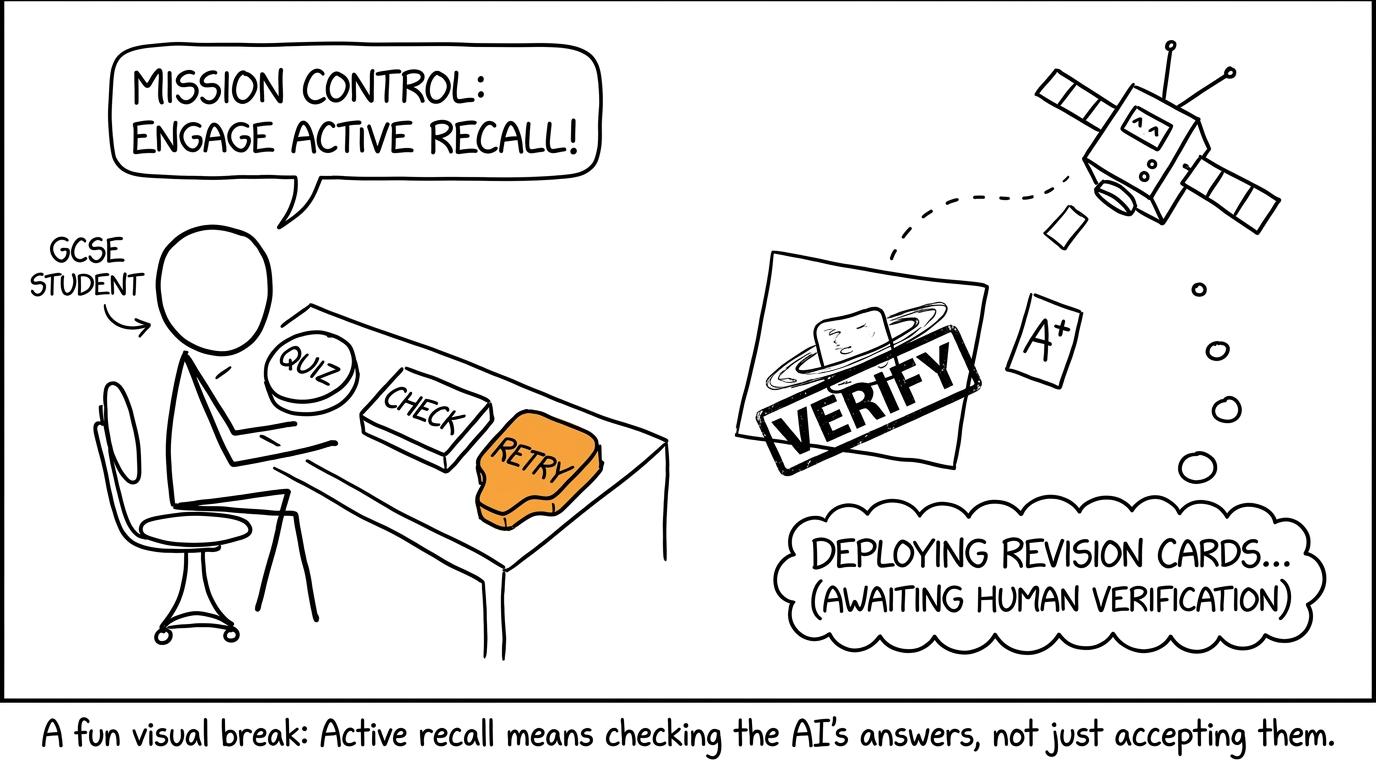 A student mission controller uses Quiz, Check and Retry buttons while an AI satellite drops revision cards
A productive revision routine
An AI quiz works best inside a wider system, not as the whole system.
Begin with a specification topic and retrieve what you know. Complete a short AI quiz, verify questionable feedback, then write two or three weaknesses in an error log. Relearn those ideas from reliable materials and retest them after a gap. A compact session can follow the rhythm in MathsGenie’s 20-minute GCSE maths revision routine.
Once the underlying knowledge is secure, move beyond chatbot questions. Complete genuine exam questions under timed conditions. For maths, the GCSE Maths revision hub brings together revision lessons, practice questions, mini tests, past papers and mark schemes. Near the exam, Edexcel GCSE Maths predicted papers can provide additional unfamiliar practice, but they should complement rather than replace official past papers.
Common mistakes when revising with AI
Trusting confident wording
A polished explanation can still be false. Verify anything involving exact data, specification wording, accepted terminology or a disputed calculation.
Letting the tool answer too soon
Hints given before an attempt weaken retrieval. Tell the AI to wait, and resist asking for the first step unless you are genuinely stuck.
Revising general space facts
Interesting facts are not automatically useful exam content. Keep every session tied to a named specification topic and an identifiable weakness.
Accepting an AI-generated mark scheme
A generated scheme may be useful for informal feedback, but it is not official. Learn exam language from awarding-body materials and genuine mark schemes.
Copying rather than learning
Submitting AI-generated work as your own can constitute malpractice. JCQ guidance requires assessed work to be demonstrably the student’s own. Follow your teacher’s instructions and ask before using AI in anything that will be submitted.
Forgetting the maths underneath
A correct astronomical idea can still lose marks through a power-of-ten error, missing unit or poorly read graph. Strengthen these foundations through focused MathsGenie practice rather than relying on the chatbot to repair every skill at once.
Make AI the quiz partner, not the authority
The best use of an AI astronomy quiz is modest but valuable. It asks. You think. It responds. You check.
That final step is what makes the process productive. The tool supplies variety and immediacy; the specification, your teacher, official questions and mark schemes supply authority. When a question reveals a mathematical weakness, return to MathsGenie. Use the free revision lessons to rebuild the method, practice questions and mini tests to make it reliable, then past papers, predicted papers, mark schemes and video solutions to test it under pressure.
Start with one astronomy topic and five carefully controlled questions. Then open MathsGenie, choose the maths skill beneath your mistakes, and turn curiosity about space into stronger exam technique.










