Can Adults Retake GCSE Statistics? How It Works
Adults retake GCSE Statistics through a college or private exam centre. Learn about boards, tiers, fees, entry, funding and a practical revision plan.
A qualification can sit quietly in the past for years. Then a university application, career change or unfinished personal goal brings it back into view.
The practical answer is yes: adults retake GCSE Statistics by enrolling with a college or by arranging an exam entry as a private candidate. There is no requirement to be attending school. You do, however, need an approved exam centre to enter you for the correct specification, tier and examination series.
The process is manageable once you separate it into two jobs: arranging the examination and preparing for it.
Your GCSE Statistics retake checklist
Before beginning revision, work through this short checklist:
- Decide why you need the qualification and what grade you are targeting.
- Check which GCSE Statistics specifications are currently available.
- Choose foundation or higher tier with appropriate advice.
- Ask local colleges whether they offer an evening, daytime or distance-learning course.
- If necessary, find an approved centre accepting private candidates.
- Confirm the complete fee, entry deadline and examination dates in writing.
- Discuss access arrangements before the centre's deadline if you need them.
- Match every revision resource to your exam board and tier.
- Build a realistic weekly plan around work and family commitments.
- Use topic practice before moving to complete timed papers.
The MathsGenie GCSE Statistics revision hub is a useful starting point because it brings together exam-board resources, questions, papers and solutions in one place.
How adults can retake GCSE Statistics
There are two main routes. Neither is automatically better. The right choice depends on how much teaching you need, what is available locally and how much flexibility your week allows.
Join an adult education or college course
Some further education colleges and adult learning providers run GCSE courses during the day or evening. Availability varies considerably by area, and GCSE Statistics is less widely offered than GCSE Maths or English.
A taught course may provide:
- regular lessons and a fixed timetable;
- access to a subject teacher;
- homework, mock examinations and feedback;
- an exam entry arranged by the provider;
- support with choosing the appropriate tier;
- advice about access arrangements and funding.
Contact colleges early and ask specifically for GCSE Statistics, rather than a general statistics, numeracy or Functional Skills course. These are different qualifications.
Ask which exam board and specification the course follows, whether the examination fee is included and whether attendance is in person, online or blended. A course advertised as online may still require you to sit the examinations at a designated centre.
Sit the qualification as a private candidate
A private candidate studies without being enrolled as a regular student at the centre making the examination entry. You might teach yourself, use a tutor or follow a distance-learning course.
You cannot normally enter directly with an exam board. An approved school, college or examination centre must submit the entry for you. The Joint Council for Qualifications maintains a private-candidate centre search, but each centre decides which subjects, boards and candidates it will accept.
Contact several centres because accepting private candidates generally does not mean accepting every qualification. Ask each centre:
- whether it offers your chosen GCSE Statistics specification;
- whether it accepts adults as private candidates;
- which tiers it can enter;
- what identification it requires;
- its internal registration deadline;
- the total cost, including board and administration fees;
- how it handles access arrangements;
- when you will receive your statement of entry.
Fees are set by individual centres and can differ significantly. Request a complete written quotation rather than assuming the exam board's entry fee is the final amount.
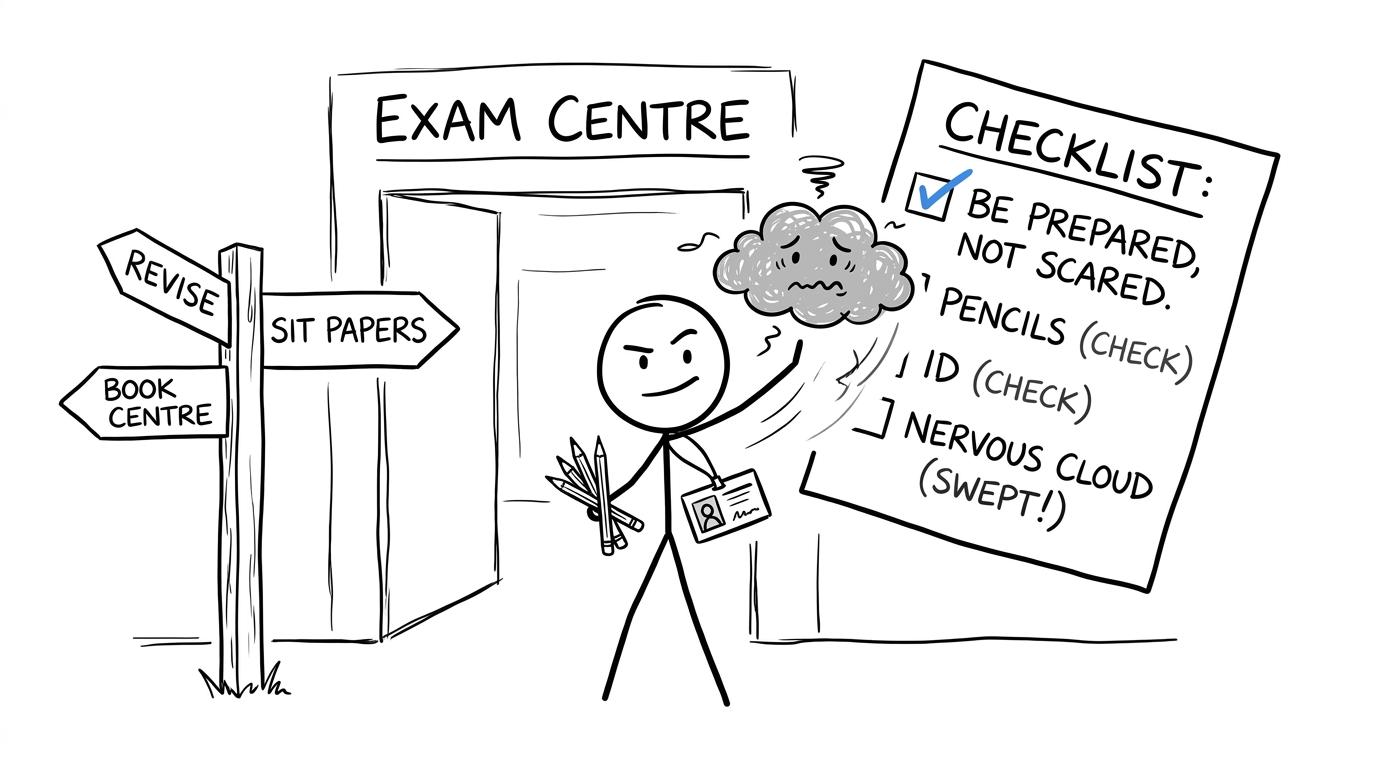 An adult learner follows a checklist towards an exam centre
Choose the correct exam board and specification
GCSE Statistics is a separate qualification from the statistics content inside GCSE Maths. Passing GCSE Maths does not mean that you hold GCSE Statistics, and revising only ordinary GCSE Maths statistics topics will not cover the whole separate qualification.
Current options include AQA GCSE Statistics and Pearson Edexcel GCSE Statistics. Availability can differ across the UK, so confirm the live specification directly with the examination centre before paying. MathsGenie also provides resources organised by board through its GCSE Statistics exam-board pages.
If your centre offers Pearson Edexcel, the relevant qualification is GCSE Statistics specification 1ST0. It is assessed through two externally examined papers taken in the same May or June series. Each paper lasts ninety minutes, carries 808080 marks and contributes half of the qualification. Calculators may be used on both papers.
The Edexcel GCSE Statistics revision page keeps lessons, worksheets, exam-style questions and past papers aligned with that specification.
Do not rely on the board you took years ago. Specifications change, and a private centre may offer only one board. Obtain the current specification code from the centre and check it carefully on your statement of entry.
Foundation or higher tier?
GCSE Statistics has foundation and higher tiers. You must sit all required papers at the same tier in the same examination series.
Foundation tier targets grades 111 to 555. Higher tier targets grades 444 to 999, with a grade 333 potentially available to a candidate narrowly missing grade 444, subject to the awarding rules for that series.
Higher is not automatically the wiser choice. It includes more demanding content and questions, while foundation offers no route above grade 555. Your decision should reflect:
- the grade required by an employer or course;
- your present understanding rather than your old result alone;
- performance on board-specific diagnostic questions;
- the time available before the examination;
- advice from a teacher, tutor or examination centre.
A private candidate remains responsible for checking the tier on the statement of entry. Finding an error after the entry deadline may be expensive or impossible to correct.
What will you need to revise?
The separate GCSE Statistics course goes beyond calculating a mean or drawing a pie chart. Depending on the specification and tier, it includes the collection of data, sampling, processing and representing data, probability, interpretation, correlation, distributions and the statistical enquiry cycle.
Several core ideas also appear in GCSE Maths. MathsGenie's lessons on averages from frequency tables, scatter graphs and correlation, probability and histograms can help strengthen these shared foundations.
A few central relationships should become familiar, such as
mean=sum of the data valuesnumber of data values\text{mean}=\frac{\text{sum of the data values}}{\text{number of data values}}mean=number of data valuessum of the data valuesand, for grouped continuous data,
frequency density=frequencyclass width.\text{frequency density}=\frac{\text{frequency}}{\text{class width}}.frequency density=class widthfrequency.But GCSE Statistics is not only about calculation. Examiners also expect you to select suitable methods, interpret results in context, identify bias and limitations, and evaluate whether conclusions are justified by the evidence.
Building revision around adult life
Adult revision rarely happens in perfect silence with an empty calendar. It happens after work, between responsibilities and in small pieces of time that initially look too modest to matter.
That makes consistency more useful than ambition. Three focused sessions each week are usually more sustainable than a large weekend plan that repeatedly gets postponed.
A productive session can follow this pattern:
- review one small part of the specification;
- answer questions without notes;
- mark them immediately;
- record why each mark was lost;
- repeat the weak skill a few days later.
Your error record should distinguish between missing knowledge, an incorrect method, weak interpretation and an avoidable examination mistake. Those categories lead to different actions. A missing method needs teaching; a misread axis needs slower checking.
Use the structure in the MathsGenie GCSE revision timetable guide to turn broad intentions into weekly tasks. Put the most difficult material at a time when you are normally alert, not automatically at the end of the longest day.
 An adult learner completes one calm evening revision session
Move from topics to examination papers
Beginning with full papers can make revision feel harder than it needs to be. Start with topic questions so that you can isolate gaps. Then use mixed mini tests, paper sections and finally complete papers under the official conditions for your board.
When you mark a paper, do more than total the score. Read the mark scheme, correct every lost mark and return to the relevant lesson. Keep some papers unseen for timed practice nearer the examination.
MathsGenie's GCSE Statistics resit plan explains how to turn past-paper results into a focused repair list. Past papers reveal the language of the qualification: not merely what you know, but how clearly you can apply, interpret and evaluate it.
Predicted papers can provide fresh practice later, but they should never replace specification coverage or official past papers. Use them as a final test, not as a forecast of questions that are guaranteed to appear.
Costs, funding and practical arrangements
Do not assume that GCSE Statistics will be funded under the same rules as GCSE Maths. In England, eligible adults have a legal entitlement to funded English and maths provision up to Level 222 in specified circumstances. That entitlement does not automatically make a separate GCSE Statistics retake free.
A college may still offer full or partial funding under other adult skills rules, depending on factors such as age, prior qualifications, income, employment status, local funding policy and whether the qualification is approved for that provision. Ask the provider to assess your individual eligibility before enrolling.
Private candidates should budget for the examination entry, centre administration and any tuition or course materials. There may also be late fees if you miss the centre's internal deadline.
If you need extra time, supervised rest breaks, modified papers or another access arrangement, tell the centre when first making contact. The centre must gather evidence and meet formal deadlines; arrangements are not simply requested on examination day.
Common mistakes adult candidates make
Booking before checking the specification
A course, textbook and exam entry must all match. Confirm the board, specification code and tier before spending money.
Assuming every centre accepts Statistics
A centre may accept private GCSE candidates but offer only selected subjects. Obtain explicit confirmation for GCSE Statistics.
Leaving the entry until spring
Centres often set internal deadlines earlier than the exam board's final deadline. Spaces can also fill. Start enquiries well in advance of the summer series.
Revising only GCSE Maths statistics
The overlap is useful, but the separate Statistics GCSE has broader content and places greater emphasis on statistical reasoning and evaluation.
Completing papers without reviewing them
A paper does not improve performance merely because it has been finished. The improvement comes from examining the mark scheme, identifying the cause of each error and practising that skill again.
Choosing higher tier for prestige
Choose the tier that gives you the strongest route to the grade you need. The label matters less than the result.
Take the next step with MathsGenie
An adult GCSE retake is partly a statistics challenge and partly an organisation challenge. The examination centre handles the formal entry, but your progress is built in smaller moments: one lesson understood, one error corrected and one paper reviewed honestly.
Begin by contacting local colleges and private-candidate centres. Once your board and tier are confirmed, open the MathsGenie GCSE Statistics revision hub and build a plan using free revision lessons, practice questions, worksheets, mini tests, past papers, mark schemes and video solutions. Add predicted papers near the end, when your knowledge is secure and you need fresh examination practice.
You do not need to recreate school. You need a confirmed entry, the right resources and a routine you can keep.