The diagram shows the long-run equilibrium position of a representative firm in a perfectly competitive market.
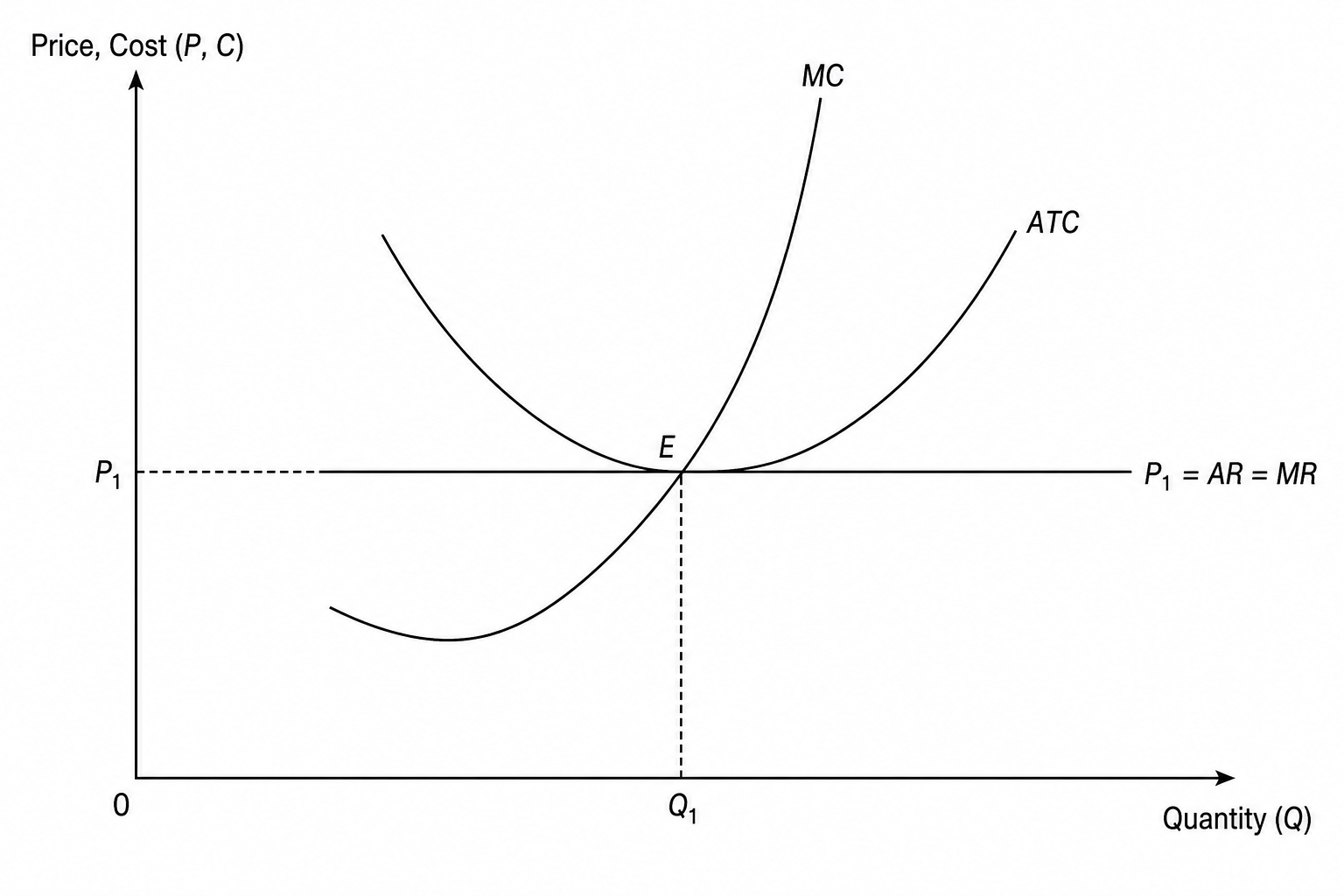
Which of the following statements correctly identifies the economic efficiencies achieved by this firm at the profit-maximising output Q1Q_1Q1, and the theoretical justification for each?
The firm achieves allocative efficiency because P1=MCP_1 = MCP1=MC at point EEE, and productive efficiency because it operates at the minimum point of its ATCATCATC curve. However, it fails to achieve X-efficiency due to a lack of competitive pressure on internal firm management, and fails to achieve dynamic efficiency due to earning only normal profit.
The firm achieves productive efficiency because it produces at the minimum point of its ATCATCATC curve, and dynamic efficiency because perfect information allows instant costless adoption of new technologies. However, it fails to achieve allocative efficiency because price-taking firms cannot set prices equal to marginal cost.
The firm achieves allocative efficiency (P1=MCP_1 = MCP1=MC at point EEE), productive efficiency (producing at the minimum point of the ATCATCATC curve), and X-efficiency (operating on its boundary cost curves due to existential survival pressure). It fails to achieve dynamic efficiency because the absence of supernormal profits in the long run prevents reinvestment in research and development.
The firm achieves allocative efficiency because P1=MCP_1 = MCP1=MC and dynamic efficiency because long-run normal profit provides the optimal incentive to innovate. However, it fails to achieve productive efficiency because a perfectly competitive firm operates at a scale too small to achieve any technical efficiencies, and fails to achieve X-efficiency.

