The diagrams below show the market and individual firm curves for a perfectly competitive industry transitioning from a short-run equilibrium to a long-run equilibrium.
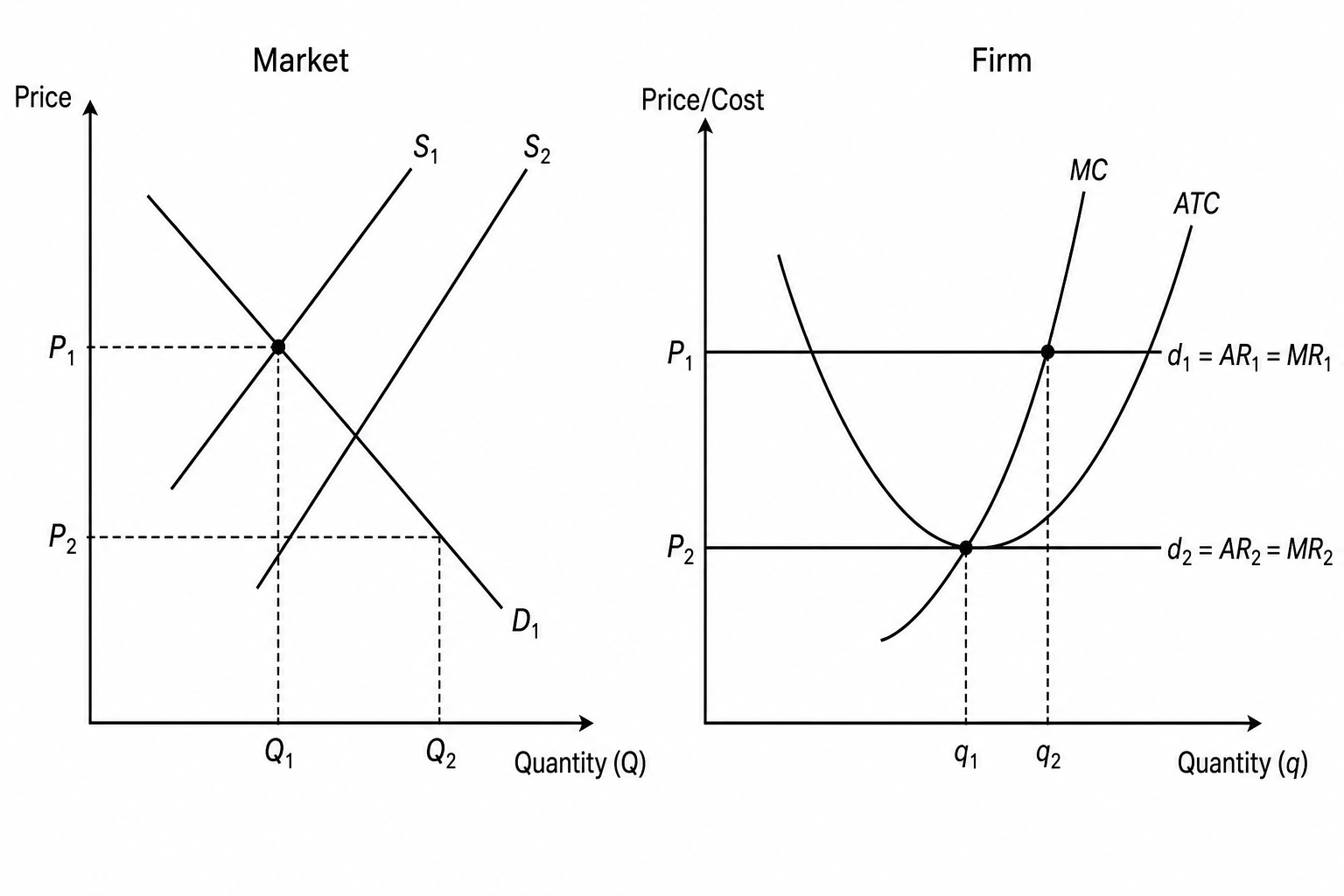
Which of the following statements correctly explains the transition from the short-run equilibrium (at price P1P_1P1) to the long-run equilibrium (at price P2P_2P2), and the efficiency characteristics of the long-run equilibrium?
The presence of supernormal profits at P1P_1P1 attracts new firms due to freedom of entry, shifting market supply from S1S_1S1 to S2S_2S2 and lowering price to P2P_2P2. At the long-run equilibrium price P2P_2P2, the firm is both productively efficient (P2=min(ATC)P_2 = \min(ATC)P2=min(ATC)) and allocatively efficient (P2=MCP_2 = MCP2=MC).
The presence of supernormal profits at P1P_1P1 leads existing firms to increase individual output to Q2Q_2Q2, shifting market supply from S1S_1S1 to S2S_2S2. At the long-run equilibrium price P2P_2P2, the firm is productively efficient (P2=min(ATC)P_2 = \min(ATC)P2=min(ATC)) but allocatively inefficient because P2>MCP_2 > MCP2>MC.
Firms facing high barriers to entry restrict industry supply to S2S_2S2 to maintain market share, driving the price down to P2P_2P2. At the long-run equilibrium price P2P_2P2, the firm earns supernormal profits and is neither productively nor allocatively efficient.
The existence of subnormal profits at P1P_1P1 causes firms to exit, shifting market supply from S1S_1S1 to S2S_2S2 and lowering price to P2P_2P2. At the long-run equilibrium price P2P_2P2, the firm achieves productive efficiency but fails to achieve allocative efficiency as P2≠MCP_2 \neq MCP2=MC.

