A firm operating in a perfectly competitive market faces a constant market price of P=20P = 20P=20. The firm's cost and revenue curves are depicted in the diagram below, where its total cost is given by TC=0.2q2+4q+80TC = 0.2q^2 + 4q + 80TC=0.2q2+4q+80 and its marginal cost is MC=0.4q+4MC = 0.4q + 4MC=0.4q+4.
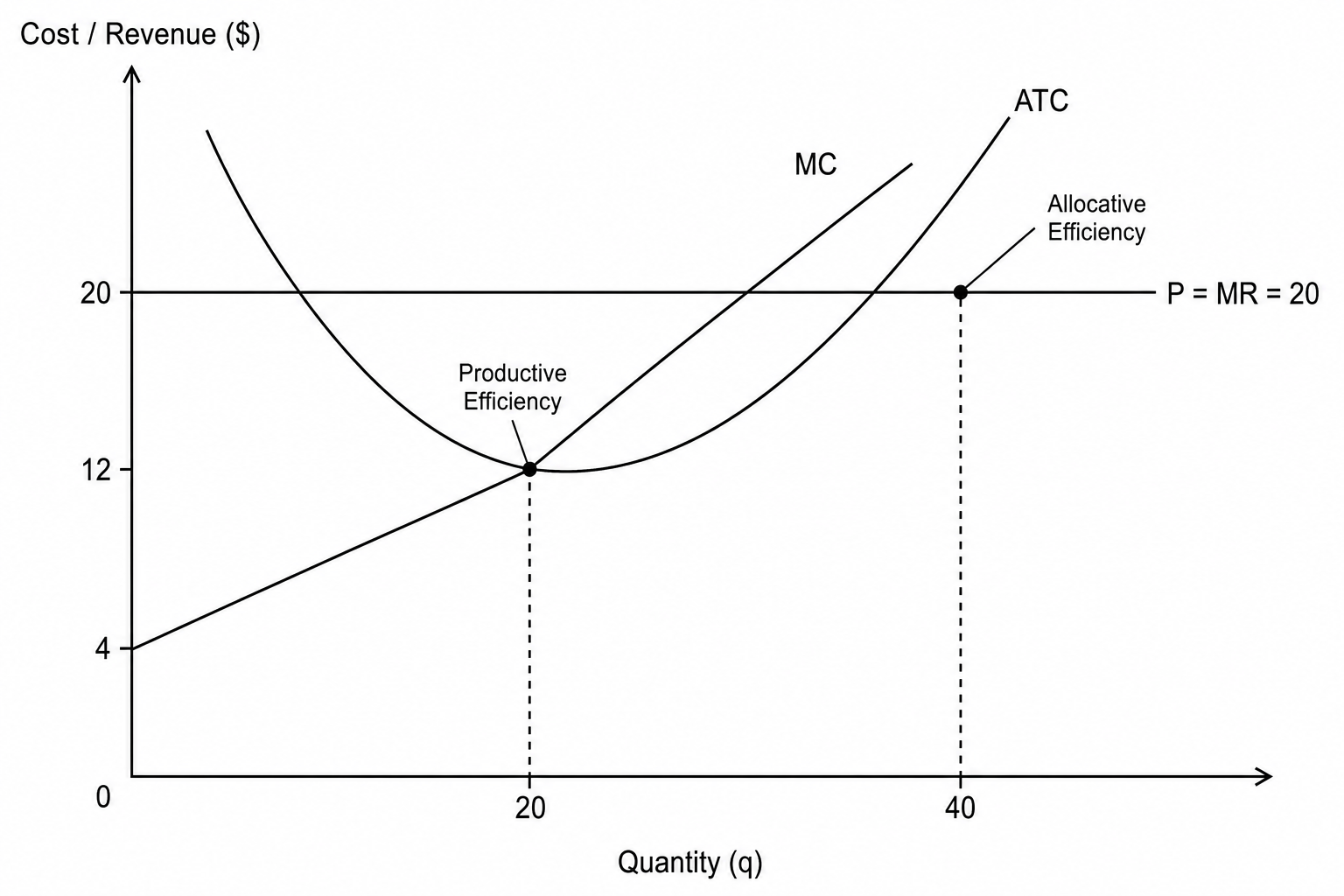
Which of the following statements correctly identifies the levels of output at which allocative efficiency and productive efficiency are achieved, and provides the correct economic rationale?
Allocative efficiency is achieved at q=40q = 40q=40 because price equals marginal cost (P=MCP = MCP=MC); productive efficiency is achieved at q=20q = 20q=20 because average total cost is minimised (MC=ATCMC = ATCMC=ATC).
Allocative efficiency is achieved at q=20q = 20q=20 because average total cost is minimised (MC=ATCMC = ATCMC=ATC); productive efficiency is achieved at q=40q = 40q=40 because price equals marginal cost (P=MCP = MCP=MC).
Allocative efficiency is achieved at q=40q = 40q=40 because marginal cost equals average total cost (MC=ATCMC = ATCMC=ATC); productive efficiency is achieved at q=20q = 20q=20 because price equals marginal cost (P=MCP = MCP=MC).
Allocative efficiency is achieved at q=20q = 20q=20 because marginal revenue is maximised; productive efficiency is achieved at q=40q = 40q=40 because profit is maximised.