The diagram below shows the aggregate demand (ADADAD) and aggregate supply (ASASAS) curves for an economy.
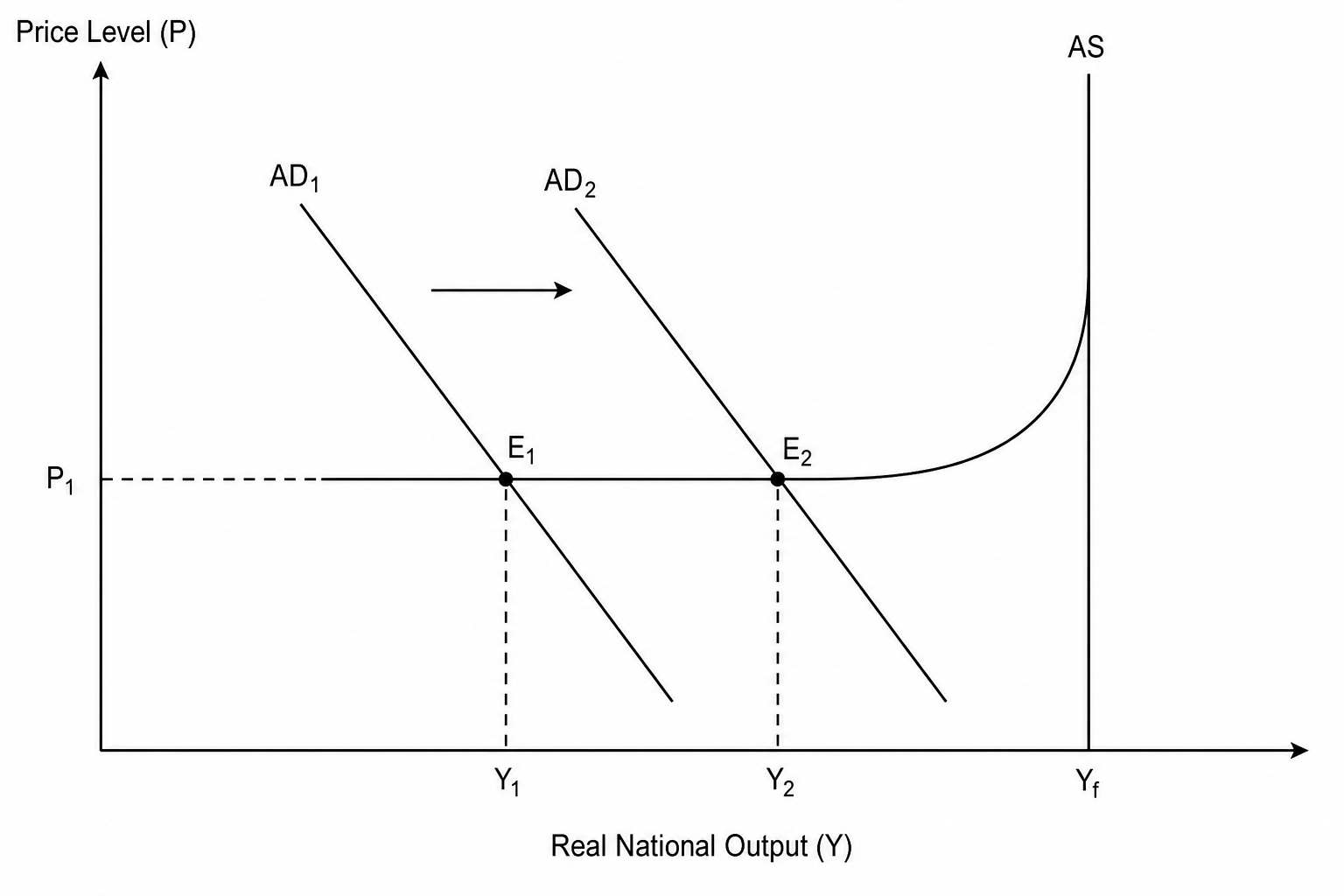
Which of the following statements correctly explains the macroeconomic outcome of the shift from AD1 AD_1\,AD1 to AD2AD_2AD2?
Real national output increases from Y1Y_1Y1 to Y2Y_2Y2 with no change in the price level because the economy is operating with significant spare capacity, allowing firms to increase production without bidding up wages or resource prices.
The shift from AD1AD_1AD1 to AD2AD_2AD2 is purely inflationary because any increase in aggregate demand must immediately bid up wages and resource prices due to a lack of spare capacity.
Real output increases to Y2Y_2Y2 but this is unsustainable in the long run because wages will automatically adjust downwards to return the economy to its natural rate of output at Y1Y_1Y1.
The expansion in aggregate demand is immediately offset by a leftward contraction in aggregate supply because of crowding-out in the financial sector.