A student investigates the rate of reaction between calcium carbonate and dilute nitric acid at room temperature and pressure (RTP):
CaCO3(s)+2HNO3(aq)→Ca(NO3)2(aq)+H2O(l)+CO2(g) \text{CaCO}_3(\text{s}) + 2\text{HNO}_3(\text{aq}) \rightarrow \text{Ca(NO}_3)_2(\text{aq}) + \text{H}_2\text{O}(\text{l}) + \text{CO}_2(\text{g}) CaCO3(s)+2HNO3(aq)→Ca(NO3)2(aq)+H2O(l)+CO2(g)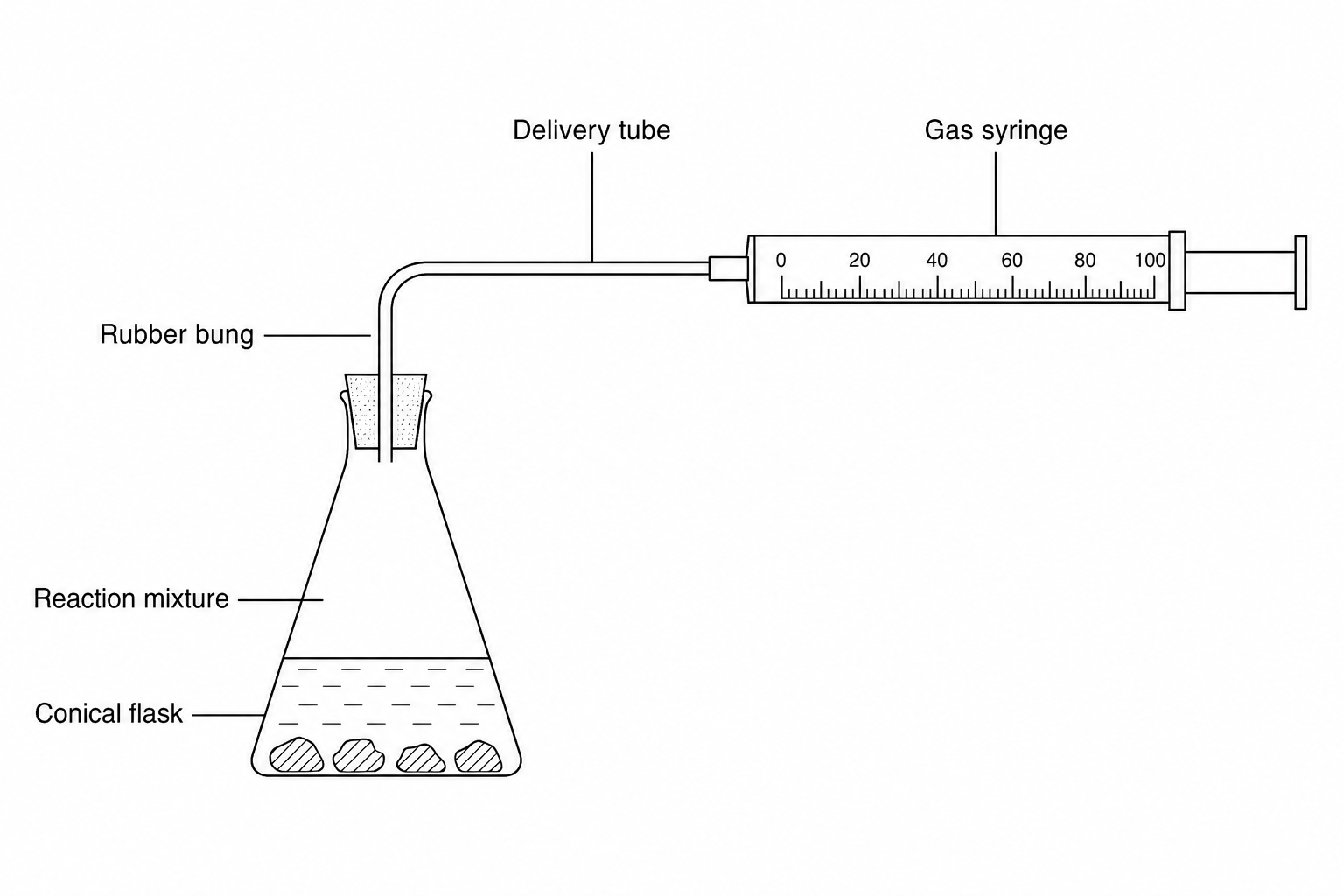
The student reacts an excess of calcium carbonate solid with 50.0 cm350.0\text{ cm}^350.0 cm3 of 0.80 mol dm−30.80\text{ mol dm}^{-3}0.80 mol dm−3 nitric acid, HNO3(aq)\text{HNO}_3(\text{aq})HNO3(aq).
Determine the total volume of carbon dioxide gas, in cm3\text{cm}^3cm3 measured at RTP, that the student should be prepared to collect if the reaction goes to completion. (Assume the molar volume of gas at RTP is 24.0 dm3 mol−124.0\text{ dm}^3\text{ mol}^{-1}24.0 dm3 mol−1.)
Suggest a suitable piece of laboratory apparatus that would allow this volume of gas to be collected, indicating clearly the scale of working.
Suggest an alternative experimental method, other than measuring gas volume, that would allow the rate of this reaction to be followed over time.

