A student investigates the rate of solvolysis of 2-chloro-2-methylpropane.
The student mixes 20.0 cm320.0\text{ cm}^320.0 cm3 of 0.050 mol dm−30.050\text{ mol dm}^{-3}0.050 mol dm−3 2-chloro-2-methylpropane in ethanol with 20.0 cm320.0\text{ cm}^320.0 cm3 of water (acting as the reactant in large excess). Because water is in large excess, the reaction is effectively zero-order with respect to water.
The concentration of 2-chloro-2-methylpropane is monitored over time, and the student plots a graph of concentration of 2-chloro-2-methylpropane against time as shown below:
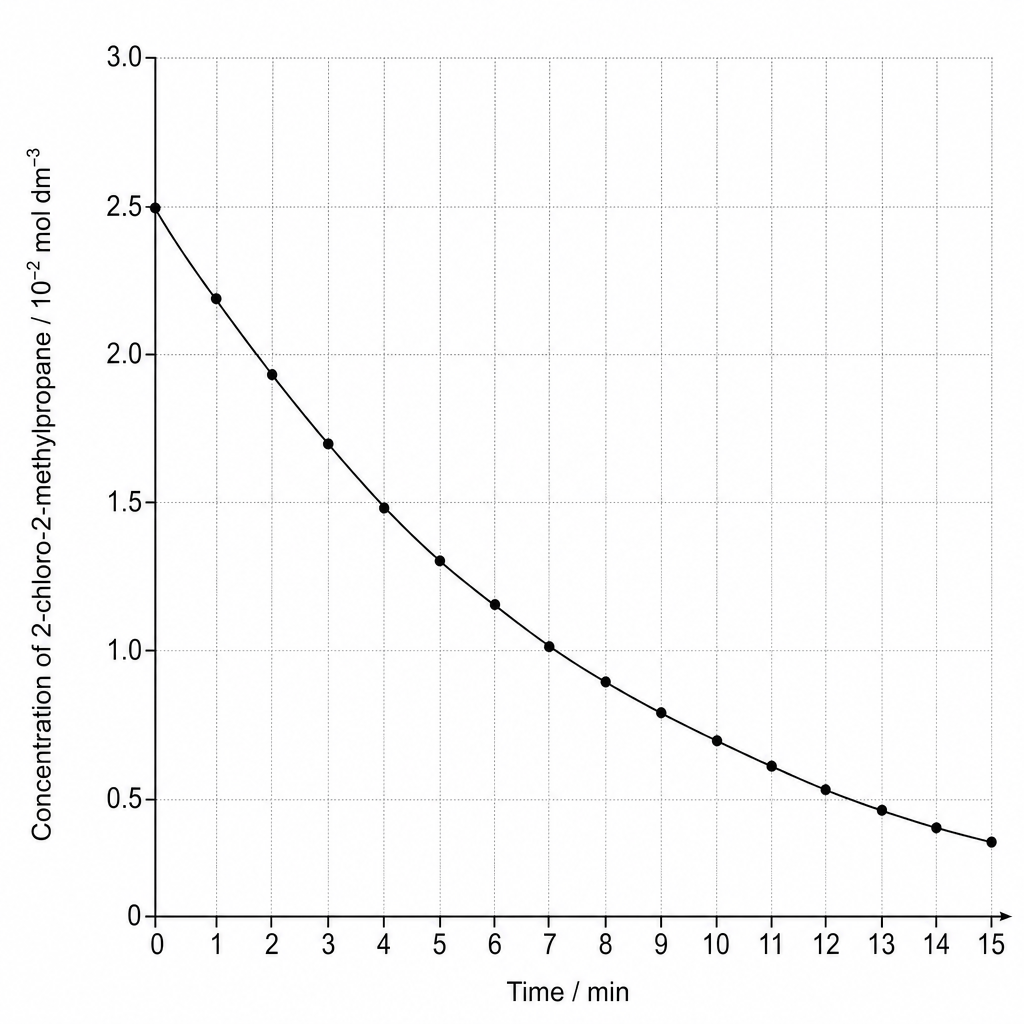
Using collision theory, explain why the gradient of the curve decreases over time.
Use the graph to determine:

