A sample of the water flea Daphnia magna was introduced into a newly established freshwater pond. The graph below shows the changes in the Daphnia population density over time.
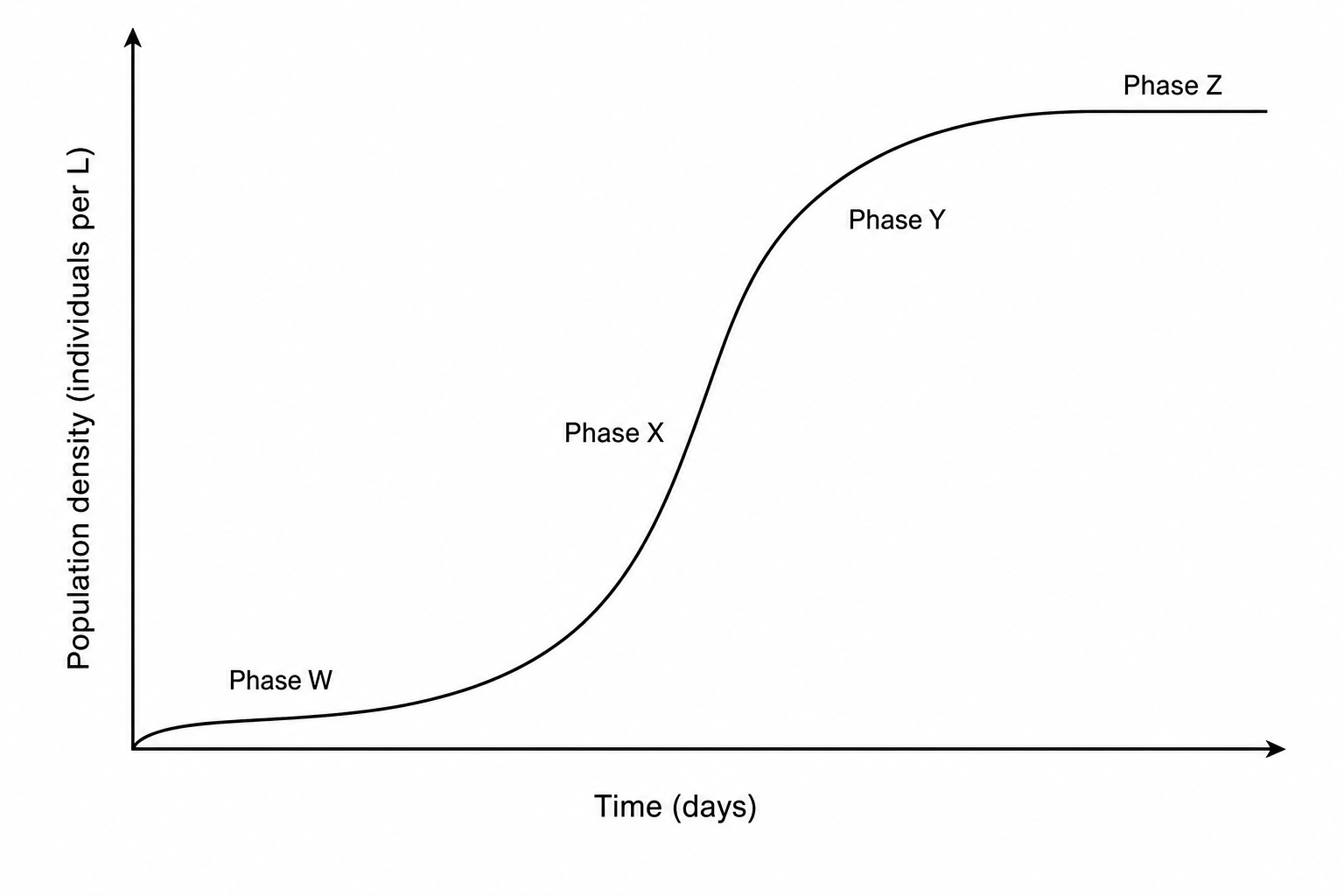
Which of the following options correctly describes the biological processes occurring during phases W to Z?
Phase W: Population decreases as individuals undergo osmotic shock. Phase X: Growth is linear and constant because resource supply is fixed. Phase Y: Intraspecific competition decreases, allowing birth rate to remain high. Phase Z: Carrying capacity is exceeded, causing the birth rate to fall to zero.
Phase W: Organisms adapt to the environment, activating genes and synthesizing proteins with little cell division. Phase X: Growth is exponential as birth rate vastly exceeds death rate under non-limiting conditions. Phase Y: Growth rate decelerates as density-dependent factors increase intraspecific competition for resources. Phase Z: Population size stabilizes at the carrying capacity (KKK) where birth rate matches death rate.
Phase W: High birth rates are completely offset by high death rates prior to genetic adaptation. Phase X: Population size increases arithmetically over time as space is unlimited. Phase Y: Growth slows exclusively due to density-independent factors such as seasonal temperature changes. Phase Z: Density-dependent factors are eliminated, leading to wild oscillations far above the carrying capacity.
Phase W: Rapid cell division is offset by high emigration rates out of the microhabitat. Phase X: Growth is slow and highly unstable due to intense interspecific competition. Phase Y: Birth rate equals death rate, keeping the population size constant at its minimum level. Phase Z: High toxic waste accumulation causes rapid death, leading to a total population crash to zero.

