An aerospace engineering team is testing a thermal control system for a scientific instrument on a space probe. The instrument consists of two identical metallic alloy blocks in perfect thermal contact with each other, each containing an internal heating element that generates thermal energy at a constant rate.
- Block X has a matte black finish.
- Block Y has a highly polished, shiny gold finish.
To prevent conduction to the spacecraft, the stack is placed on an insulating mount inside a vacuum chamber.
- In Configuration 1, Block Y is placed on top of Block X.
- In Configuration 2, Block X is placed on top of Block Y.
In both configurations, the base of the lower block rests on the insulating mount, so thermal energy loss from the bottom face is negligible. The heating elements operate under identical power settings in both configurations.
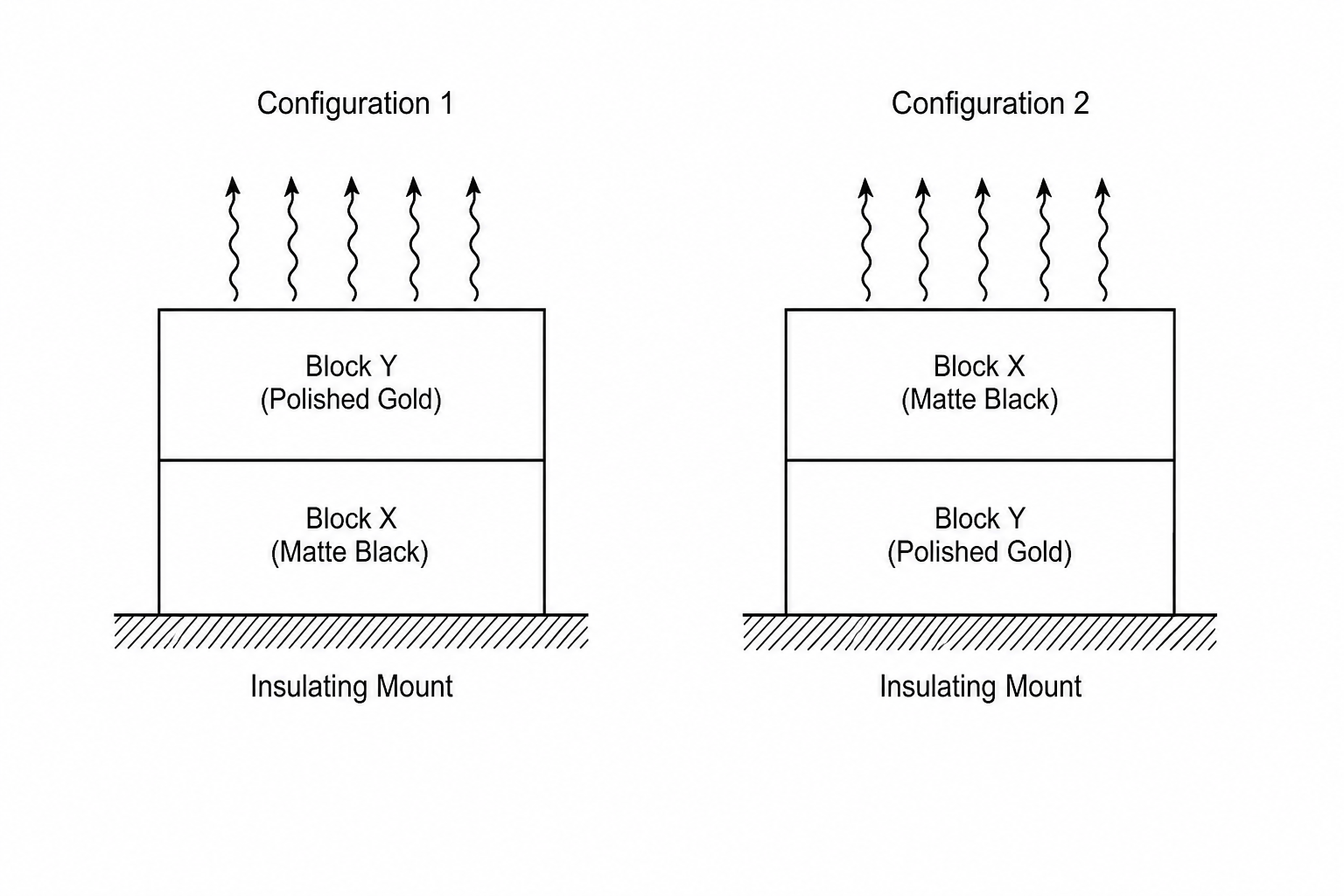
It is observed that the steady-state (equilibrium) temperature of the blocks is significantly lower in Configuration 2 than in Configuration 1.
Explain why the system reaches a lower equilibrium temperature when Block X (matte black) is on top.