

What you'll learn
- How an electric current produces a magnetic field around a conductor.
- How electromagnets, coils and solenoids are constructed and drawn.
- Why moving charges and current-carrying wires can experience a force in a magnetic field.
- How the motor effect is used in simple d.c. motors and loudspeakers.
Starting point: current, conductors and fields
Electromagnetism is about the link between electricity and magnetism. The key idea is simple but powerful: if charge is moving, magnetism is involved.
Key starting terms
- Electric current is the flow of electric charge. Current, III, is measured in amps (A).
- A conductor is a material that allows charge to flow through it easily, such as copper wire.
- A magnetic field is a region where magnetic materials, magnets, moving charged particles or current-carrying wires experience a force.
A magnetic field is represented using field lines. The arrows show the direction that the north-seeking end of a compass would point. Where field lines are closer together, the field is stronger.
Current makes magnetism
An electric current in a conductor produces a magnetic field around the conductor. No current means no magnetic field from that conductor.
Magnetic field around a straight wire
For a straight current-carrying wire, the magnetic field forms concentric circles around the wire. The field is strongest close to the wire and gets weaker further away.
To find the direction of the field, use the right-hand grip rule:
- Point your right thumb in the direction of the conventional current.
- Your curled fingers show the direction of the magnetic field lines.
Conventional current
Conventional current is the direction in which positive charge would flow: from the positive terminal to the negative terminal. This is the direction used in IGCSE left-hand and right-hand rules.
Finding the field direction around a wire
A wire is shown as a dot, meaning the conventional current is coming out of the page. What direction are the magnetic field lines?
- The dot means the current is travelling towards you, so point your right thumb out of the page.
- Your fingers curl around the wire; viewed on the page, they curl anticlockwise.
- Therefore the field lines should be drawn as circles around the wire with arrows anticlockwise. If the current went into the page instead, the arrows would be clockwise.
Dots and crosses
A dot means something is coming out of the page, like the tip of an arrow coming towards you. A cross means something is going into the page, like the tail feathers of an arrow moving away.
Electromagnets
The construction of electromagnets is Paper 2 only, but the idea is very useful for understanding the whole topic.
An electromagnet is a magnet made using an electric current. A typical electromagnet is made from:
- a coil of insulated wire
- a soft iron core
- a power supply
- a switch, so the current can be turned on and off
The wire is often wrapped into many turns. When current flows, each turn produces a magnetic field. These fields add together, making a stronger overall field.
Soft iron core
A soft iron core is used because it is easily magnetised when current flows, but loses most of its magnetism when the current is switched off.
You can make an electromagnet stronger by increasing the current, increasing the number of turns on the coil, or adding a soft iron core.
Making an electromagnet stronger
A small electromagnet has a coil wrapped around a plastic tube. It is too weak to pick up many paperclips. Suggest three improvements.
- Replace the plastic tube with a soft iron core, because soft iron becomes magnetised and strengthens the field inside the coil.
- Add more turns of insulated wire, because each turn contributes to the total magnetic field.
- Increase the current safely, because a larger current produces a stronger magnetic field around the wire.
Field patterns for wires, coils and solenoids
Drawing the magnetic field patterns for a straight wire, a flat circular coil and a solenoid is Paper 2 only.
A flat circular coil is a loop of wire. Its field passes through the centre of the loop and curves around the outside.
A solenoid is a long coil of wire with many turns. Its magnetic field is like the field around a bar magnet: one end acts like a north pole and the other acts like a south pole. Inside the solenoid, the field is strong and nearly uniform.
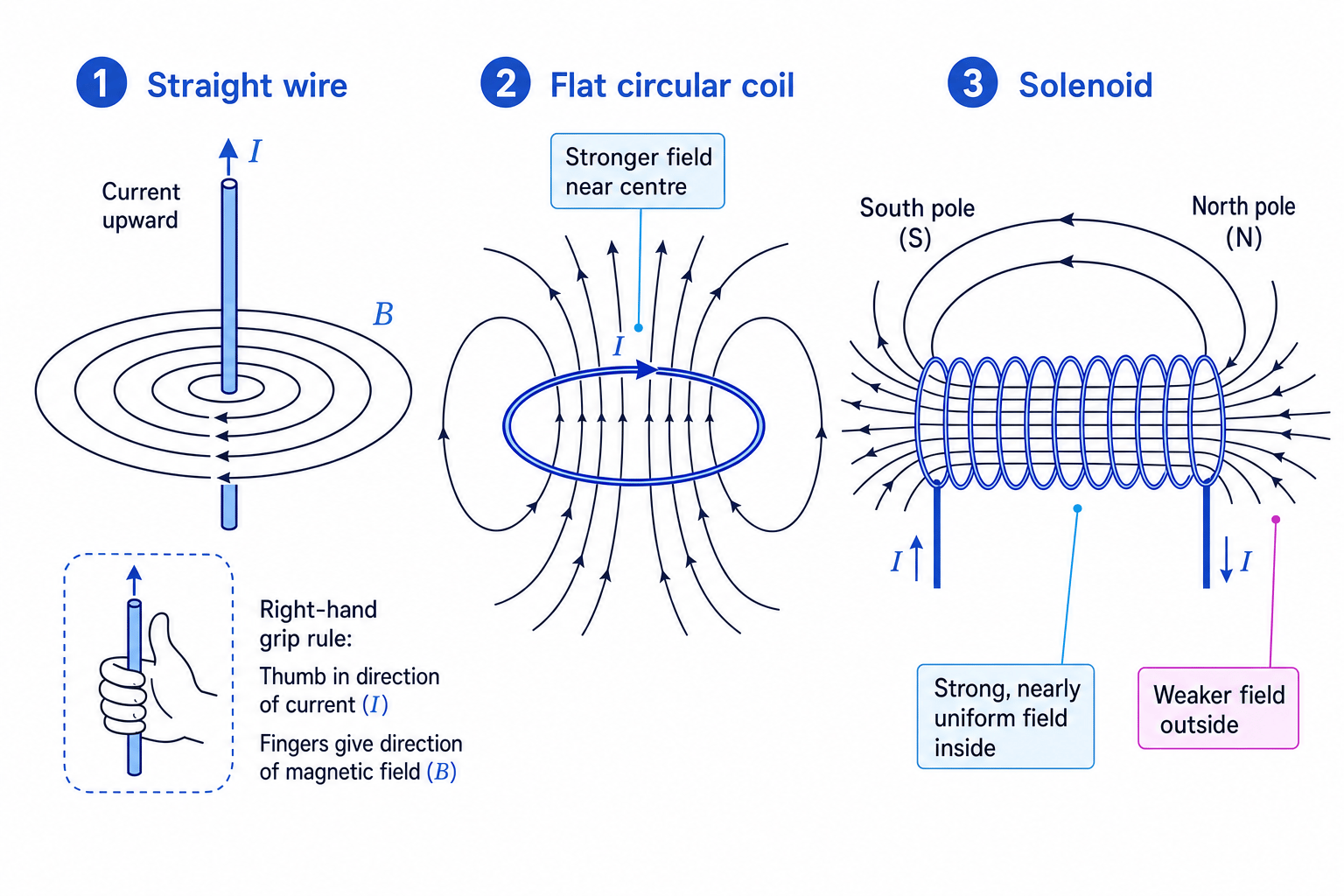
When drawing these patterns:
- Straight wire: draw circular field lines centred on the wire.
- Flat circular coil: draw field lines passing through the centre and curving back around the outside.
- Solenoid: draw a bar-magnet-shaped pattern, with a strong, nearly uniform field inside.
Mixing up the two hand rules
Use the right-hand grip rule for the magnetic field around a current-carrying wire or coil. Use Fleming’s left-hand rule for the force on a current-carrying wire in a magnetic field.
Moving charged particles in magnetic fields
A charged particle is a particle with electric charge, such as an electron or proton. The charged-particle idea here is Paper 2 only.
A charged particle experiences a force when it moves through a magnetic field, as long as its motion is not parallel to the magnetic field. Parallel means along the same line, either in the same direction or the opposite direction.
If the particle moves parallel to the magnetic field, there is no magnetic force on it.
Motion must cut across the field
A moving charged particle only experiences a magnetic force if its motion has a direction across the magnetic field. If it moves exactly parallel to the field, the magnetic force is zero.
Deciding whether a charged particle feels a force
A proton moves through a magnetic field. First it moves parallel to the field, then it turns so that it moves at 90° to the field. Compare the magnetic force in the two cases.
- When the proton moves parallel to the field, its motion does not cut across the field, so there is no magnetic force.
- When the proton moves at 90° to the field, its motion cuts across the field as much as possible, so it experiences a force.
- The force is perpendicular to both the proton’s motion and the magnetic field. If the particle were an electron, the force direction would be opposite to that for a proton.
The motor effect
The motor effect is the force on a current-carrying conductor placed in a magnetic field.
This happens because a current is made of moving charges. If those charges move through an external magnetic field, they can experience a force. Since the charges are inside the wire, they push on the wire, so the whole wire experiences a force.
The force is greatest when the current is perpendicular to the magnetic field. If the current is parallel to the magnetic field, there is no force.
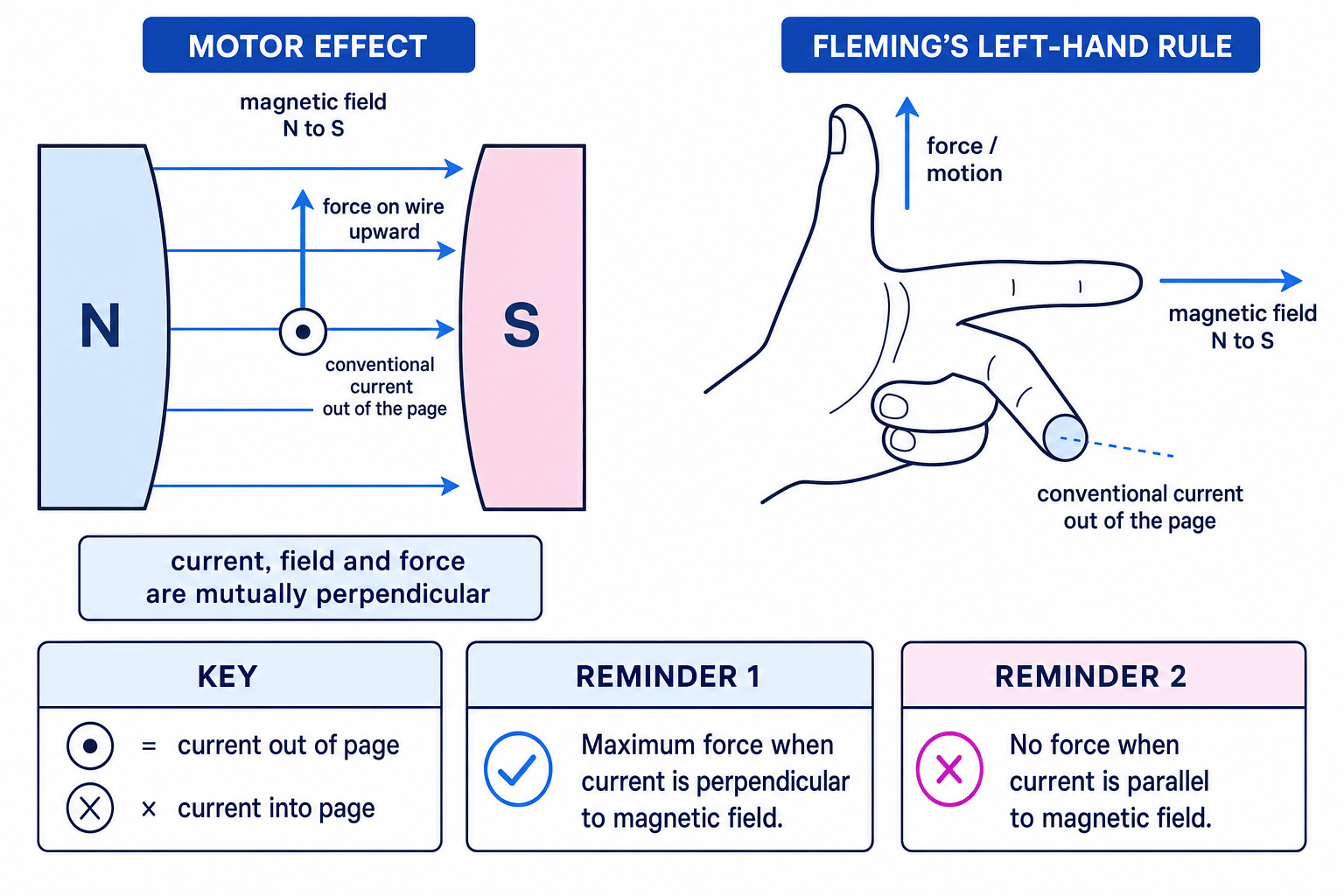
Fleming’s left-hand rule
Use Fleming’s left-hand rule to predict the direction of the force when a wire carries a current perpendicular to a magnetic field.
Hold your left hand so that the thumb, first finger and second finger are all at right angles:
- First finger: magnetic field, from north to south
- Second finger: conventional current, from positive to negative
- Thumb: force or motion
Using the left-hand rule
A wire is between a north pole on the left and a south pole on the right. The current comes out of the page. Find the force direction.
- Point your first finger from north to south, so it points left to right.
- Point your second finger out of the page, matching the direction of the conventional current.
- Your thumb points upwards, so the force on the wire is upwards.
Using electron flow instead of conventional current
Fleming’s left-hand rule uses conventional current, not electron flow. If you use electron flow by mistake, your force direction will be reversed.
Changing the force on a current-carrying conductor
The force on a current-carrying conductor in a magnetic field depends on the current, the magnetic field and their directions.
For a wire at 90° to the magnetic field:
- increasing the current increases the force
- increasing the magnetic field strength increases the force
- reversing the current reverses the force
- reversing the magnetic field reverses the force
- reversing both the current and the magnetic field leaves the force in the same direction
Predicting changes to the force
A wire at 90° to a magnetic field carries a current of 2 A and experiences an upward force. The current is increased to 4 A, then the magnetic field is reversed. What happens to the force?
- The current has doubled from 2 A to 4 A, so with the same field and angle, the force becomes larger; in the same setup it doubles.
- Reversing the magnetic field reverses the direction of the force.
- The final force is twice as large as before and acts downwards.
Applications: d.c. motors and loudspeakers
A d.c. motor uses the motor effect to convert electrical energy into kinetic energy.
In a simple d.c. motor:
- a rectangular coil sits between magnetic poles
- current flows through the coil
- the two vertical sides of the coil carry current in opposite directions
- the forces on the two sides act in opposite directions, causing rotation
- a split-ring commutator reverses the current every half-turn so the coil keeps rotating in the same direction
- brushes maintain contact between the external circuit and the rotating commutator
A loudspeaker also uses the motor effect. A coil of wire is attached to a cone and placed in the field of a permanent magnet. A varying current in the coil produces a changing force. This moves the coil and cone backwards and forwards, making sound waves.
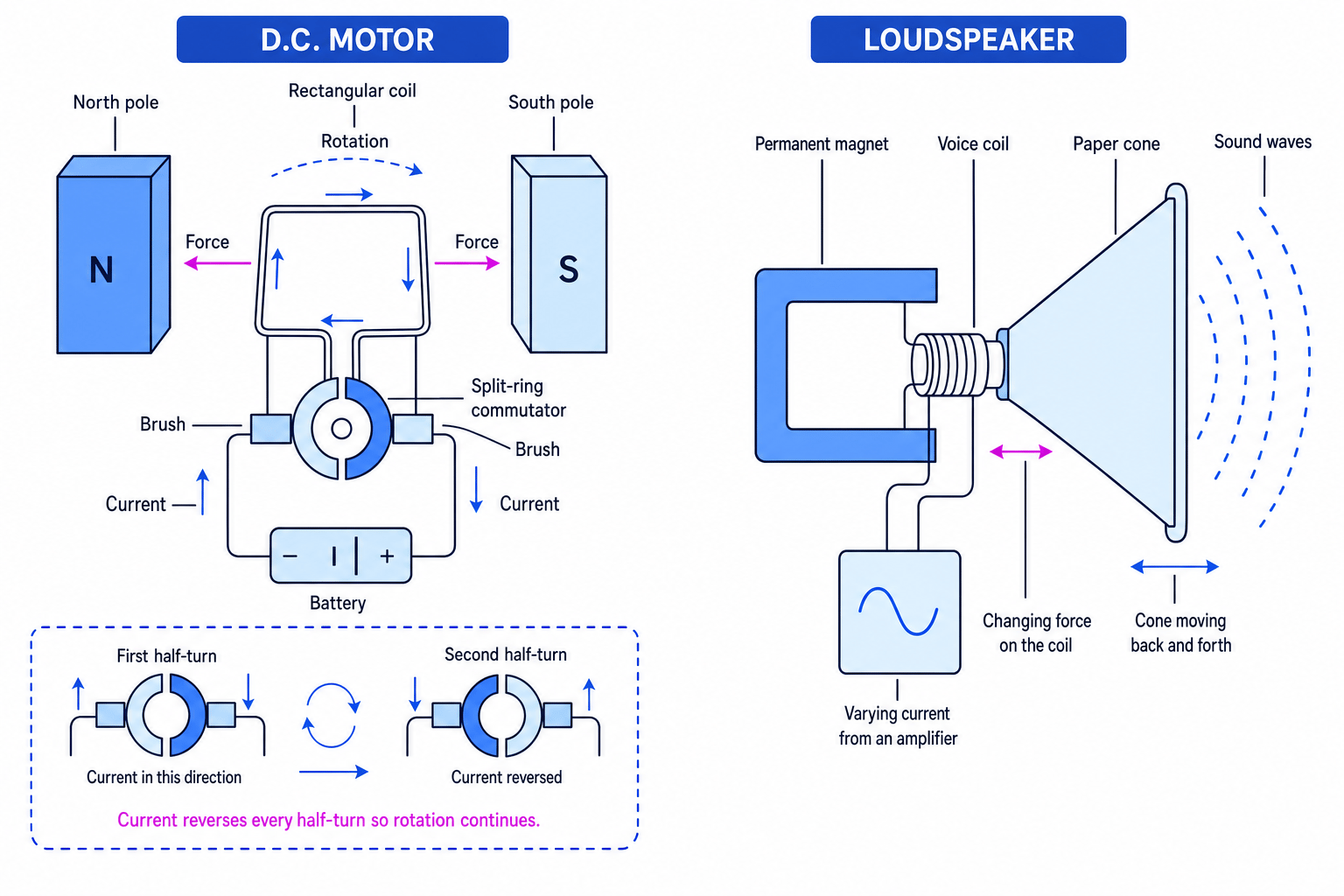
Explaining continuous rotation in a d.c. motor
Explain why the split-ring commutator is needed in a simple d.c. motor.
- The current in the two sides of the coil is in opposite directions, so the magnetic forces on those sides act in opposite directions and create a turning effect.
- After half a turn, each side of the coil has swapped position; without changing the current, the forces would tend to reverse the rotation.
- The split-ring commutator reverses the current every half-turn, so the forces continue to push the coil around in the same rotational direction.
In the exam
- For field-pattern questions, draw the correct shape first, then add arrows using the right-hand grip rule or the north-to-south field direction.
- For motor-effect direction questions, always use the left hand and conventional current.
- For “what happens if…” questions, decide separately whether the change affects force size, force direction, or both.
Check yourself
- What is the magnetic field pattern around a straight current-carrying wire?
- Why does a solenoid behave like a bar magnet?
- In Fleming’s left-hand rule, what do the thumb, first finger and second finger represent?

