

What you'll learn
- When a voltage is induced in a conductor or coil.
- What affects the size and direction of the induced voltage.
- How generators produce alternating voltage.
- How transformers change alternating voltages and why this helps transmit electrical energy.
The starting ideas
A conductor is a material, usually a metal, in which electric charges can move. A coil is a wire wound into loops. A magnetic field is a region where a magnetic material, or a current-carrying wire, can experience a force.
A voltage is a potential difference: it tells you how much energy is transferred per coulomb of charge. In this topic, the voltage is not supplied by a cell — it is produced by motion or by a changing magnetic field.
Electromagnetic induction
Electromagnetic induction is the production of a voltage in a conductor or coil when it moves through a magnetic field, or when the magnetic field through it changes.
Inducing a voltage
There are two main situations you need for Edexcel IGCSE:
- A conductor moves through a magnetic field.
- A magnetic field changes through a coil.
In both cases, the conductor or coil must experience a change. If everything is stationary and the magnetic field is steady, no voltage is induced.
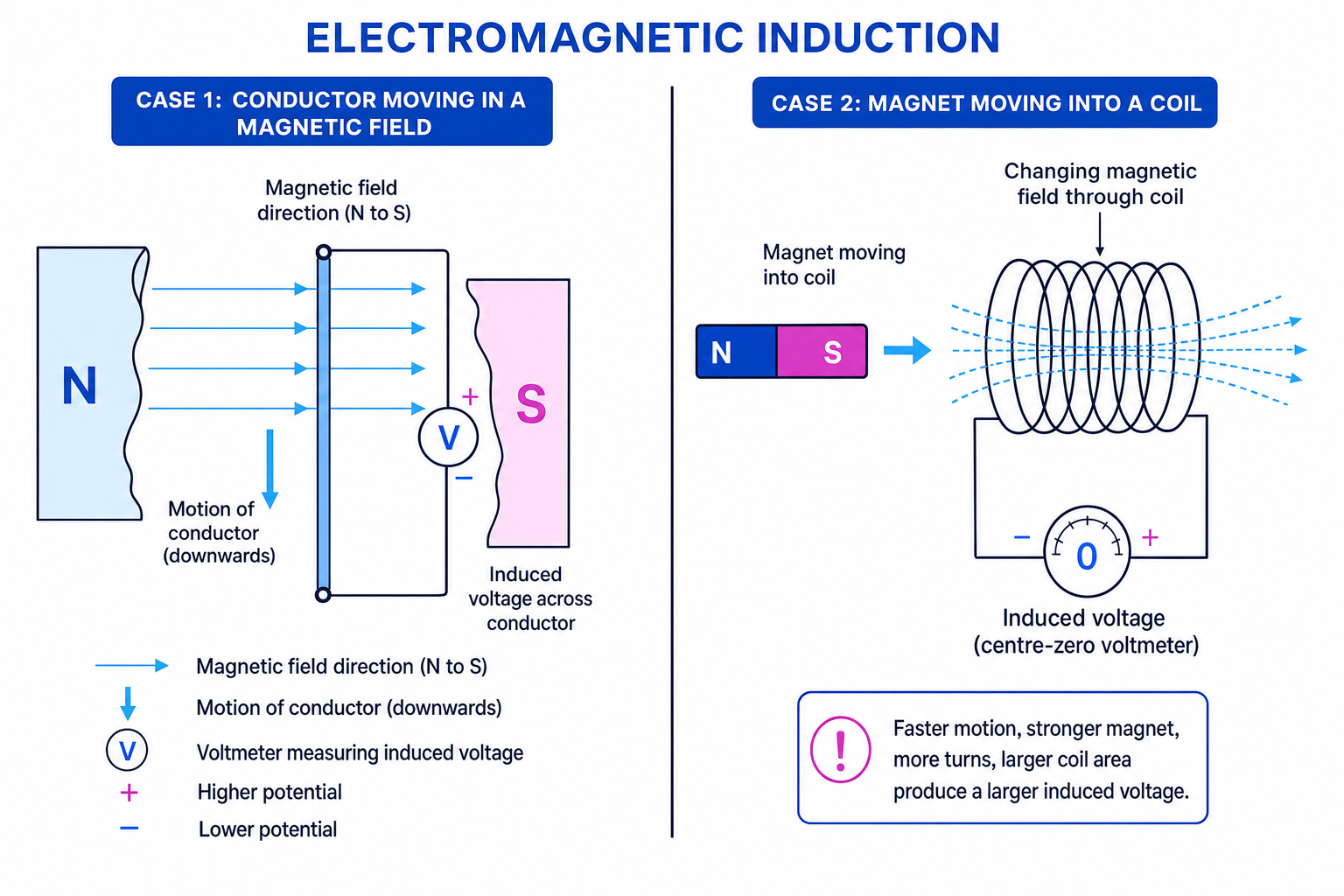
A centre-zero voltmeter has zero in the middle, so its needle can deflect either way. This is useful because the induced voltage can reverse direction.
What affects the size of the induced voltage?
The induced voltage is larger when the magnetic field changes more quickly or more strongly. You can increase it by:
- moving the conductor, magnet, or coil faster
- using a stronger magnet
- using more turns on the coil
- using a coil with a larger area
- making the wire cut across the magnetic field lines more directly
Bigger change, bigger induced voltage
A larger induced voltage is produced when there is a faster or larger change in the magnetic field through the conductor or coil.
Voltage first, current only if the circuit is complete
Induction always produces an induced voltage. An induced current flows only if there is a complete circuit for the charges to move around.
Predicting an induced voltage
A magnet is pushed into coil A slowly. The same magnet is pushed into coil B faster, and coil B has twice as many turns. Compare the induced voltages.
-
The magnet moves relative to each coil, so the magnetic field through each coil changes. Therefore, a voltage is induced in both coils.
-
Coil B has more turns, so the induced voltages from the individual loops add up to a larger total voltage.
-
The magnet is also moved faster into coil B, so the magnetic field through the coil changes more quickly. Both factors make the induced voltage in coil B larger than in coil A.
Direction of the induced voltage
The direction of the induced voltage depends on the direction of the motion and the direction of the magnetic field.
If you reverse the motion, the induced voltage reverses. If you reverse the magnetic field, the induced voltage also reverses. If you reverse both, the induced voltage direction stays the same as before.
Sanity check for direction
If a centre-zero voltmeter deflects one way when a magnet is pushed into a coil, it will deflect the opposite way when the magnet is pulled out in the same orientation.
Generating electricity
A generator transfers kinetic energy into electrical energy using electromagnetic induction.
There are two generator arrangements you should be able to describe:
- rotating a magnet inside a coil of wire
- rotating a coil of wire inside a magnetic field
In both arrangements, the magnetic field through the coil changes continuously as something rotates. This induces a voltage. If the coil is part of a complete circuit, an induced current flows.
An alternating voltage is a voltage that repeatedly changes direction. The output from a simple generator is alternating because each half-turn reverses the way the coil cuts through the magnetic field.
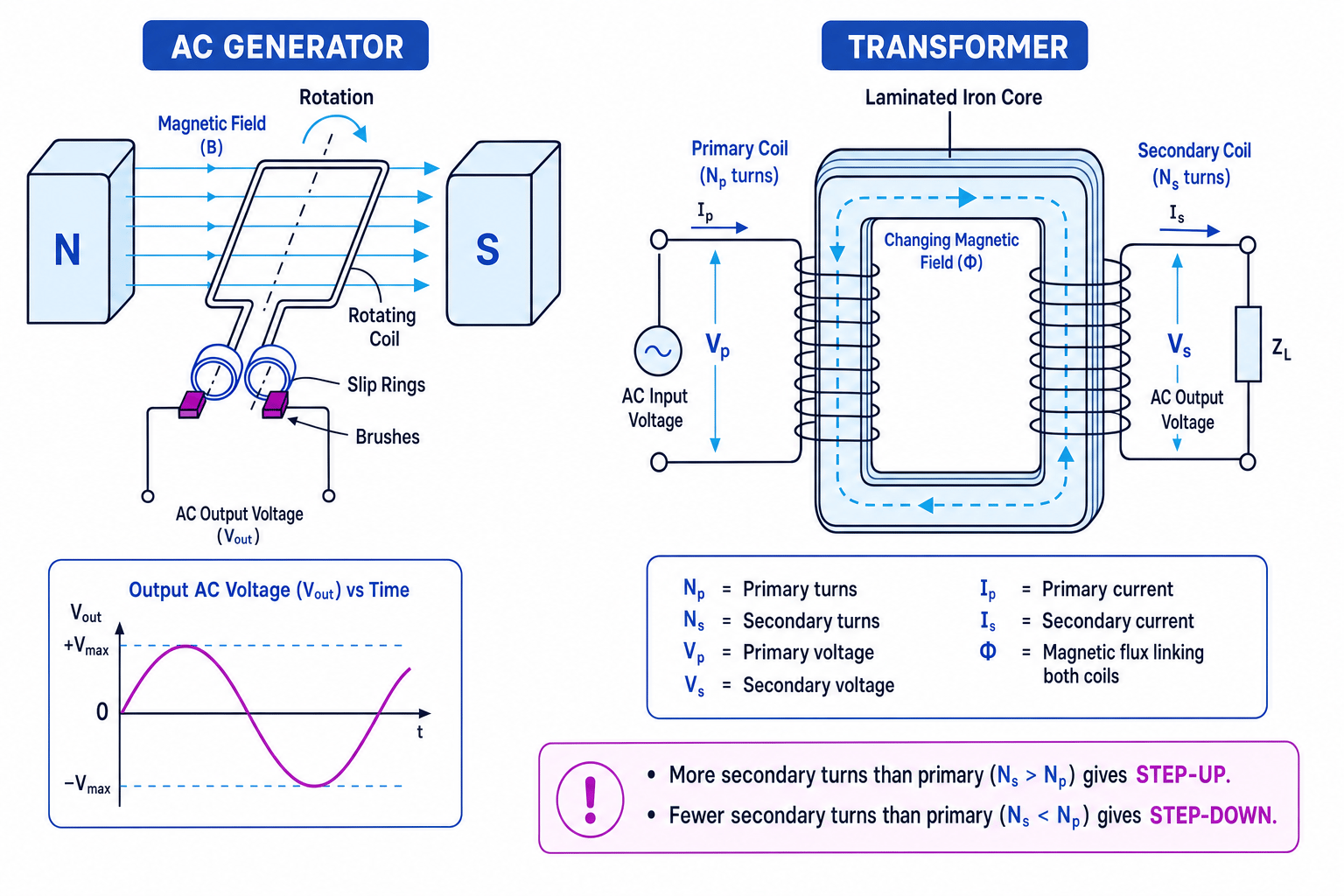
In a rotating-coil generator, slip rings are rotating contacts connected to the coil. Brushes are fixed contacts that press on the slip rings and connect the generator to the external circuit.
The size of the generated voltage is increased by using a stronger magnetic field, rotating faster, increasing the number of turns on the coil, or using a coil with a larger area.
Explaining an alternating generator output
A coil rotates in a magnetic field and is connected to an external circuit by slip rings and brushes. Explain why the output is alternating.
-
During one half-turn, the sides of the coil cut through the magnetic field in one direction, so a voltage is induced with one polarity.
-
After half a turn, each side of the coil is moving through the magnetic field in the opposite direction, so the induced voltage reverses polarity.
-
This reversal happens every half-turn, so the output voltage repeatedly changes direction: it is an alternating voltage.
Transformers
The transformer material in this section is Paper 2 only, but the story is quite logical.
Transformer
A transformer is a device that changes the size of an alternating voltage using two coils with different numbers of turns linked by an iron core.
A transformer has:
- a primary coil, which is connected to the input voltage
- a secondary coil, which provides the output voltage
- an iron core, which links the changing magnetic field through both coils
A turn means one loop of wire around the core.
An alternating current in the primary coil produces a changing magnetic field in the core. This changing magnetic field passes through the secondary coil and induces an alternating voltage in it.
- A step-up transformer has more turns on the secondary coil than on the primary coil, so it increases voltage.
- A step-down transformer has fewer turns on the secondary coil than on the primary coil, so it decreases voltage.
Transformers need alternating voltage
A transformer does not work properly with a steady direct voltage because the magnetic field would not keep changing. No continuous changing magnetic field means no continuous induced voltage in the secondary coil.
Transformer turns ratio
For a transformer, the voltage ratio equals the turns ratio.
In words:
input (primary) voltage divided by output (secondary) voltage = primary turns divided by secondary turns
In symbols:
input (primary) voltageoutput (secondary) voltage=primary turnssecondary turns\frac{\text{input (primary) voltage}}{\text{output (secondary) voltage}} = \frac{\text{primary turns}}{\text{secondary turns}}output (secondary) voltageinput (primary) voltage=secondary turnsprimary turnsUsing standard symbols:
VpVs=NpNs\frac{V_p}{V_s} = \frac{N_p}{N_s}VsVp=NsNpwhere VpV_pVp is the primary voltage, VsV_sVs is the secondary voltage, NpN_pNp is the number of primary turns, and NsN_sNs is the number of secondary turns.
Using a transformer turns ratio
A transformer has 500 turns on the primary coil and 2500 turns on the secondary coil. The primary voltage is 230 V. Calculate the secondary voltage.
-
Choose the transformer ratio equation:
VpVs=NpNs\frac{V_p}{V_s} = \frac{N_p}{N_s}VsVp=NsNp -
Rearrange to make VsV_sVs the subject:
Vs=VpNsNpV_s = \frac{V_p N_s}{N_p}Vs=NpVpNs -
Substitute the values, remembering that turns have no unit:
Vs=230 V×2500500=1150 VV_s = \frac{230\ \text{V} \times 2500}{500} = 1150\ \text{V}Vs=500230 V×2500=1150 V -
Since the secondary has more turns than the primary, this is a step-up transformer, which matches the larger output voltage.
Transformers in energy transmission
Power stations generate electrical energy using generators. For large-scale transmission, the voltage is stepped up before electricity travels through long cables.
The reason is that, for the same power transfer, a higher voltage means a lower current. Lower current means less heating in the transmission cables, so less energy is wasted to the surroundings.
Near homes, schools, and businesses, step-down transformers reduce the voltage to a safer, more useful value.
Why step up for the National Grid?
Step-up transformers increase voltage and reduce current for transmission, reducing energy wasted by heating in cables. Step-down transformers then reduce the voltage for consumers.
For an ideal transformer with 100% efficiency:
In words:
input power = output power
In symbols:
VpIp=VsIsV_p I_p = V_s I_sVpIp=VsIswhere IpI_pIp is the primary current and IsI_sIs is the secondary current.
The 100% efficiency assumption
The equation VpIp=VsIsV_p I_p = V_s I_sVpIp=VsIs is for a transformer with 100% efficiency. Real transformers waste some energy as heat and sound, so exam questions will normally say if you should assume 100% efficiency.
Finding current after a step-up transformer
An ideal transformer steps up the voltage from 2.5×10⁴ V2.5 \times 10^4\ \text{V}2.5×10⁴ V to 4.0×10⁵ V4.0 \times 10^5\ \text{V}4.0×10⁵ V. The primary current is 800 A. Calculate the secondary current.
-
Use the 100% efficiency relationship:
VpIp=VsIsV_p I_p = V_s I_sVpIp=VsIs -
Rearrange to make IsI_sIs the subject:
Is=VpIpVsI_s = \frac{V_p I_p}{V_s}Is=VsVpIp -
Substitute the values with units:
Is=2.5×104 V×800 A4.0×105 V=50 AI_s = \frac{2.5 \times 10^4\ \text{V} \times 800\ \text{A}}{4.0 \times 10^5\ \text{V}} = 50\ \text{A}Is=4.0×10⁵ V2.5×104 V×800 A=50 A -
The voltage increased, so the current decreased. This is why step-up transformers are useful for long-distance transmission.
In the exam
-
For induction questions, always identify what is changing: motion through a magnetic field, or a changing magnetic field through a coil.
-
For transformer ratio questions, write VpV_pVp, VsV_sVs, NpN_pNp, and NsN_sNs next to the correct side before substituting.
-
If a transformer is described as 100% efficient, use VpIp=VsIsV_p I_p = V_s I_sVpIp=VsIs and check that a step-up in voltage gives a step-down in current.
Check yourself
-
Why is no voltage induced when a magnet is stationary inside a coil?
-
How can you increase the voltage produced by a rotating-coil generator?
-
A transformer has more turns on its secondary coil than its primary coil. Is it step-up or step-down, and what happens to the current if it is 100% efficient?
