

What you'll learn
- How magnets attract, repel and interact with magnetic substances.
- What magnetic field lines represent, including their direction and spacing.
- The difference between magnetically hard and soft materials.
- How to investigate field patterns around one or two bar magnets, and how to produce a uniform magnetic field.
Magnets, poles and magnetic substances
A magnet is an object that produces a magnetic field. A permanent magnet keeps its magnetism without needing electricity or another magnet nearby.
Every magnet has two poles:
- a north pole, often labelled N
- a south pole, often labelled S
The basic interaction rules are:
- like poles repel: N repels N, and S repels S
- unlike poles attract: N attracts S
- magnets also attract magnetic substances
Magnetic substance
A magnetic substance is a material that is attracted by a magnet and can become magnetised. For IGCSE, the key examples are iron, steel, nickel and cobalt.
Repulsion is the strongest test
Attraction does not prove that an object is a magnet, because an unmagnetised piece of iron can be attracted. Repulsion is the only reliable test for a magnet, because it only happens between two like magnetic poles.
Thinking all metals are magnetic
Not all metals are magnetic. Iron, steel, nickel and cobalt are magnetic, but common metals such as aluminium and copper are not attracted to a magnet.
Identifying an unknown pole
A known north pole is brought near one end of an unknown bar. The two ends repel.
- Repulsion can only happen between two like magnetic poles, so the unknown bar must be magnetised.
- The known pole is N, and it is repelled by the unknown end.
- Therefore the unknown end must also be N. The other end of the bar must be S.
Magnetically hard and soft materials
Magnetic materials do not all behave in the same way. Some keep their magnetism easily; others lose it quickly.
Magnetically hard material
A magnetically hard material is difficult to magnetise, but once magnetised it is difficult to demagnetise. It is used for permanent magnets. Steel is a common example.
Magnetically soft material
A magnetically soft material is easy to magnetise and easy to demagnetise. It is used for temporary magnets, especially electromagnets. Soft iron is a common example.
This is not about physical hardness. A “soft” magnetic material does not mean it is bendy or weak; it means its magnetism is easy to switch on and off.
Choosing a material for an electromagnet core
An engineer needs a core for an electromagnet that becomes magnetic when current flows, but stops being magnetic when the current is switched off.
- The core must become magnetised easily, so a magnetically soft material is needed.
- The core must also lose its magnetism easily when the current stops, so steel would be a poor choice because it tends to remain magnetised.
- Soft iron is the best choice because it is easy to magnetise and demagnetise.
Magnetic fields
A magnet can exert a force without touching another object. We describe this using the idea of a magnetic field.
Magnetic field
A magnetic field is a region where a magnetic material, magnet or compass experiences a magnetic force.
A compass is useful because its small needle is a tiny magnet. The north-seeking end of the compass needle points in the direction of the magnetic field at that point.
Magnetic field lines
Magnetic field line
A magnetic field line is an imaginary line used to show the direction and shape of a magnetic field. The arrow on the line shows the direction a north pole would move or point.
Around a bar magnet, magnetic field lines go from N to S outside the magnet. Inside the magnet, the complete field pattern continues from S back to N, making closed loops.
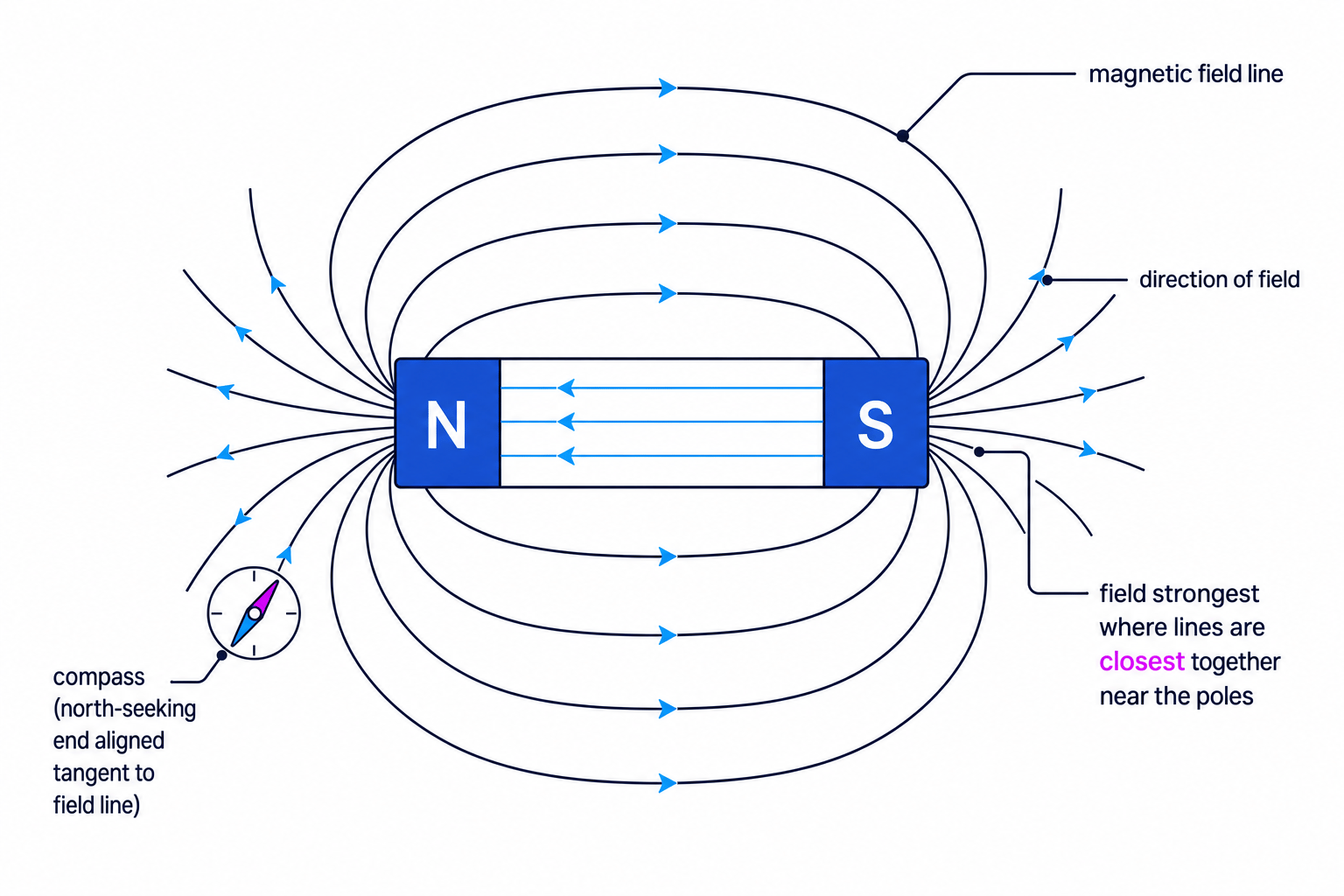
Field-line diagrams show two important things:
- direction: shown by the arrows
- strength: stronger fields are shown by lines closer together
The field is strongest near the poles, where the field lines are most crowded.
Reading field-line diagrams
If a compass is placed on a field line, the north-seeking end of the compass points along the arrow direction at that point.
Treating field lines as real wires
Field lines are not physical strings or wires. They are a model used to show the direction and strength of the magnetic field.
Induced magnetism
Some materials become magnetic when placed in a magnetic field. This is called induced magnetism.
Induced magnetism
Induced magnetism happens when a magnetic material becomes magnetised because it is placed in a magnetic field.
For example, an unmagnetised iron nail becomes a temporary magnet when it is close to a permanent magnet. The end of the nail nearest the magnet becomes the opposite pole, so it is attracted.
This explains why a magnet attracts an unmagnetised magnetic substance. The magnet induces an opposite pole in the nearby end of the substance.
Explaining attraction by induced magnetism
A north pole is brought near an unmagnetised iron nail, and the nail is attracted.
- Iron is a magnetic substance, so it can become magnetised when placed in a magnetic field.
- The end of the nail nearest the north pole becomes an induced south pole.
- Unlike poles attract, so the nail is pulled towards the magnet.
Soft magnetic materials usually lose most of their induced magnetism when the field is removed. Magnetically hard materials may keep more of it.
Field patterns between two magnets
When two magnets are near each other, their magnetic fields combine.
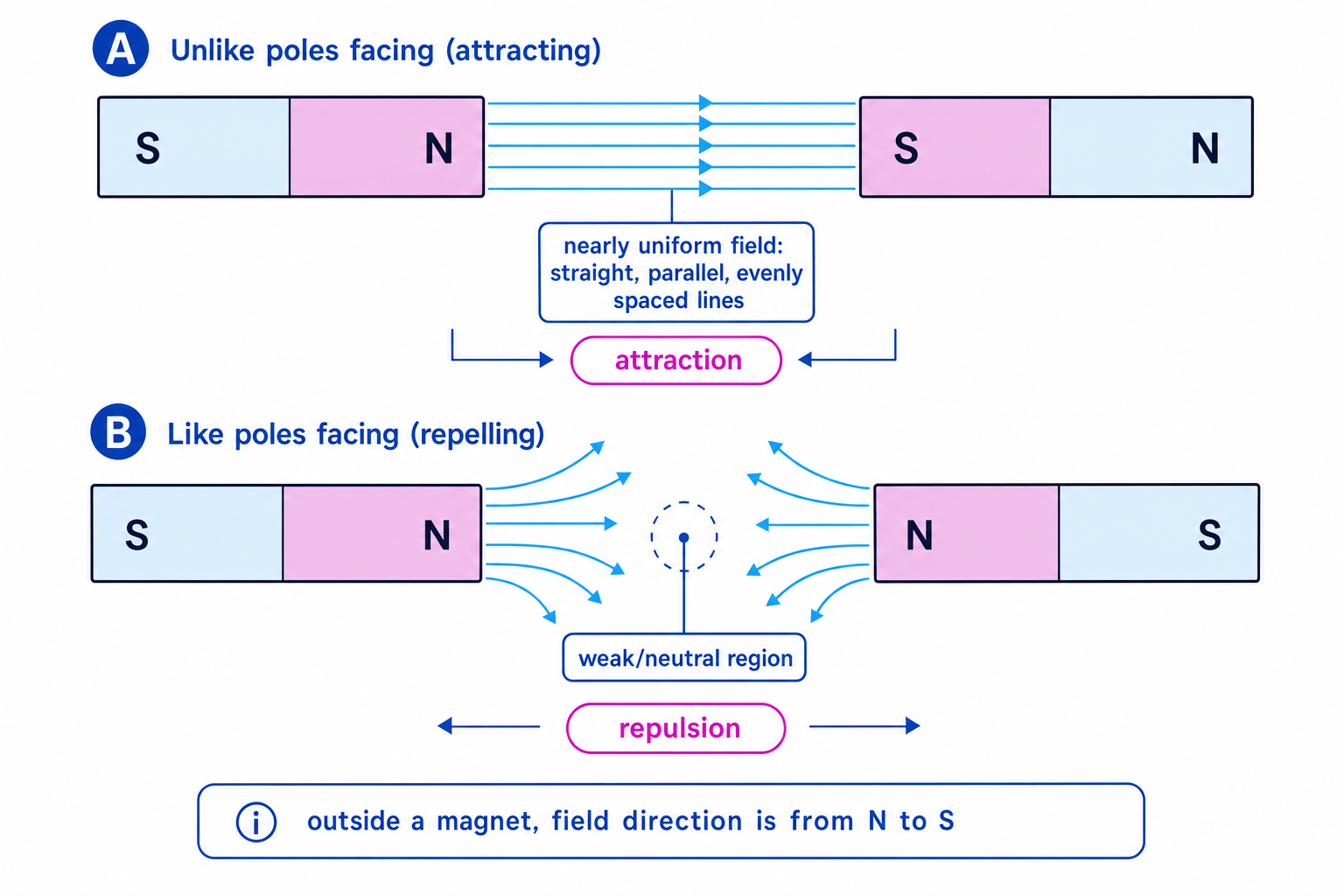
If unlike poles face each other, the field lines connect across the gap. The magnets attract. If like poles face each other, the field lines spread away from the gap. The magnets repel, and there may be a weak region between them.
Producing a uniform magnetic field
A uniform magnetic field has the same strength and direction throughout a region. On a field-line diagram, this is shown by lines that are:
- straight
- parallel
- equally spaced
- all pointing in the same direction
To produce an approximately uniform magnetic field using two permanent magnets, place unlike poles facing each other with a small gap between them. The most uniform region is in the middle of the gap, away from the edges.
Uniform field pattern
Between two flat unlike poles, the central magnetic field is shown by straight, parallel, evenly spaced lines directed from N to S.
Practical: investigating magnetic field patterns
You need to know how to investigate the field pattern for:
- one permanent bar magnet
- two bar magnets with unlike poles facing
- two bar magnets with like poles facing
Apparatus
You can use:
- one or two bar magnets
- paper or thin card
- iron filings in a shaker
- plotting compass
- pencil
- tape or Blu Tack to keep magnets fixed
- non-magnetic surface
Method using iron filings
Iron filings show the shape of the magnetic field.
- Place a bar magnet on the bench and cover it with paper or thin card.
- Sprinkle a small amount of iron filings evenly over the paper.
- Gently tap the paper so the filings line up with the magnetic field.
- Sketch the pattern formed by the filings.
- Use a plotting compass to add arrows showing the direction of the field lines.
For two magnets, repeat the method with:
- unlike poles facing, such as N facing S
- like poles facing, such as N facing N
Keep the distance between the magnets fixed while you collect the pattern.
Method using a plotting compass
A plotting compass gives the direction of the magnetic field.
- Place the bar magnet on paper and draw around it.
- Put the compass near one pole.
- Mark the direction of the north-seeking end of the compass needle.
- Move the compass along that direction and mark the new direction.
- Repeat to build up a curved field line.
- Start from several different positions to map the full field pattern.
Variables and fair testing
For this practical, the result is mainly a pattern rather than a number. Still, you should control the conditions carefully.
- Independent variable: the magnet arrangement, such as one magnet, unlike poles facing, or like poles facing.
- Dependent variable: the observed field pattern, including shape, direction and spacing of field lines.
- Control variables: same magnets, same separation, same paper position, same compass, and no nearby magnetic materials.
Recording and graphing results
The usual result is a labelled field-line diagram, not a numerical graph. Your diagram should show:
- the magnets and their N/S poles
- field lines
- arrows showing direction
- closer lines near stronger regions
If a question asks for a quantitative investigation, you could measure how a compass deflection changes with distance from a magnet. Then you would plot distance from the pole on the x-axis and a measure of magnetic effect, such as compass deflection, on the y-axis. The trend should decrease as distance increases.
Using iron filings for direction
Iron filings show the shape of the field, but they do not tell you which way the field points. Use a compass to find the direction and add arrows.
Practical errors to avoid
Good experimental technique matters because magnetic fields are easily affected.
- Do not use too many iron filings, or they clump together and hide the pattern.
- Keep magnets fixed; if they move, the pattern changes.
- Keep steel objects, phones and other magnets away from the experiment.
- Tap the paper gently so the filings can rotate and line up.
- Add arrows using a compass, not guesswork.
In the exam
- Use the words like poles repel and unlike poles attract when explaining magnet interactions.
- Remember that repulsion proves magnetism, but attraction alone does not.
- In field diagrams, arrows outside a magnet go from N to S, and closer lines mean a stronger field.
- For practical questions, describe both the iron filings pattern and the plotting compass direction.
Check yourself
- Why can an unmagnetised iron nail be attracted to both the north and south pole of a magnet?
- What is the difference between a magnetically hard material and a magnetically soft material?
- How would you arrange two permanent magnets to produce an approximately uniform magnetic field?
