A vertical seismological survey probe launcher uses two identical parallel springs to shoot a cylindrical probe vertically upwards.
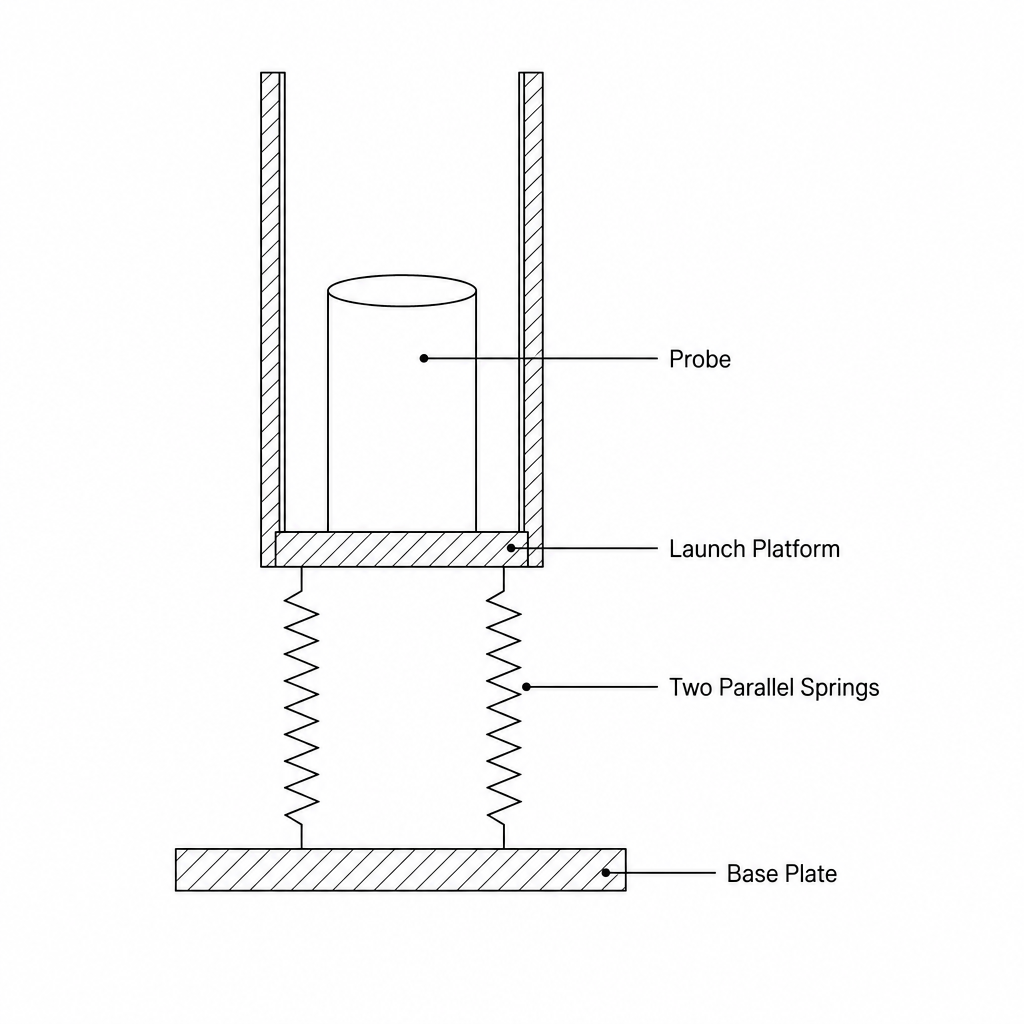
At the lowest point, the extension of each of the two springs is 0.20 m0.20\text{ m}0.20 m. The spring constant of each spring is 75 N/m75\text{ N/m}75 N/m. Calculate the total elastic potential energy stored in the two springs.
As the launcher releases the probe, the springs return to their unstretched position. The kinetic energy of the probe at the point of release is less than the total elastic potential energy stored in the springs initially. Explain why.
In a second trial, the springs are stretched to a new position:
- The total elastic potential energy stored in the two springs is 4.8 J4.8\text{ J}4.8 J.
- The mass of the probe is 0.12 kg0.12\text{ kg}0.12 kg.
- The probe reaches its maximum height.
Calculate the maximum height reached by the probe above the release point. Assume all the initial elastic potential energy is converted to gravitational potential energy when the probe is at its maximum height. Use the equation:
potential energy=mass×gravitational field strength×height\text{potential energy} = \text{mass} \times \text{gravitational field strength} \times \text{height}potential energy=mass×gravitational field strength×height
(Take the gravitational field strength g=10 N/kgg = 10\text{ N/kg}g=10 N/kg.)
A student investigates how the mass of the probe affects its launch speed at release. Describe one factor the student must control in this investigation.