A student investigates the motion of a pendulum swinging from a fixed support.
She releases the pendulum bob from various heights above its lowest position and measures the maximum height reached on the opposite side of its swing. She then calculates the ratio:
Ratio=Swing heightRelease height\text{Ratio} = \frac{\text{Swing height}}{\text{Release height}}Ratio=Release heightSwing height
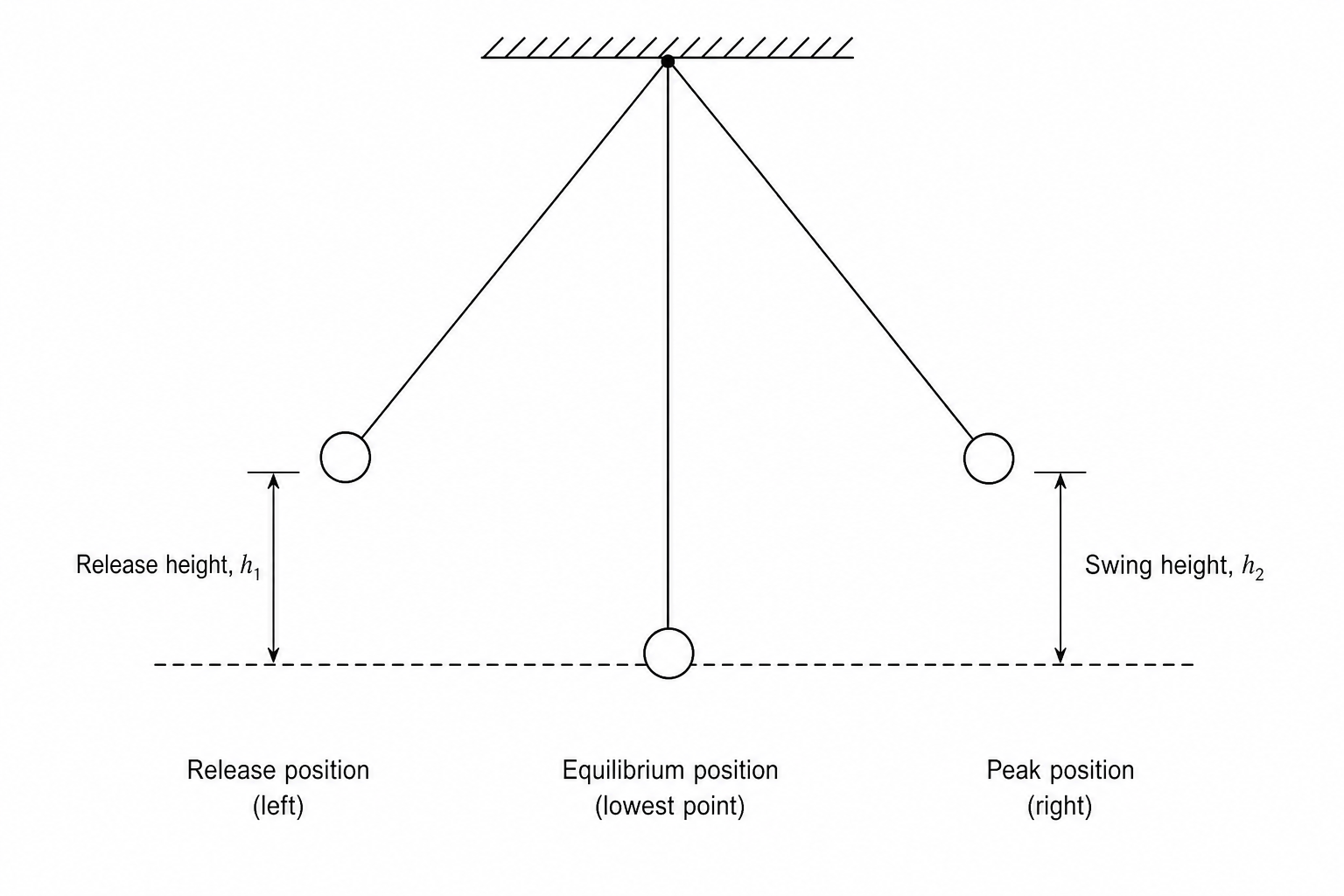
The table shows her results:
| Release height (cm) | Swing height (cm) | Swing height / Release height |
|---|---|---|
| 50 | 30 | 0.60 |
| 40 | 28 | 0.70 |
| 30 | 24 | 0.80 |
| 20 | 18 | 0.90 |
| 10 |
The student predicts that the ratio of swing height to release height will be 1.00 when the release height is 10 cm. Suggest why she made this prediction.
Use ideas about energy to explain why this prediction cannot be correct for a real pendulum.
Suggest two improvements the student could make to her experiment to obtain more accurate or reliable results.
The mass of the pendulum bob is 180 grams.
Calculate the mass of the bob in kg.
Calculate the gravitational potential energy of the bob when it is held 0.50 m above its lowest position. Use your answer to (c)(i) and the equation:
potential energy=mass×gravitational field strength×height\text{potential energy} = \text{mass} \times \text{gravitational field strength} \times \text{height}potential energy=mass×gravitational field strength×height
(Gravitational field strength = 10 N/kg10\text{ N/kg}10 N/kg)