Question 10
HA student heats a 0.20 kg metal block in boiling water until it is at 100 ∘C100\ ^{\circ}\text{C}100 ∘C.
She quickly moves the block into 0.30 kg of water at 20 ∘C20\ ^{\circ}\text{C}20 ∘C in an insulated cup, as shown in the Figure.
Figure
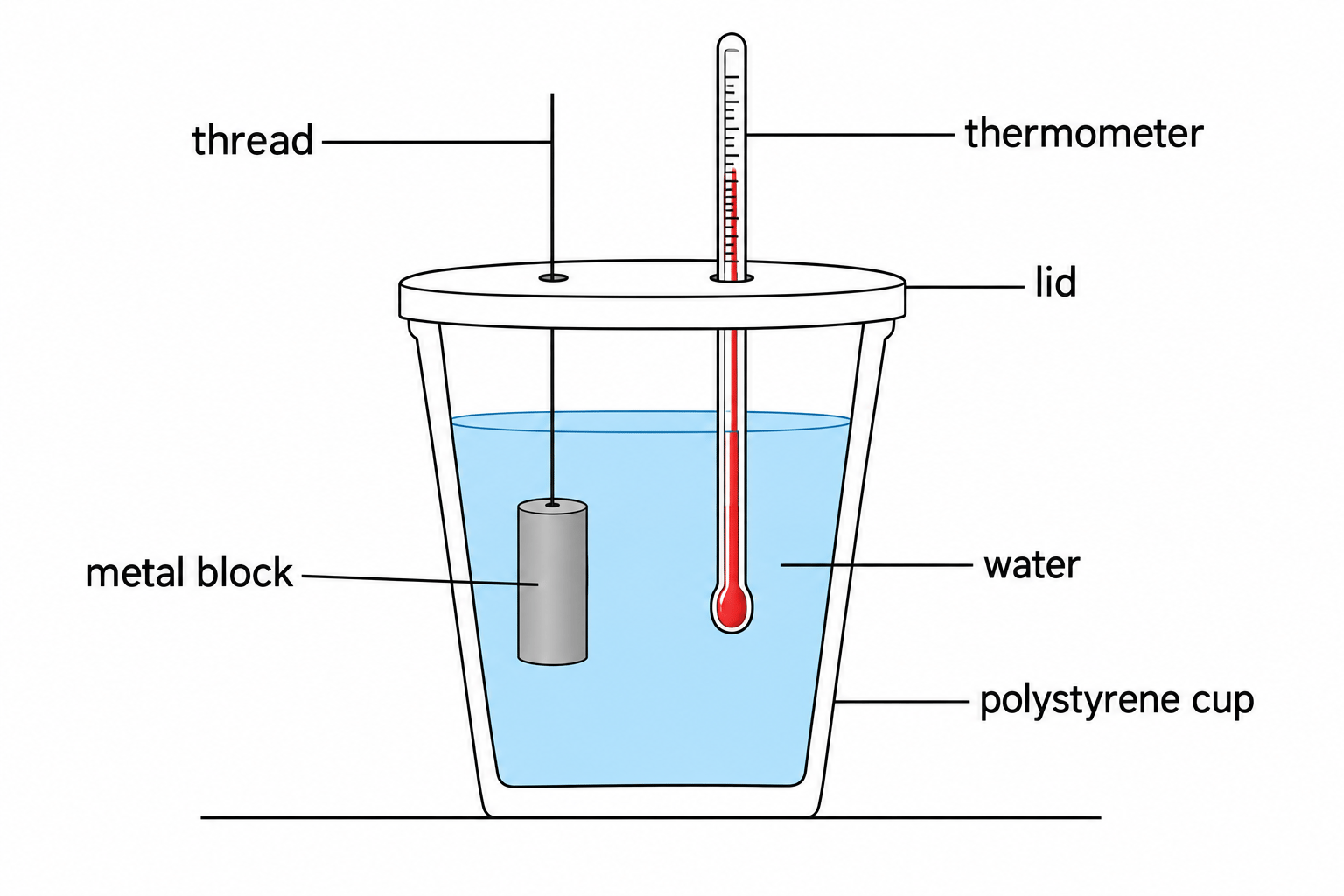
The water and the block both reach a final temperature of 25 ∘C25\ ^{\circ}\text{C}25 ∘C.
The specific heat capacity of water is 4200 J/kg ∘C4200\ \text{J/kg}\ ^{\circ}\text{C}4200 J/kg ∘C.
Use the equation: change in thermal energy=mass×specific heat capacity×change in temperature\text{change in thermal energy} = \text{mass} \times \text{specific heat capacity} \times \text{change in temperature}change in thermal energy=mass×specific heat capacity×change in temperature
a.[2]
Calculate the energy gained by the water.
b.[3]
Assume that all of the energy lost by the block is gained by the water.
Calculate the specific heat capacity of the metal.
c.[2]
In reality, some energy is transferred to the surroundings.
Explain whether the true specific heat capacity of the metal is greater or smaller than your answer to (b).
d.[1]
Suggest why the student moves the block into the cup quickly.
1.2 Changes of state Questions
44 exam-style questions on OCR GCSE Physics 1.2 Changes of state, covering 1.2.1 Conservation of mass during changes of state, 1.2.2 Physical and chemical changes, 1.2.3 Heating, temperature and changes of state, 1.2.4 Specific heat capacity and specific latent heat, 1.2.5 Internal energy and temperature change, and 1.2.6 Energy transfer during a change of state. Each one has a worked solution and a mark scheme showing where the marks go.