Question 2
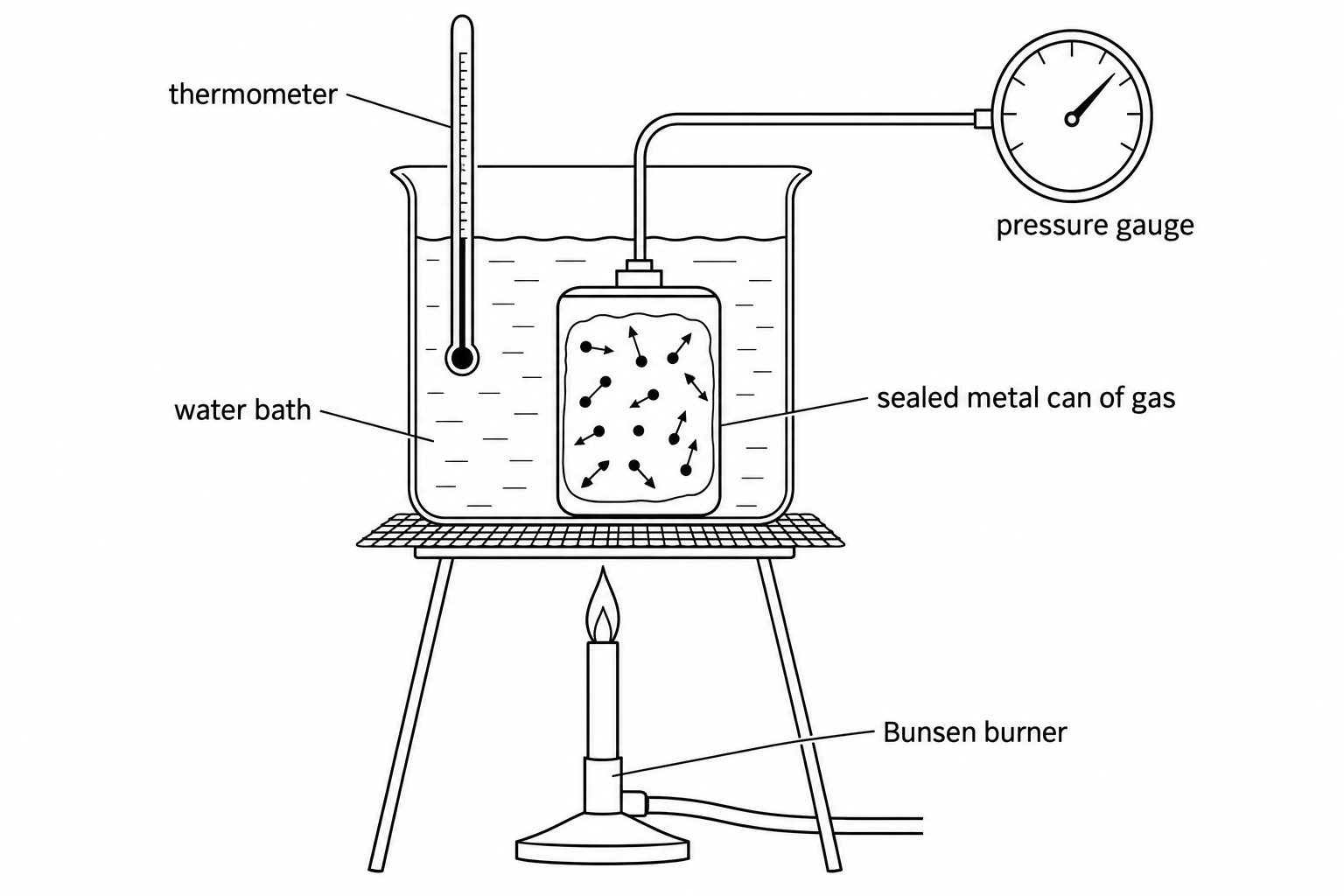
FFigure shows a sealed metal can of gas standing in a water bath. The can is connected to a pressure gauge. The volume of the can does not change.
Figure: a sealed metal can of gas standing in a water bath and connected to a pressure gauge
a.[1]
The water bath is heated from 20 ∘C20\ ^\circ\text{C}20 ∘C to 80 ∘C80\ ^\circ\text{C}80 ∘C. Write down what happens to the pressure of the gas inside the can.
b.[2]
Explain why the pressure of the gas changes in this way.
c.[1]
Give one reason why the can must stay sealed during the experiment.
3.3 Particle model and pressure Questions
40 exam-style questions on AQA GCSE Physics 3.3 Particle model and pressure, covering 3.3.1 Particle motion in gases, 3.3.2 Pressure in gases, and 3.3.3 Increasing the pressure of a gas (HT only). Each one has a worked solution and a mark scheme showing where the marks go.