Question 3
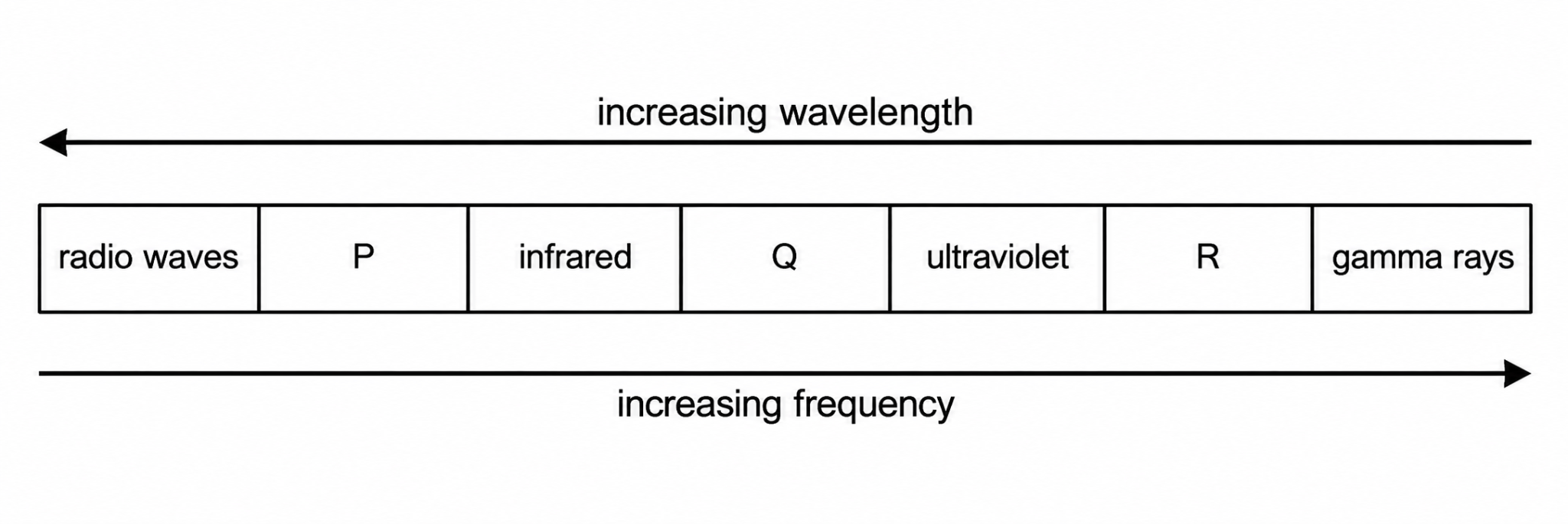
HFigure shows part of the electromagnetic spectrum. Three of the groups have been replaced by the letters P, Q and R.
Figure: Part of the electromagnetic spectrum, in order of increasing frequency
a.[2]
Write the names of the groups labelled P and R.
b.[3]
A wave in group Q has a wavelength of 5.0 × 10⁻⁷ m. Electromagnetic waves travel through a vacuum at 3.0 × 10⁸ m/s. Calculate the frequency of this wave. Use the Physics Equations Sheet.
c.[1]
A different electromagnetic wave has half the wavelength of the wave in part (b). Describe the frequency of this different wave.
6.2 Electromagnetic waves Questions
40 exam-style questions on AQA GCSE Physics 6.2 Electromagnetic waves, covering 6.2.1 Types of electromagnetic waves, 6.2.2 Properties of electromagnetic waves 1, 6.2.3 Properties of electromagnetic waves 2, 6.2.4 Uses and applications of electromagnetic waves, 6.2.5 Lenses, and 6.2.6 Visible light. Each one has a worked solution and a mark scheme showing where the marks go.