Electromagnetic waves

EasyMediumHard
12345678910111213141516171819202122232425262728
Question 24
Medium

The figure below shows how a concave lens forms an image of an object on a grid where each small square represents 1 unit of length.
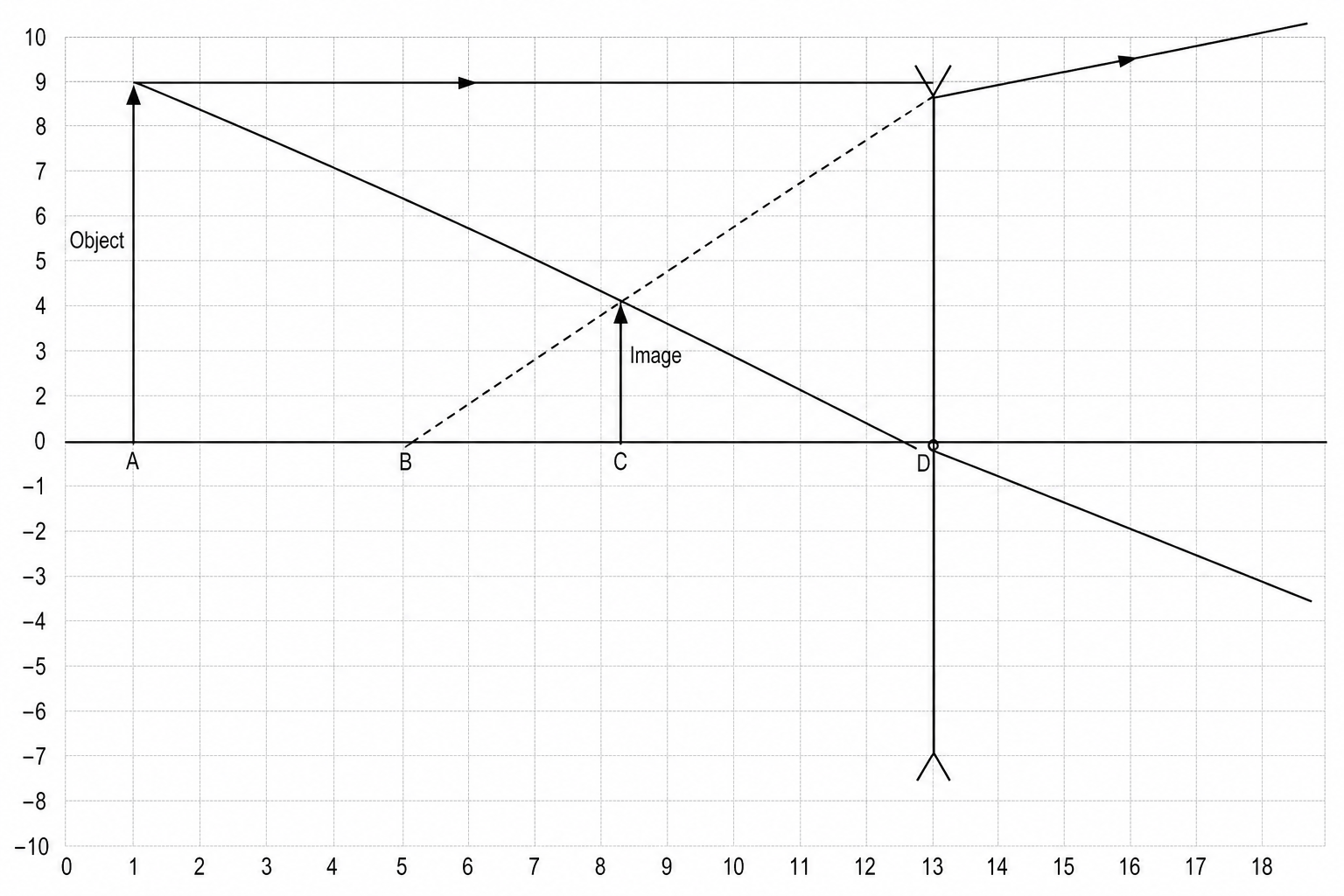
A ray diagram on a grid showing a concave lens forming an image of an object. The principal axis is a horizontal line with several labeled points: A, B, C, D. The concave lens is represented by a vertical line with inward-pointing arrow tips at each end, passing vertically through point D on the principal axis. Point A is located on the principal axis to the left of the lens, at 12 grid units from the lens. The base of an upright arrow representing the "Object" is at point A, and its height is 9 grid units. Point B is located on the principal axis at 6 grid units to the left of the lens. Point C is located on the principal axis at 4 grid units to the left of the lens. The base of a smaller, upright arrow representing the "Image" is at point C, and its height is 3 grid units. Two ray paths are drawn from the top of the object: one horizontal ray goes from the top of the object to the lens, then refracts upward and outward, with its backward dashed-line extension passing through point B. The other ray is a straight diagonal line passing from the top of the object straight through the optical center of the lens at point D. The intersection of this straight line and the dashed extension line is exactly at the top of the upright image arrow at point C.

a.

Which point on the figure marks the position of the principal focus of the lens? Choose from: A, B, C, D.

[1]
b.

Which two words describe the image?

  • Enlarged
  • Inverted
  • Real
  • Upright
  • Virtual
[2]
c.

Calculate the magnification produced by the lens. Use the equation: magnification=image heightobject height\text{magnification} = \frac{\text{image height}}{\text{object height}}magnification=object heightimage height​

[3]
d.

Complete the sentence by choosing from: decrease, increase, not change: "As the object is moved further away from the lens, the size of the image will __________."

[1]

Electromagnetic waves Questions

  1. GCSE
  2. /Physics
  3. /Electromagnetic waves