Question 14
FA student puts marble chips (calcium carbonate) and dilute hydrochloric acid in an open flask on a balance.
CaCO3+2HCl→CaCl2+H2O+CO2 \mathrm{CaCO_{3} + 2HCl \rightarrow CaCl_{2} + H_{2}O + CO_{2}} CaCO3+2HCl→CaCl2+H2O+CO2The graph shows the mass of the flask and its contents during the reaction.
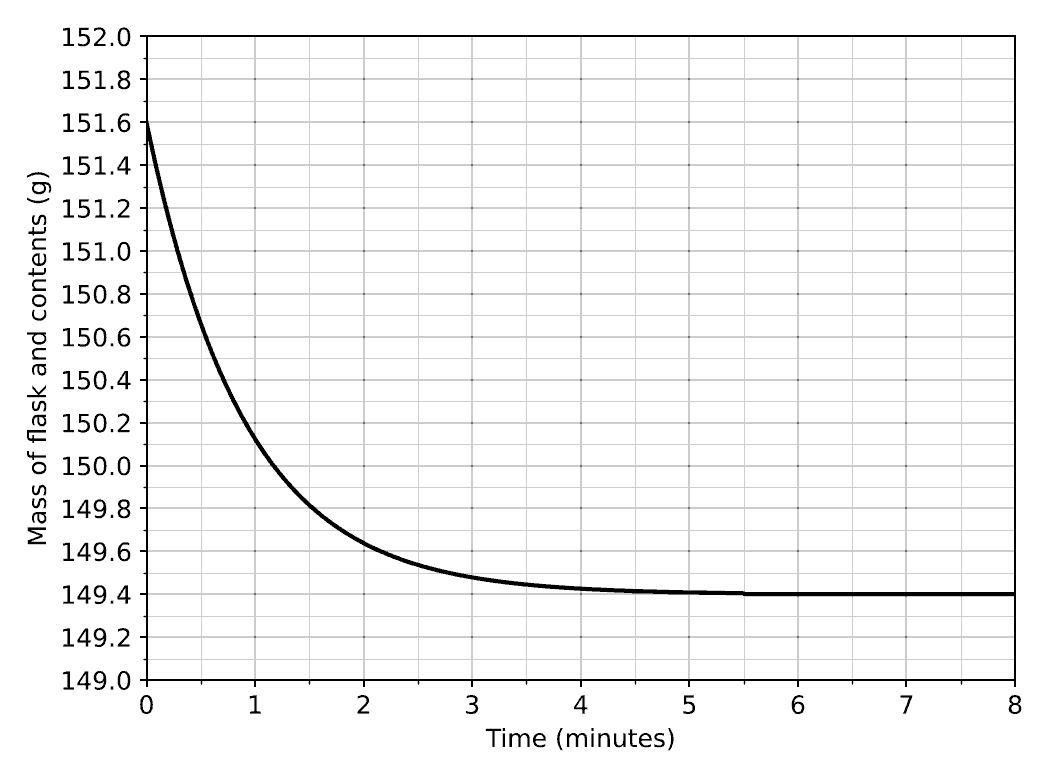
Which statement is correct?
The total mass of the products is less than the total mass of the reactants.
2.2 g of carbon dioxide escaped, and more than half of it escaped in the first minute.
2.2 g of carbon dioxide escaped, and less than half of it escaped in the first minute.
If the flask were sealed with a bung, the mass shown on the balance would fall by 2.2 g.
3.1 Introducing chemical reactions Questions
55 exam-style questions on OCR GCSE Chemistry 3.1 Introducing chemical reactions, covering 3.1.1 Writing formulae and balanced chemical equations, 3.1.2 Formulae of compounds from ions, and state symbols, 3.1.3 Conservation of mass and observed changes in mass, 3.1.4 Half equations and balanced ionic equations, 3.1.5 The mole and the Avogadro constant, and 3.1.6 Stoichiometry, limiting reactants and reacting masses. Each one has a worked solution and a mark scheme showing where the marks go.