Question 1
FCopper carbonate decomposes when it is heated. Copper oxide and carbon dioxide are made.
CuCO3→CuO+CO2 \mathrm{CuCO_{3} \rightarrow CuO + CO_{2}} CuCO3→CuO+CO2Relative atomic mass (Ar): C = 12.0, Cu = 63.5, O = 16.0
a.[1]
Calculate the relative formula mass (Mᵣ) of copper carbonate, CuCO₃.
b.[3]
A student heats 6.18 g of copper carbonate.
Calculate the mass of copper oxide, CuO, the student should make.
Give your answer to 3 significant figures.
Mass of copper oxide = ...... g
c.i.[1]
The student then heats 4.94 g of copper carbonate in an open boiling tube. The student measures the mass of the solid every minute.
The graph shows the results.
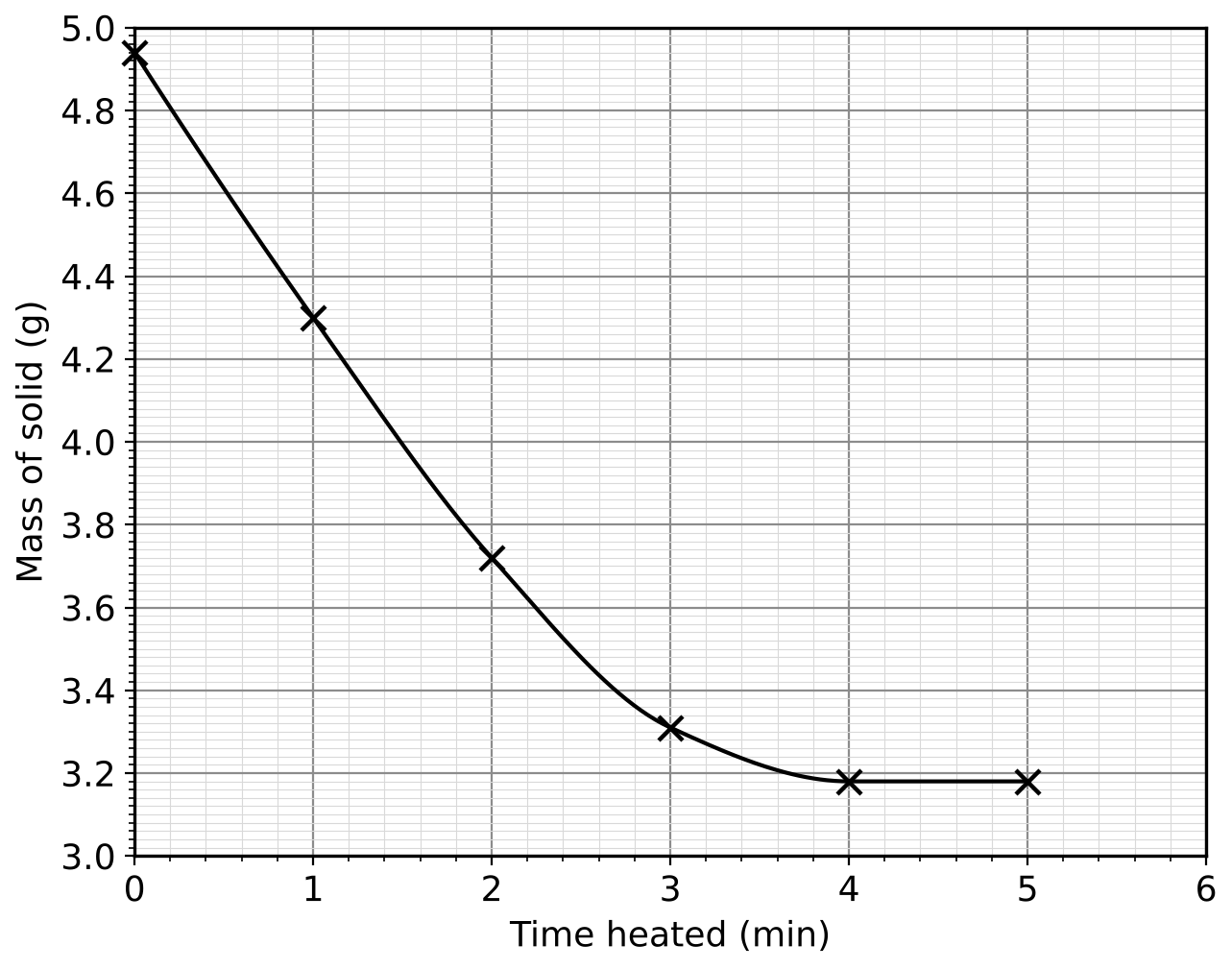
Use the graph to calculate the total mass of carbon dioxide given off.
Mass of carbon dioxide = ...... g
c.ii.[2]
Explain why the mass of the solid decreases. Use ideas about particles.
c.iii.[1]
Explain why the student keeps heating until the mass stops changing.
d.[2]
Another student heats 6.18 g of copper carbonate for only 2 minutes. The mass of solid left is 4.62 g.
The student concludes:
"The reaction made 4.62 g of copper oxide."
Evaluate this conclusion. Use your answer to (b).
3.1 Introducing chemical reactions Questions
55 exam-style questions on OCR GCSE Chemistry 3.1 Introducing chemical reactions, covering 3.1.1 Writing formulae and balanced chemical equations, 3.1.2 Formulae of compounds from ions, and state symbols, 3.1.3 Conservation of mass and observed changes in mass, 3.1.4 Half equations and balanced ionic equations, 3.1.5 The mole and the Avogadro constant, and 3.1.6 Stoichiometry, limiting reactants and reacting masses. Each one has a worked solution and a mark scheme showing where the marks go.