Question 8
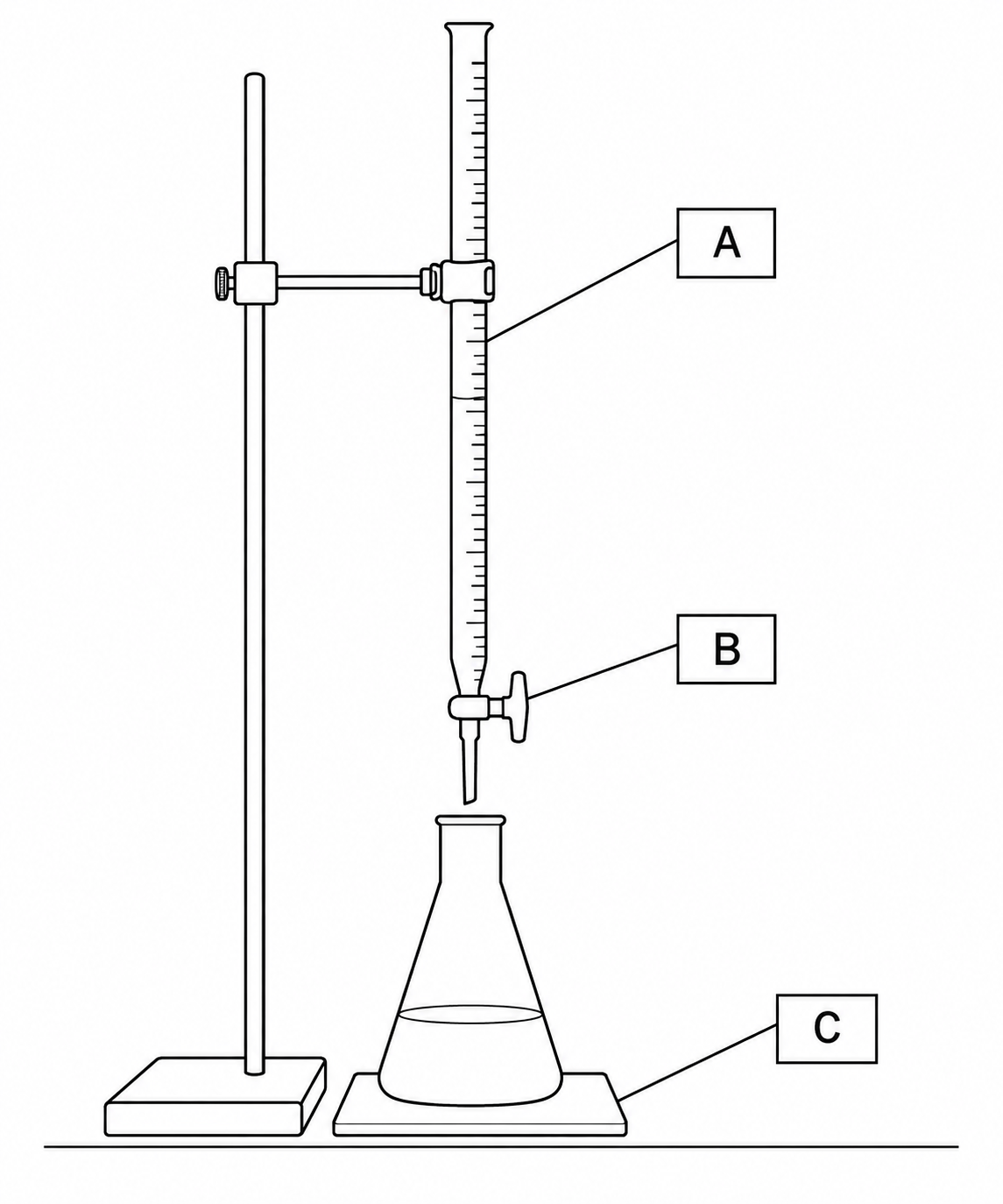
FA student carried out a titration to find the volume of dilute hydrochloric acid needed to neutralise 25.0 cm3 of sodium hydroxide solution. Figure shows the apparatus the student used.
Figure: The apparatus used to titrate dilute hydrochloric acid against sodium hydroxide solution
a.[1]
Name the piece of apparatus labelled A in Figure.
b.[1]
Give the reason for standing the conical flask on the white tile labelled C.
c.[1]
Name the piece of apparatus that should be used to measure the 25.0 cm3 of sodium hydroxide solution into the conical flask.
d.[1]
A few drops of an indicator are added to the sodium hydroxide solution in the conical flask. Give one reason why universal indicator should not be used as this indicator.
e.[2]
Explain why the student should repeat the titration.
4.2 Reactions of acids Questions
40 exam-style questions on AQA GCSE Chemistry 4.2 Reactions of acids, covering 4.2.1a Reactions of acids with metals, 4.2.1b Redox in acid-metal reactions, 4.2.2 Neutralisation of acids and salt production, 4.2.3 Soluble salts, 4.2.4 The pH scale and neutralisation, 4.2.5a Titrations, 4.2.5b Calculating quantities in titrations, and 4.2.6 Strong and weak acids. Each one has a worked solution and a mark scheme showing where the marks go.