Question 5
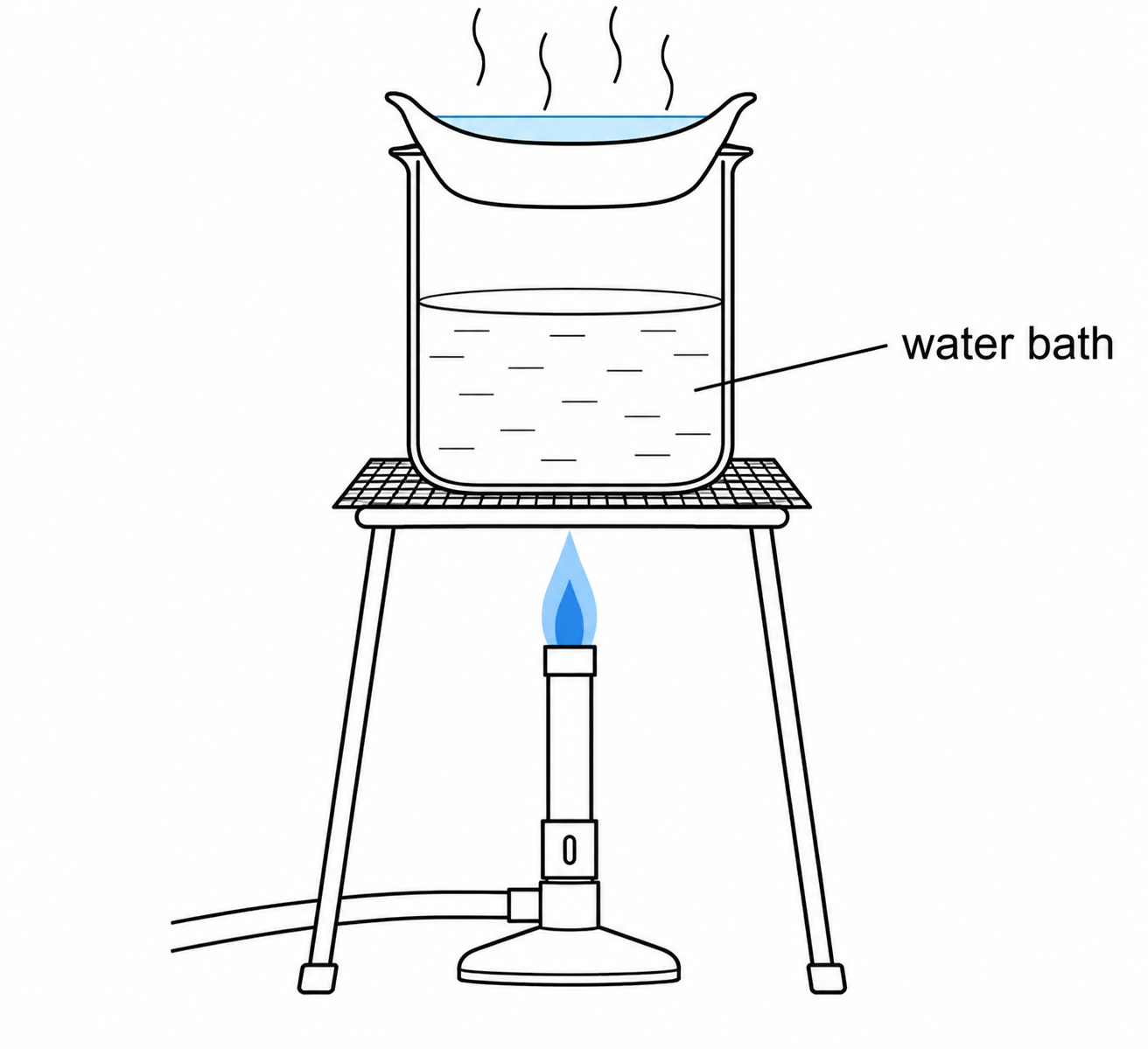
HA student prepared copper sulfate solution from copper oxide and dilute sulfuric acid. Figure shows the apparatus the student used to evaporate some of the water from the copper sulfate solution.
Figure: Apparatus used to evaporate some of the water from a solution of copper sulfate
a.[2]
Explain why the solution is heated using a water bath rather than by heating the evaporating basin directly with the Bunsen burner.
b.[1]
The student stopped heating before all of the water had evaporated. Give the reason why.
c.[2]
Describe how the student could then obtain a dry sample of the copper sulfate crystals.
d.[1]
Give one reason why the sample of crystals might not be pure.
4.2 Reactions of acids Questions
40 exam-style questions on AQA GCSE Chemistry 4.2 Reactions of acids, covering 4.2.1a Reactions of acids with metals, 4.2.1b Redox in acid-metal reactions, 4.2.2 Neutralisation of acids and salt production, 4.2.3 Soluble salts, 4.2.4 The pH scale and neutralisation, 4.2.5a Titrations, 4.2.5b Calculating quantities in titrations, and 4.2.6 Strong and weak acids. Each one has a worked solution and a mark scheme showing where the marks go.