Question 4
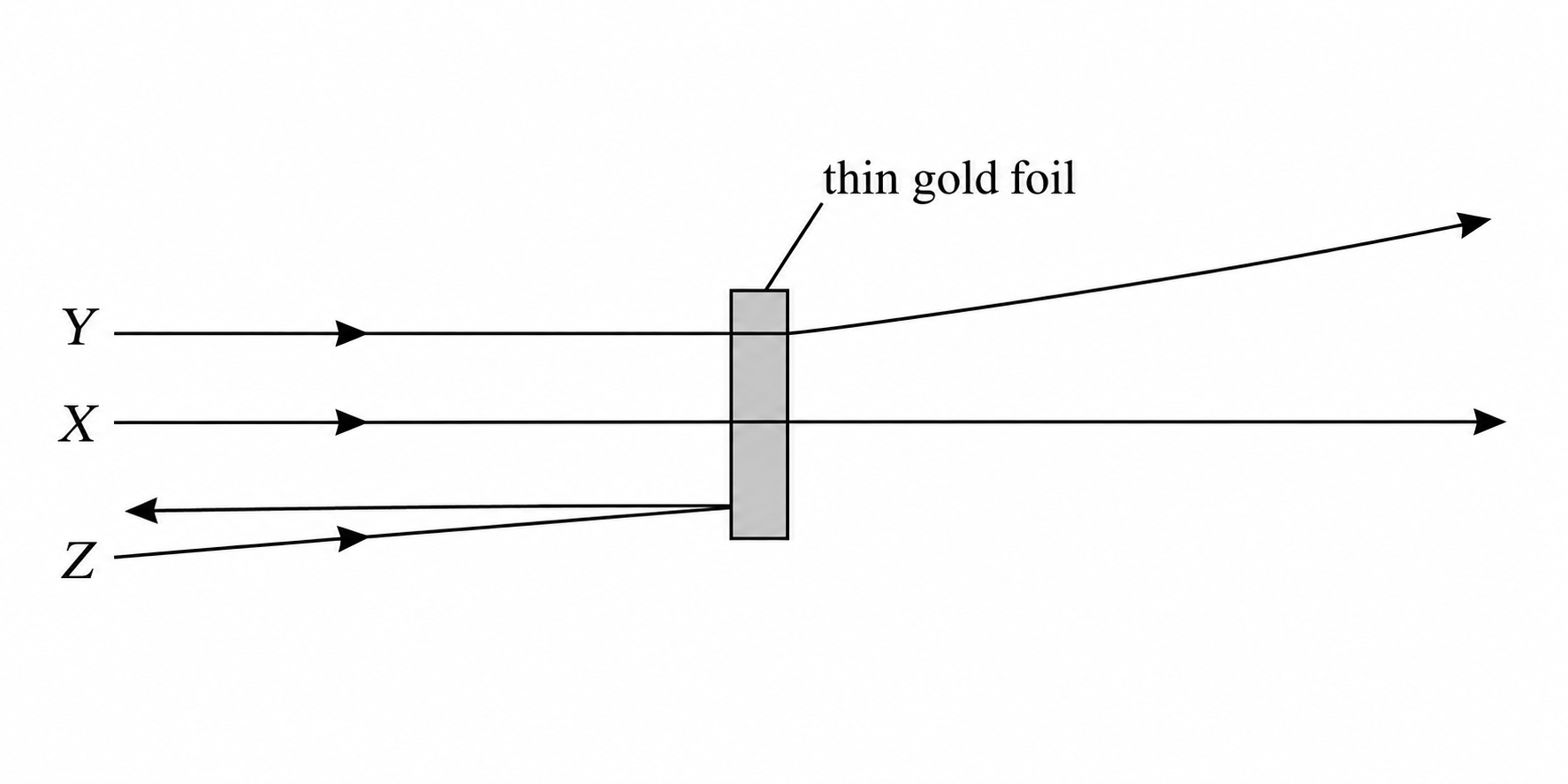
H40%Alpha particles were fired at a thin sheet of gold foil. The figure shows the paths of three of the alpha particles, X, Y and Z.
Figure: The paths of three alpha particles fired at a thin sheet of gold foil
a.[2]
Explain what the path of alpha particle X shows about the structure of an atom.
b.[2]
Explain what the path of alpha particle Z shows about the structure of an atom.
c.[1]
Name the model of the atom that was replaced because of the results of this experiment.
1.1 A simple model of the atom, symbols, relative atomic mass, electronic charge and isotopes Questions
40 exam-style questions on AQA GCSE Chemistry 1.1 A simple model of the atom, symbols, relative atomic mass, electronic charge and isotopes, covering 1.1.1a Atoms, elements and compounds, 1.1.1b Half equations and ionic equations, 1.1.2 Mixtures, 1.1.3 The development of the model of the atom (common content with physics), 1.1.4 Relative electrical charges of subatomic particles, 1.1.5 Size and mass of atoms, 1.1.6 Relative atomic mass, and 1.1.7 Electronic structure. Each one has a worked solution and a mark scheme showing where the marks go.