Question 2
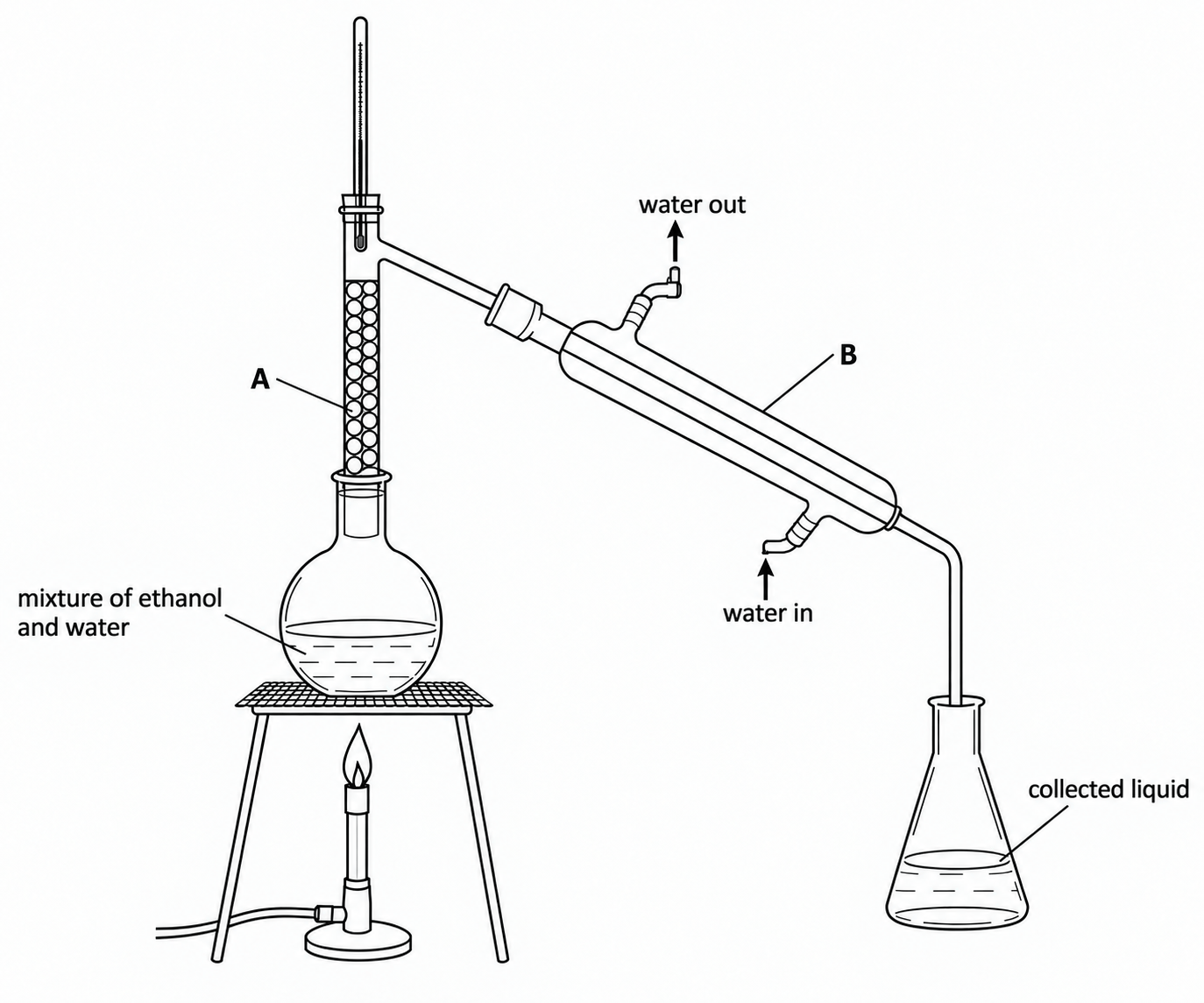
F48%A student separates a mixture of ethanol and water by fractional distillation. The figure shows the apparatus the student uses.
Figure: Apparatus used to separate a mixture of ethanol and water by fractional distillation
a.[1]
Name the piece of apparatus labelled A.
b.[2]
The boiling point of ethanol is 78 ∘C78\ ^\circ\text{C}78 ∘C. The boiling point of water is 100 ∘C100\ ^\circ\text{C}100 ∘C. Explain why ethanol is the first liquid to be collected.
c.[1]
Name the change of state that takes place inside the apparatus labelled B.
d.[1]
The student says that fractional distillation makes a new substance. Explain why the student is wrong.
1.1 A simple model of the atom, symbols, relative atomic mass, electronic charge and isotopes Questions
40 exam-style questions on AQA GCSE Chemistry 1.1 A simple model of the atom, symbols, relative atomic mass, electronic charge and isotopes, covering 1.1.1a Atoms, elements and compounds, 1.1.1b Half equations and ionic equations, 1.1.2 Mixtures, 1.1.3 The development of the model of the atom (common content with physics), 1.1.4 Relative electrical charges of subatomic particles, 1.1.5 Size and mass of atoms, 1.1.6 Relative atomic mass, and 1.1.7 Electronic structure. Each one has a worked solution and a mark scheme showing where the marks go.