What market research is for
Definition
Market research: gathering and analysing information about customers, competitors and the market so that business decisions are based on evidence.
- Before it commits money to a product, a price or a new site, a business gathers information so the decision rests on evidence rather than a hunch.
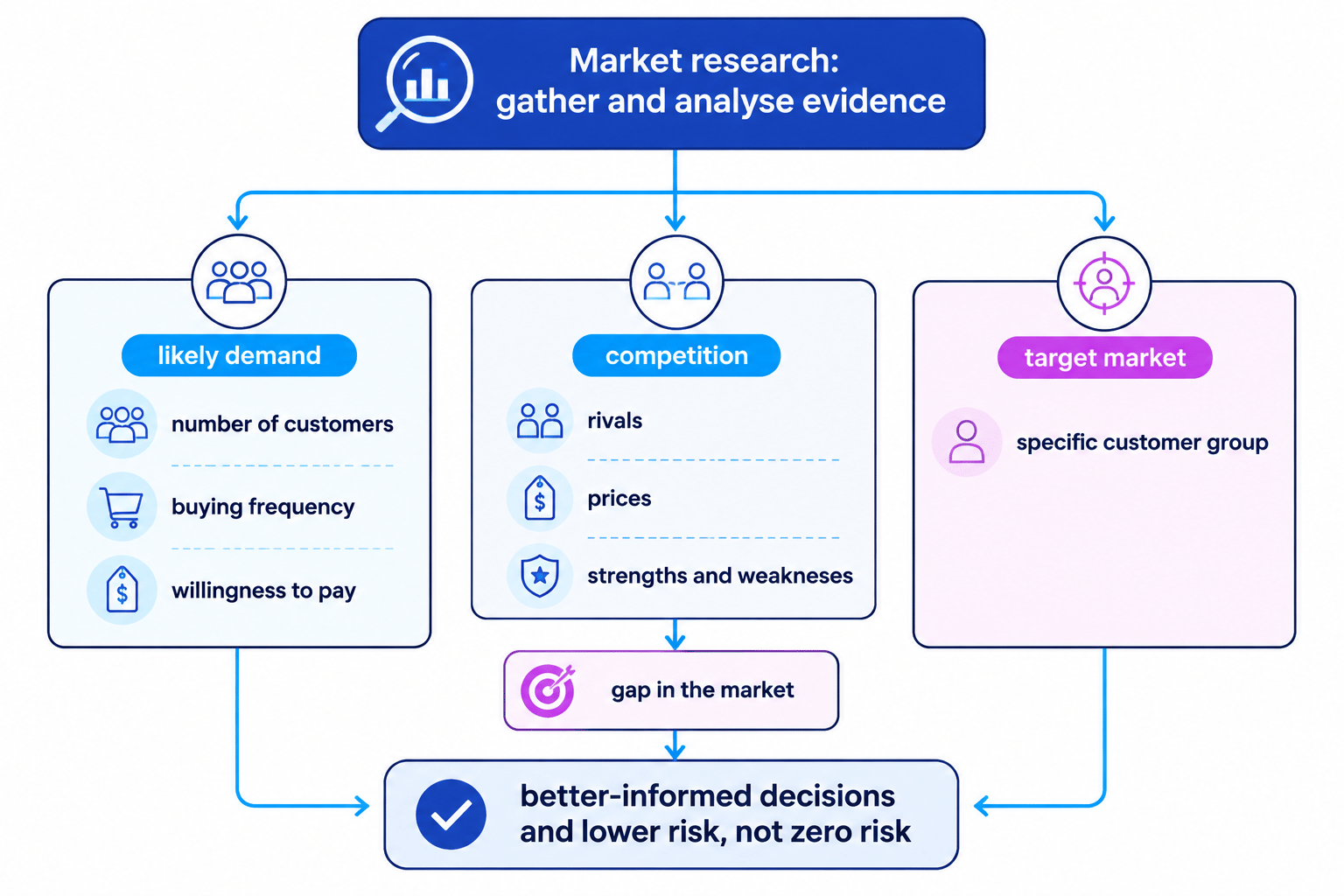
- Research is aimed at three things: how much demand there is likely to be, who the competition is, and who exactly the target market is.
Finding out likely demand
- Demand is the quantity of a product customers are willing and able to buy, and research tries to size it before the business spends anything.
- The business asks how many potential customers there are, how often they would buy and what they would be prepared to pay.
- A café owner who counts 1,800 people walking past a proposed site between 7am and 10am has evidence about demand that a hunch could never provide.
- If the answers show too few customers, the business can change the product, pick a different site or drop the idea altogether while it is still cheap to do so.
Example
Greggs tested its vegan sausage roll in a limited number of shops first, so it had evidence of real demand before putting the product into shops nationwide.
Understanding the competition
- Research also looks outwards at rivals: how many there are, what they sell, what they charge and how customers rate them.
- That shows whether there is room to enter the market at all, and what the business would have to do differently to win customers away from firms already there.
- Aldi checks rivals' shelf prices constantly, which is how it can advertise direct price comparisons against Tesco and Sainsbury's.
- Rivals' weaknesses are where the market opportunities sit, such as slow service, short opening hours or a part of the range that nobody stocks.
- Deliveroo grew out of one such opportunity, that thousands of restaurants had customers who wanted delivery and no way of delivering to them.
Note
A customer need that no competitor currently satisfies is called a gap in the market, and finding one is the clearest opportunity research can hand a business.
Identifying the target market
Definition
Target market: the specific group of customers a business aims its product and its marketing at.
- Research shows which customers actually want the product, so the business can aim at them rather than at everybody and hope.
- Knowing the target market then sets the whole marketing mix, because the product, the price, the promotion and the place all follow from who the customer is.
- Monzo found that younger customers wanted instant notifications and simple budgeting on a phone, so it built an app-only bank instead of a branch network.
Reducing risk
- Every business decision carries risk, the chance that the money, time and reputation put into it are lost.
- Research reduces that risk by finding out what customers want first, so the business is far less likely to launch something nobody wants.
- The cost of a few hundred questionnaires is tiny next to the cost of fitting out a shop that then stands empty.
- Research reduces risk without ever removing it, because a sample may not represent everyone, people do not always do what they say they will, and tastes can move after the research is finished.
Common Mistake
- Do not confuse market research, which gathers information from customers, with advertising, which sends information to them.
- Never write that research guarantees success, because a business can still be beaten by a rival or overtaken by a change in taste.
Exam technique
- A common wording is explain why this business carries out market research before launching a new product, so give the purpose and then its consequence for the business.
- Say what the research would find out, such as whether enough local customers would pay £3.50 for a coffee, rather than just naming a method.
- The mistake to avoid is describing how research is carried out when the question asks why it is carried out.
Self review
- What is market research?
- Name the three things a business collects information about.
- What is a gap in the market?
- How does research reduce the risk of a new product failing?
- Why can research never remove risk completely?