Dividing a market into segments
Definition
Market segmentation: dividing a market into groups of customers who share similar characteristics and want similar things.
Market segment: one of those groups of customers, such as men aged over 60 or households on high incomes.
Target market: the segment or segments a business chooses to aim its product and its marketing at.
- Customers in the same market want very different things, so a business splits them into groups it can serve properly instead of trying to please everybody at once.
- In the UK holiday market a family with toddlers, a student backpacker and a retired couple all buy holidays, but never the same holiday.
- Segmenting and targeting are two separate steps: the business first divides the market into groups, then chooses which group or groups to sell to.
Example
- One supermarket cereal aisle serves several segments at the same time.
- Cartoon-fronted boxes are aimed at children, so the segment is defined by age.
- Value own-brand bags and premium granola separate the same shoppers by income.
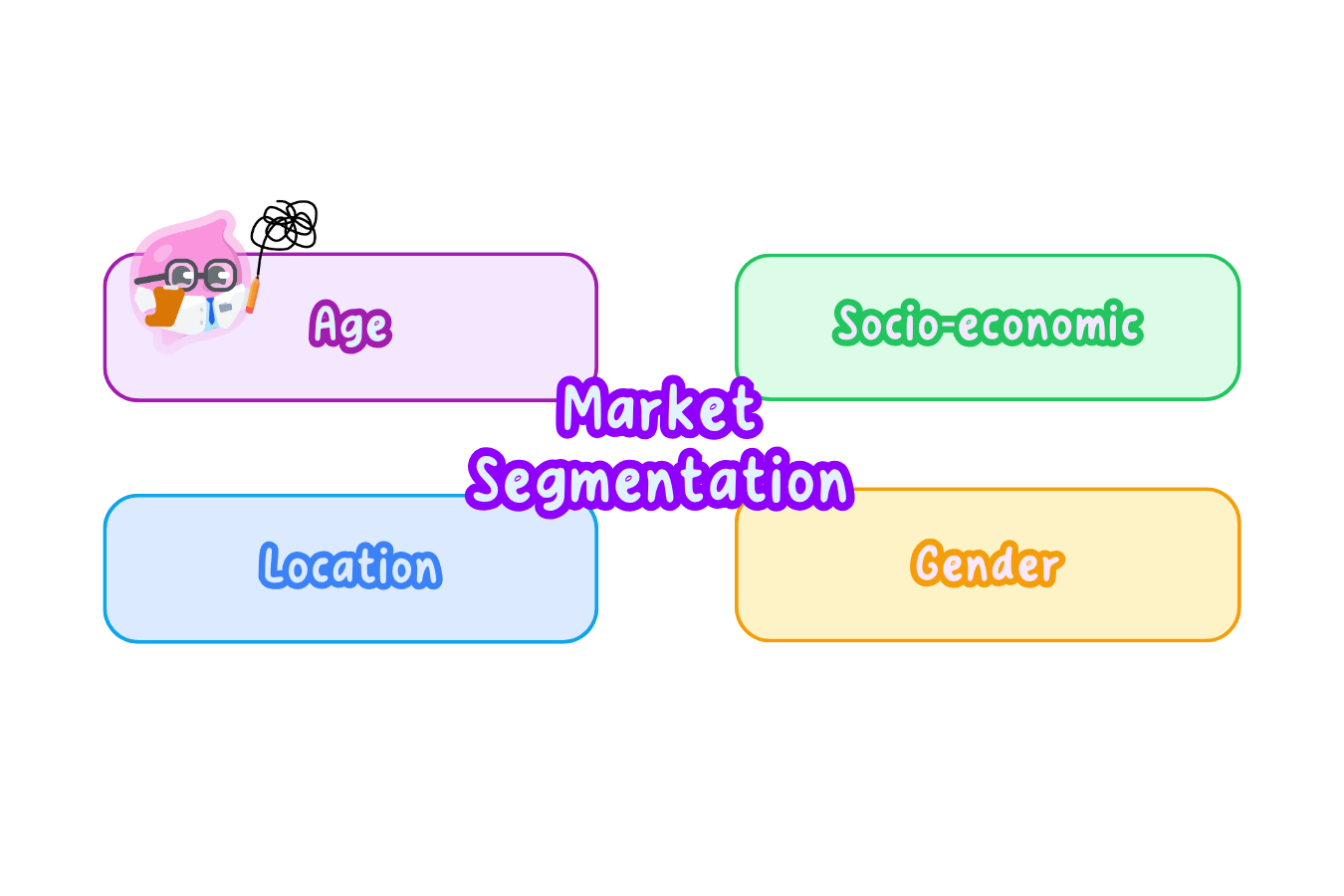
The four characteristics used to segment a market
- Four characteristics are used to divide customers up, and most businesses combine two or more of them at once, so premium walking boots sold in Lake District towns segment by income and location together.
- Gender: customers are grouped as men or women, and the product, packaging, advertising and even the price are then designed differently for each group.
- ASOS runs separate menswear and womenswear ranges with their own pages, models and adverts, and Gillette sells much the same blade technology as a Venus range for women and a Fusion range for men.
- Age: customers are grouped into bands such as children, teenagers, young adults, families and the over-60s, because what people buy changes as they get older.
- LEGO aims Duplo at pre-school children and Technic at teenagers and adults, while Saga sells holidays and insurance only to customers aged over 50 so it can build every part of the service around one age band.
- Location: customers are grouped by where they are, by country, region, city, or simply by urban and rural area, because location changes what people can get to and what they need.
- Tesco stocks small Express stores in city centres with meal deals and sandwiches for people on foot, and large Extra stores with clothing and homeware where customers arrive by car.
- Income: customers are grouped by how much they have to spend, from shoppers watching every pound to buyers who will pay a premium for something better.
- Tesco serves both ends inside one store with its Finest and its low-priced everyday ranges, while Aldi built a whole business on the budget segment and Waitrose on the opposite end of the market.
Common Mistake
- A segment is always a group of customers and never the product sold to them, so 'the luxury car segment' should be 'higher-income customers'.
- Avoid vague groups such as 'everyone' or 'people who like sport', because a segment has to be specific enough to aim a product and an advert at.
Why businesses segment
- The right product: a product designed for one group satisfies that group better than a compromise built to please everybody.
- Less wasted promotion: advertising can be placed where that group will see it, so Gymshark spends on fitness creators rather than on television adverts most of whose viewers would never buy.
- A price that fits: knowing the segment's income lets the business charge what those customers will pay, whether that is Aldi's low prices or Waitrose's higher ones.
- Higher sales and loyalty: customers who feel a product was made for them buy more often and switch to rivals less readily.
- Room for small firms: a small business can beat a large rival by serving one segment properly, which is how an independent barber holds its local customers against a national chain.
Note
Segmenting is not free, because running several ranges, price points and advertising campaigns costs more than selling one product to everyone.
Exam technique
- A common wording is identify one method of segmentation used by this business, and the answer needs the characteristic named plus the group it creates, such as 'segmenting by age, targeting the over-60s'.
- Quote the one piece of evidence that proves it, the price, the wording of the advert or the location of the store, instead of listing all four characteristics and hoping one fits.
- A full definition of segmentation has two halves: dividing the market into groups, and customers within a group sharing similar characteristics.
Self review
- What is market segmentation, and what is a market segment?
- Name the four characteristics a business can use to segment a market.
- Give one UK example of a business segmenting by income.
- How does targeting a segment cut wasted spending on promotion?
- Name two clues in a case study that show which segment a business is targeting.
