Primary research and its methods
Definition
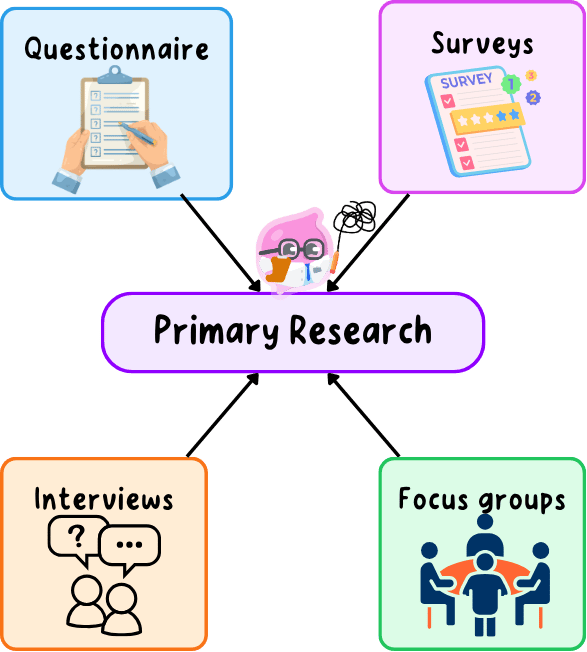
Primary research: new, first-hand information collected by a business, or by an agency working for it, to answer its own specific question. It is also called field research.
- The business either gathers the data itself or pays a market research agency to gather it, and because it is collected for one purpose it is up to date and matched to the decision being made.
- Questionnaires: a set list of written questions, on paper or online, put to a large number of people, like the short feedback form Nando's prints on its receipts. Hundreds of replies can be collected cheaply and counted, but most customers ignore them, and a tick box cannot ask why a customer answered as they did.
- Surveys: the process of putting those questions to a sample of customers face to face, by phone or online, so the answers can be added up and compared; the questionnaire is the document, the survey is the exercise. A large sample gives figures the business can act on, though customers do not always do at the till what they said they would do.
- Interviews: a one-to-one conversation in which the researcher can ask follow-up questions and push for the reason behind an answer, giving depth no tick box can. Each interview takes up an hour of staff time, so only a handful of customers are ever reached and the sample stays small.
- Focus groups: a small group of customers brought together to discuss a product or an idea, which uncovers opinions and objections the business never thought to ask about. Someone has to be paid to run the session, and one confident voice can pull the group towards a view none of them arrived with.
Example
- Before adding a new range, Greggs invites customers to taste samples and answer a short questionnaire in store.
- Both the tasting and the questionnaire are primary research, because the information is new and collected for that one decision.
Benefits and drawbacks of primary research
- Specific to the business: the questions are written to answer exactly what this business needs to know, about its own customers and its own product.
- Up to date and private: the data describes customers as they are now, and no competitor has a copy of it.
- Costly: printing, staff time, incentives for participants and agency fees all cost money that a start-up may not have.
- Slow: writing the questions, reaching a sample and analysing the replies takes weeks, so it is no help for a decision needed this week.
- Only as good as the sample: asking twenty friends, or asking shoppers only on a Tuesday morning, produces answers that do not represent the target market.
Secondary research and its sources
Definition
Secondary research: information that already exists, collected by somebody else or by the business earlier for a different purpose. It is also called desk research.
- Internet research: competitors' websites and price lists, customer reviews and published market reports can be searched in minutes and are mostly free. Anyone can publish online, so a figure with no named source behind it may be wrong or out of date.
- Printed press: newspapers, magazines and trade publications report on markets, new competitors and changing tastes, and a trade title is written by people who follow that industry closely. The articles are written for readers in general, so they may say nothing about this business's own customers.
- Government reports: population, income and spending figures published by the Office for National Statistics show how many people live in an area and what they earn, free of charge. The data is collected for the whole population rather than for this business, so it describes an area without telling you anything about your own customers or your own product, and it can be a year or more out of date by the time it is published.
- Industry reports: research firms and trade bodies publish reports on whole markets, giving sales figures and market shares that a single business could never collect for itself. Full reports are expensive, often costing hundreds of pounds, and every competitor can buy the same report, so it gives no advantage that rivals do not also have.

Example
A baker deciding whether to open in a new town can read the council's population figures, the trade press on bakery sales and rivals' menus online without leaving the office.
Benefits and drawbacks of secondary research
- Quick and cheap: the data already exists, so it can be gathered in an afternoon and much of it costs nothing at all.
- Broad: it covers whole markets and long periods, which is how a business finds the size of the market it is thinking of entering.
- Not specific to this business: it was collected to answer somebody else's question, so it may say nothing about this firm's customers or its particular product.
- No control over how it was gathered: the business cannot see how large the sample was or how the questions were worded, and it cannot go back and ask a follow-up, so it has to decide how far to trust a figure it did not produce.
Common Mistake
- Always ask who collected secondary data, why and how long ago, because an unsourced blog is not the equal of official statistics.
- If the information existed before the business went looking for it, it is secondary, however recent and however useful it turns out to be.
Choosing the best method for a given business
- Budget: a sole trader can afford a clipboard and an afternoon, while Tesco can commission an agency to run focus groups in six cities.
- Time: a decision needed before the weekend rules out fieldwork that would take a month to design and analyse.
- What it needs to know: numbers on how many customers would buy come from questionnaires and surveys, while the reasons customers stopped buying come from interviews and focus groups.
- Most businesses use both, starting with cheap secondary research to size the market and study rivals, then spending on targeted primary research to answer the questions the existing data leaves open.
Exam technique
- A common wording is recommend which method of market research this business should use, which means choosing one and justifying it with the firm's budget, its deadline and what it needs to find out.
- Name the method precisely, so 'a focus group with eight regular customers' rather than 'doing some market research'.
- The mistake to avoid is claiming primary research is always better, because a reliable national sales figure is only available second-hand.
Self review
- Define primary research and secondary research.
- Name four methods of primary research.
- Name four sources of secondary research.
- Give one benefit and one drawback of using a focus group.
- Why might a new start-up rely mostly on secondary research?
