Question 13
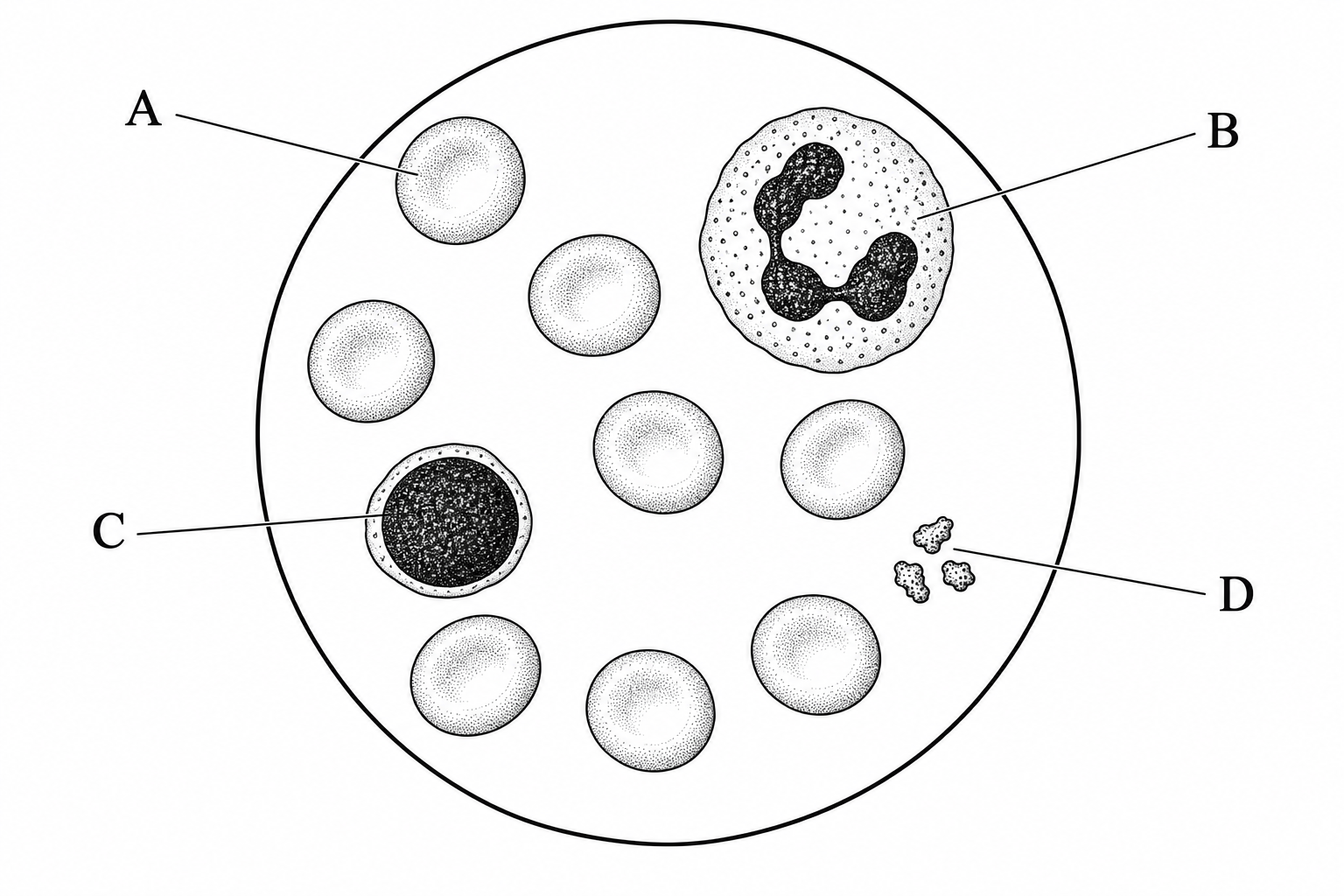
FThe Figure shows some cells in a sample of human blood, seen using a light microscope.
Figure
a.[2]
Name cell B and cell C.
Use words from the list.
lymphocyte phagocyte platelet red blood cell
b.[2]
Structures D are platelets.
Describe how platelets help to defend the body against pathogens.
c.[2]
Cell B engulfs and digests pathogens.
Explain how cell B is adapted to carry out this function.
d.[2]
The body has non-specific defences that stop pathogens getting into the blood.
Give two of these defences.
6.3 Monitoring and maintaining health Questions
181 exam-style questions on OCR GCSE Biology 6.3 Monitoring and maintaining health, covering 6.3.1 Health and disease, 6.3.2 Interactions between diseases, 6.3.3 Spread of communicable diseases, 6.3.4 Common infections and diseases, 6.3.5 Physical plant defence responses, 6.3.6 Chemical plant defence responses, 6.3.7 Detecting and identifying plant diseases, 6.3.8 White blood cells and platelets, 6.3.9 Non-specific defence systems, 6.3.10 The immune system, 6.3.11 Monoclonal antibodies, 6.3.12 Vaccines and medicines, 6.3.13 Aseptic techniques, 6.3.14 Discovery and development of new medicines, 6.3.15 Causes of non-communicable diseases, 6.3.16 Treatments for cardiovascular disease, 6.3.17 Lifestyle factors and non-communicable diseases, 6.3.18 Cancer, 6.3.19 Stem cells in medicine, 6.3.20 Gene technology in medicine, and 6.3.21 The human genome and medicine. Each one has a worked solution and a mark scheme showing where the marks go.