The diagram below shows the second-messenger pathway of antidiuretic hormone (ADH) in a cell of the renal collecting duct:
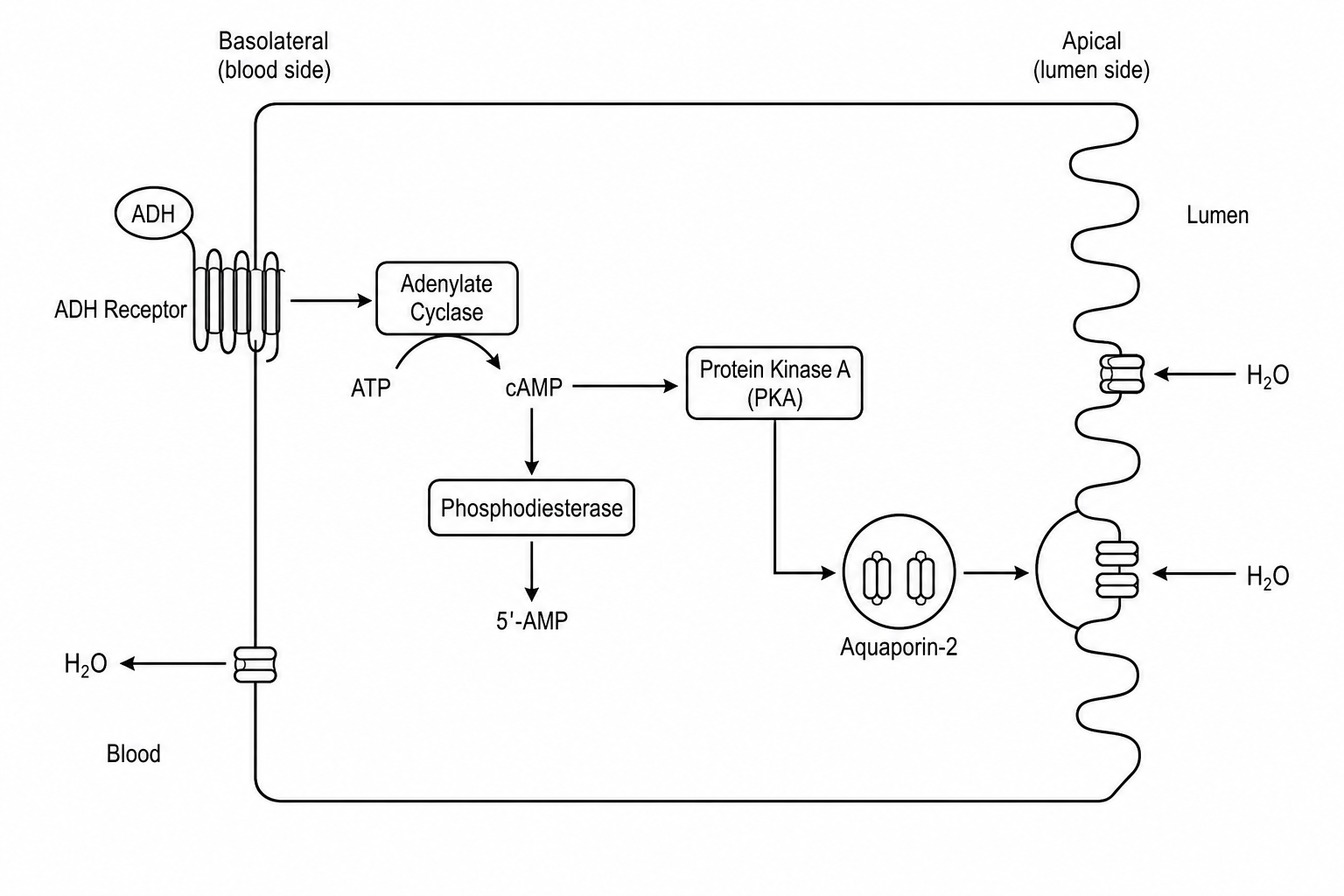
A patient is treated with cilostamide, a drug that acts as a competitive inhibitor of the enzyme phosphodiesterase in the collecting duct cells.
Which of the following options correctly predicts the immediate effects of cilostamide on the intracellular concentration of cyclic AMP ([cAMP][\text{cAMP}][cAMP]), the density of Aquaporin-2 channels in the apical membrane, and the volume and concentration of the urine produced?
Intracellular [cAMP][\text{cAMP}][cAMP] decreases; apical [Aquaporin-2][\text{Aquaporin-2}][Aquaporin-2] density decreases; urine volume increases; urine concentration decreases.
Intracellular [cAMP][\text{cAMP}][cAMP] increases; apical [Aquaporin-2][\text{Aquaporin-2}][Aquaporin-2] density increases; urine volume decreases; urine concentration increases.
Intracellular [cAMP][\text{cAMP}][cAMP] increases; apical [Aquaporin-2][\text{Aquaporin-2}][Aquaporin-2] density decreases; urine volume increases; urine concentration decreases.
Intracellular [cAMP][\text{cAMP}][cAMP] decreases; apical [Aquaporin-2][\text{Aquaporin-2}][Aquaporin-2] density increases; urine volume decreases; urine concentration increases.