5.2 The human nervous system

EasyMedium
12345678910111213141516171819202122232425262728293031323334353637
Question 31
Medium

A study was conducted to investigate the effect of drinking hot tea on a person's core body temperature and rate of sweating.

This is the method used:

  1. Sit a person inside a room kept at a constant temperature of 21∘C21^\circ\text{C}21∘C.
  2. Measure the person's internal body temperature near the brain.
  3. Measure the person's rate of sweating.
  4. After 15 minutes, give the person 450 cm3450\text{ cm}^3450 cm3 of hot tea to drink.
  5. Continue to measure the internal body temperature and sweating rate for a further 45 minutes.

Figure A and Figure B show the results.
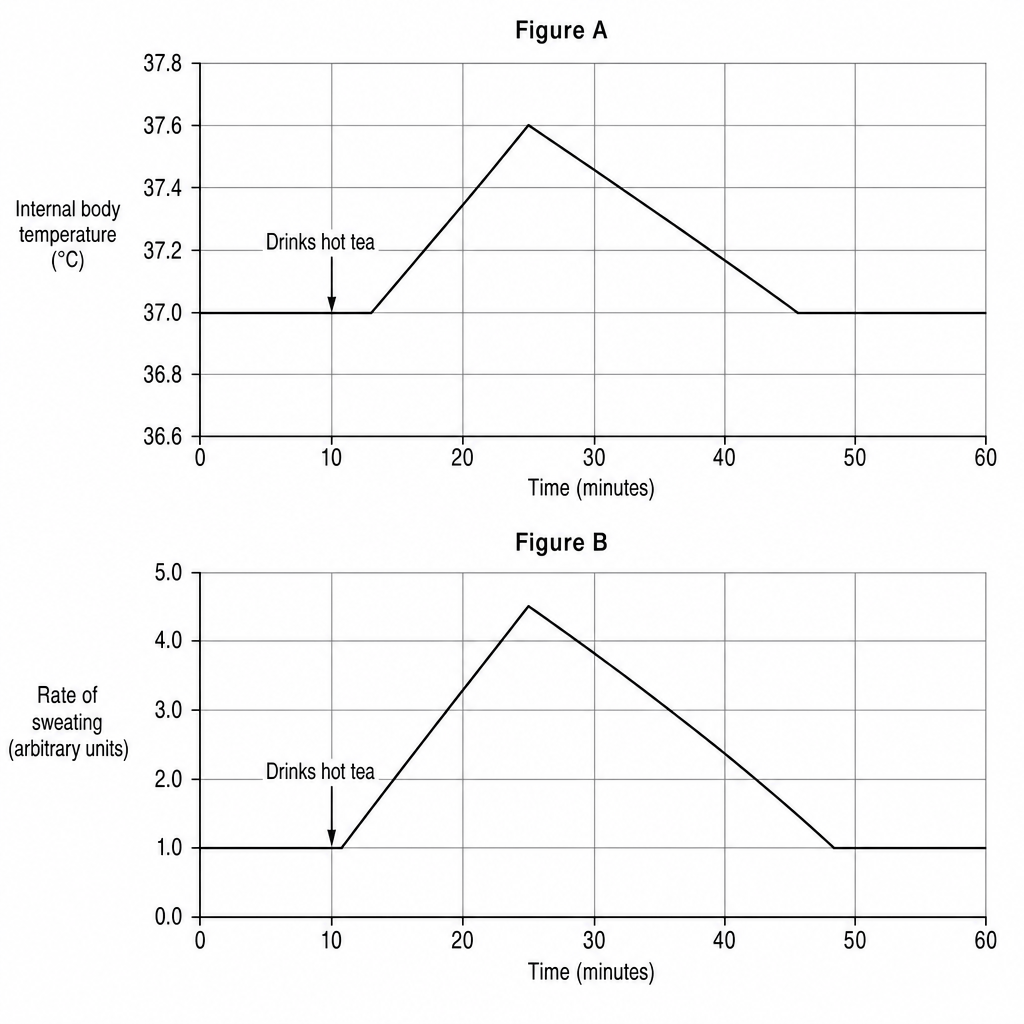
Two line graphs depicting the experimental results. Figure A shows 'Internal body temperature in ^\circ\text{C}' on the y-axis (ranging from 36.6 to 37.8, with grid lines) and 'Time in minutes' on the x-axis (ranging from 0 to 60). From 0 to 15 minutes, the line is constant at 37.0. At 15 minutes, there is an arrow labeled 'Drinks hot tea'. From 15 minutes, the temperature increases, peaking at 37.6 at 25 minutes, before declining back to 37.0 by 50 minutes and remaining constant. Figure B shows 'Rate of sweating in arbitrary units' on the y-axis (ranging from 0.0 to 5.0) and 'Time in minutes' on the x-axis. From 0 to 15 minutes, the rate is constant at 1.0. At 15 minutes, there is an arrow labeled 'Drinks hot tea'. After 15 minutes, the sweating rate increases rapidly to a peak of 4.5 at 25 minutes, before gradually falling back to 1.0 by 50 minutes.

a.

What was the person's normal internal body temperature before drinking the tea?

[1]
b.

Explain why the internal body temperature increased shortly after drinking the hot tea.

[2]
c.

Explain how the change in sweating rate between 15 minutes and 25 minutes helps to restore the person's normal body temperature.

[3]

5.2 The human nervous system Questions

  1. GCSE
  2. /Biology
  3. /5.2 The human nervous system