Question 19
FA scientist investigated whether hairs on the leaves of a wild cabbage plant protect the plant against a leaf-eating beetle.
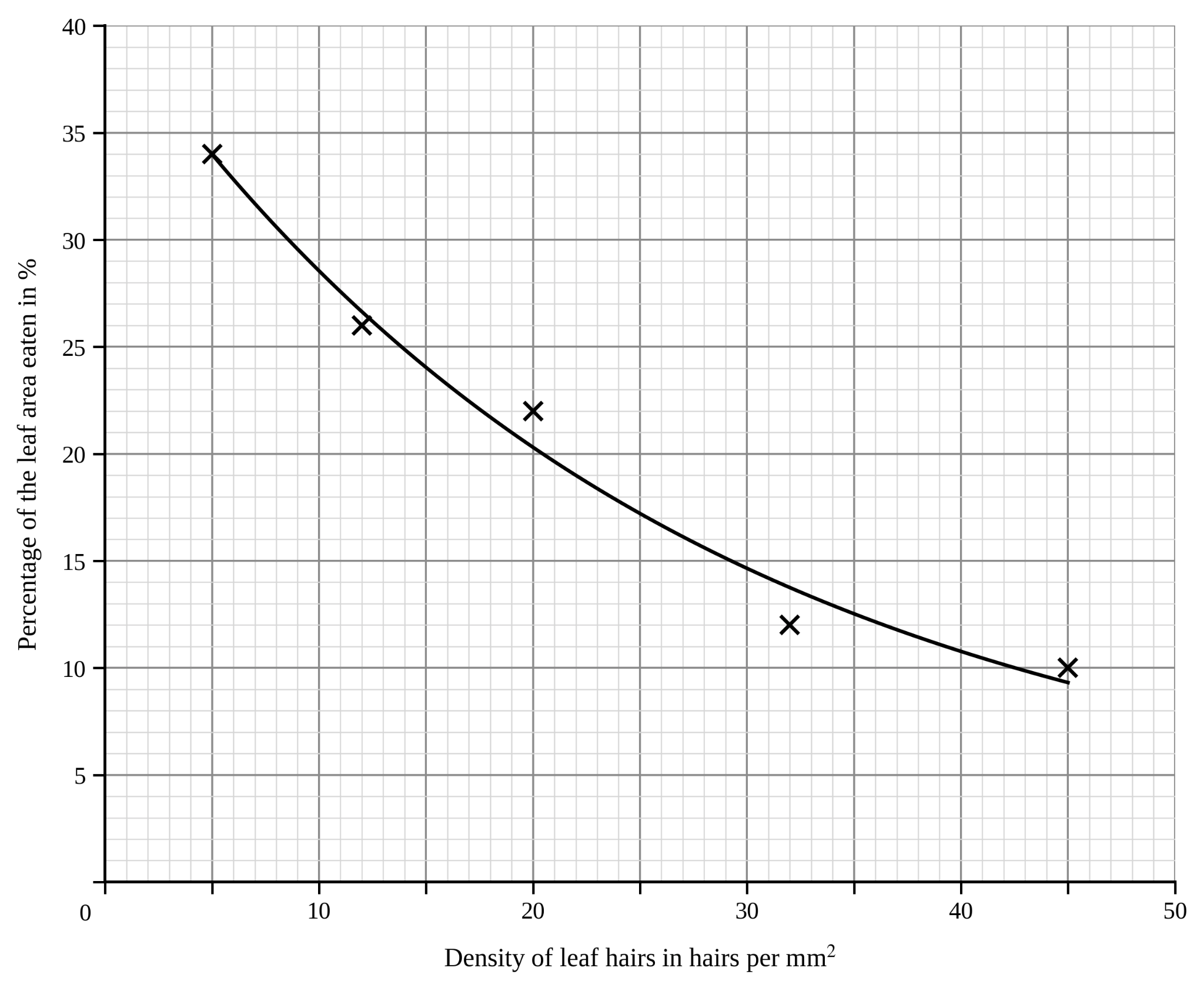
She grew plants of five varieties. Each variety had a different density of hairs on its leaves. She released the same number of beetles onto each variety and measured the percentage of the leaf area eaten after 14 days. The figure shows her results.
Figure: The percentage of the leaf area eaten by beetles after 14 days, plotted against the density of hairs on the leaves, for five varieties of wild cabbage
a.[3]
Describe the relationship shown in the figure. Use data from the figure in your answer.
b.[2]
Explain how hairs on a leaf reduce the amount of leaf that is eaten.
c.[3]
The scientist concluded that growing cabbages with more leaf hairs would remove the need for pesticides. Evaluate this conclusion.
3.3 Plant disease Questions
57 exam-style questions on AQA GCSE Biology 3.3 Plant disease, covering 3.3.1 Detection and identification of plant diseases and 3.3.2 Plant defence responses. Each one has a worked solution and a mark scheme showing where the marks go.