Question 29
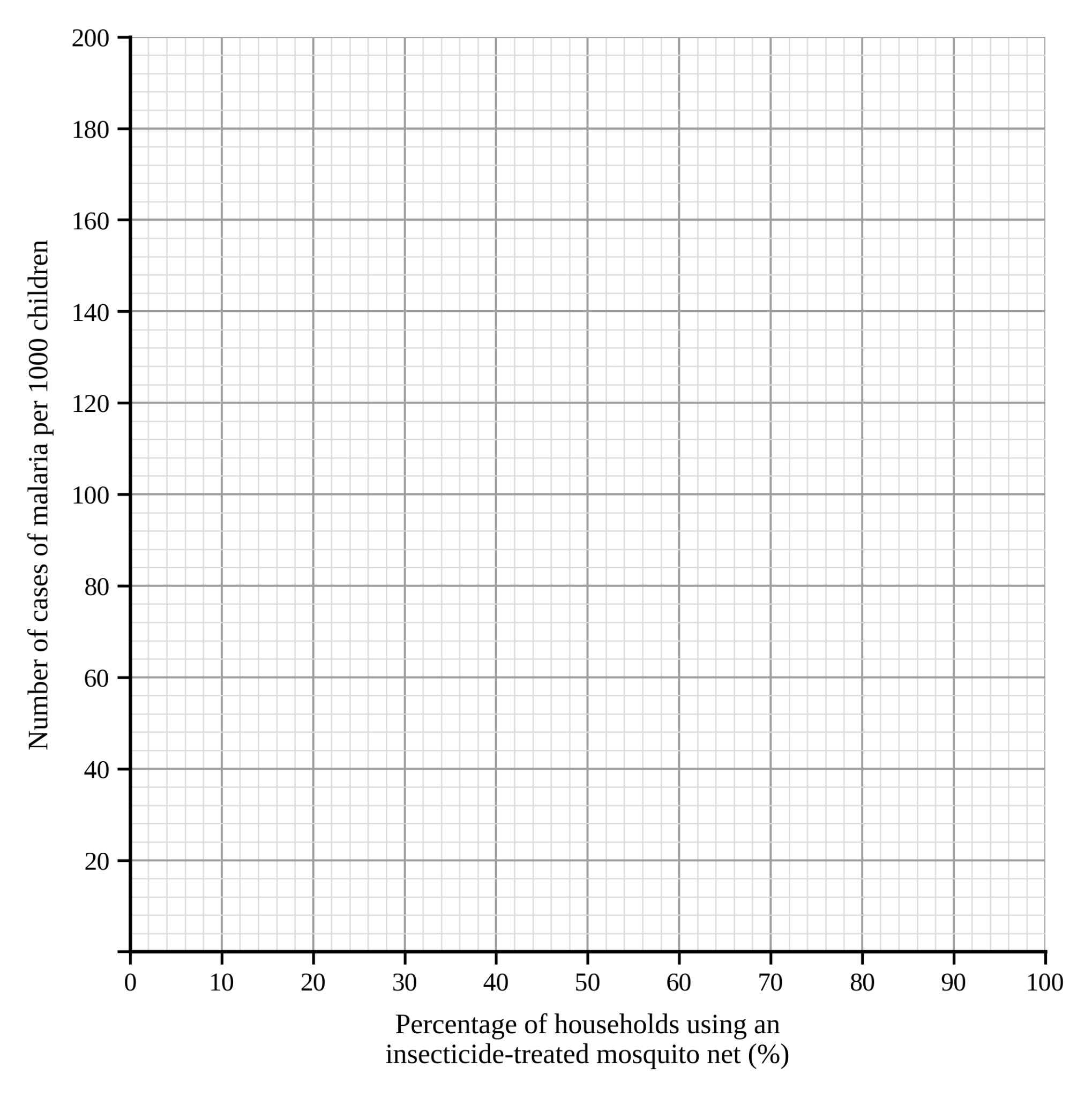
FScientists investigated the link between the use of insecticide-treated mosquito nets and malaria. In six areas they recorded the percentage of households using a net and the number of cases of malaria in children. The table shows their results.
Table: The percentage of households using an insecticide-treated mosquito net and the number of cases of malaria per 1000 children in six areas
| Households using a net (%) | Cases of malaria per 1000 children |
|---|---|
| 0 | 200 |
| 20 | 170 |
| 40 | 135 |
| 60 | 150 |
| 80 | 65 |
| 100 | 30 |
Figure: Grid for plotting the data in the table
a.[2]
Plot the data from the table on the figure and draw a line of best fit.
b.[1]
One of the results is anomalous. Give the percentage of households using a net for the anomalous result.
c.[1]
Use your line of best fit to estimate the number of cases of malaria per 1000 children when 30 % of households use a net.
d.[2]
A newspaper reports that these results prove that insecticide-treated mosquito nets stop children catching malaria. Explain why this report is not valid.
3.1 Communicable diseases Questions
176 exam-style questions on AQA GCSE Biology 3.1 Communicable diseases, covering 3.1.1 Communicable (infectious) diseases, 3.1.2 Viral diseases, 3.1.3 Bacterial diseases, 3.1.4 Fungal diseases, 3.1.5 Protist diseases, 3.1.6 Human defence systems, 3.1.7 Vaccination, 3.1.8 Antibiotics and painkillers, and 3.1.9 Discovery and development of drugs. Each one has a worked solution and a mark scheme showing where the marks go.