Question 84
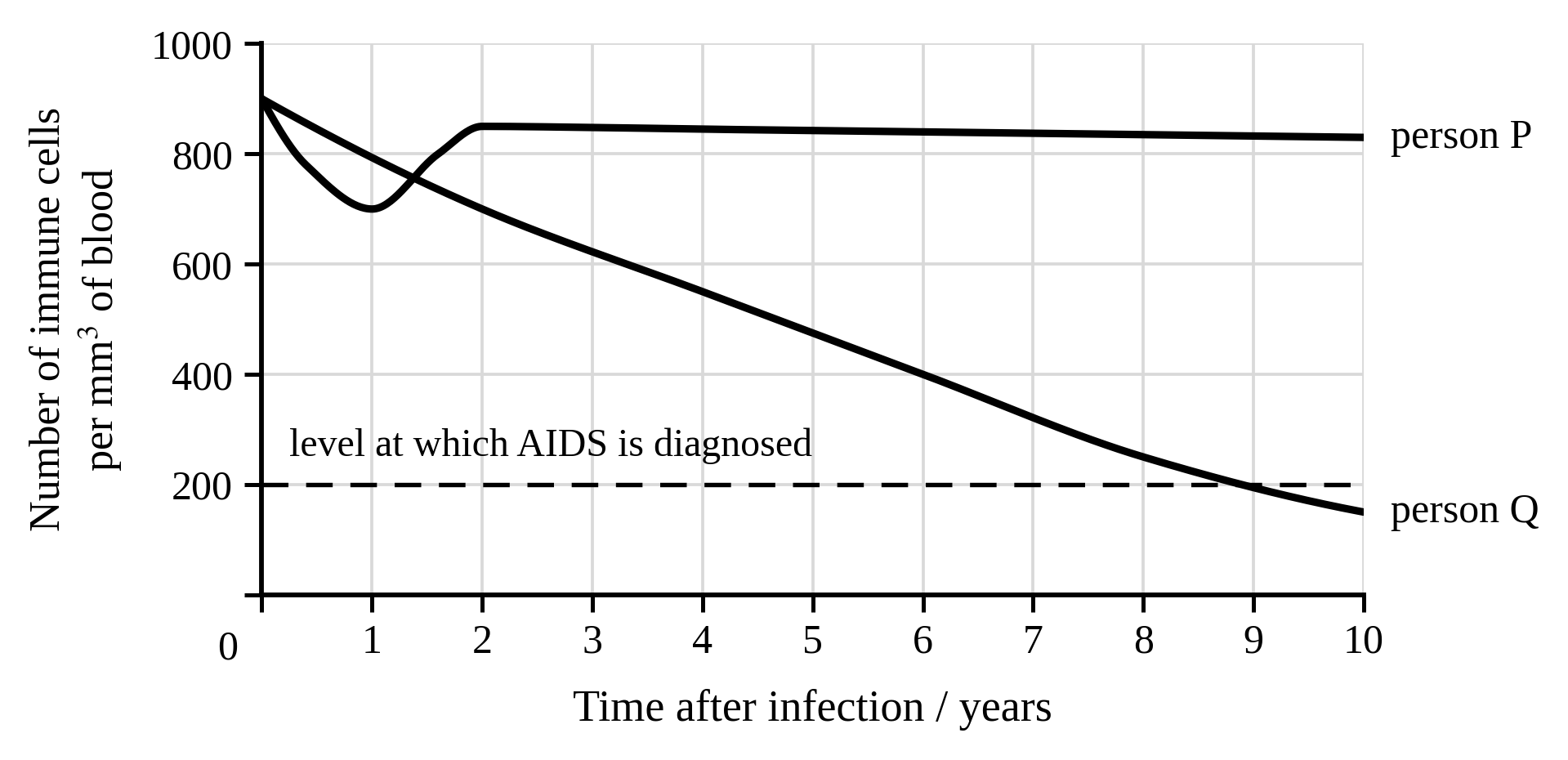
FThe immune cells that HIV attacks can be counted in a sample of blood. A low count of these cells means that the immune system is badly damaged. Two people, P and Q, were both infected with HIV in the same year. Person P was treated with antiretroviral drugs from year 1 onwards. Person Q was not treated. The figure shows the results.
Figure: The number of immune cells in the blood of two people infected with HIV over 10 years
a.[1]
The number of immune cells in both people falls during the first year after infection.
Suggest why.
b.[1]
Use the figure to determine the time after infection at which person Q would be diagnosed with AIDS.
c.[3]
Explain the difference between the line for person P and the line for person Q after year 1.
d.[2]
In year 10 person Q develops pneumonia, which is an infection of the lungs. Person P does not.
Explain why.
3.1 Communicable diseases Questions
176 exam-style questions on AQA GCSE Biology 3.1 Communicable diseases, covering 3.1.1 Communicable (infectious) diseases, 3.1.2 Viral diseases, 3.1.3 Bacterial diseases, 3.1.4 Fungal diseases, 3.1.5 Protist diseases, 3.1.6 Human defence systems, 3.1.7 Vaccination, 3.1.8 Antibiotics and painkillers, and 3.1.9 Discovery and development of drugs. Each one has a worked solution and a mark scheme showing where the marks go.