Question 78
FA doctor recorded the number of people with a communicable disease in four villages, J, K, L and M. The table shows the results.
Table: The number of people with a communicable disease in four villages
| Village | Number of people with the disease |
|---|---|
| J | 30 |
| K | 45 |
| L | 15 |
| M | 60 |
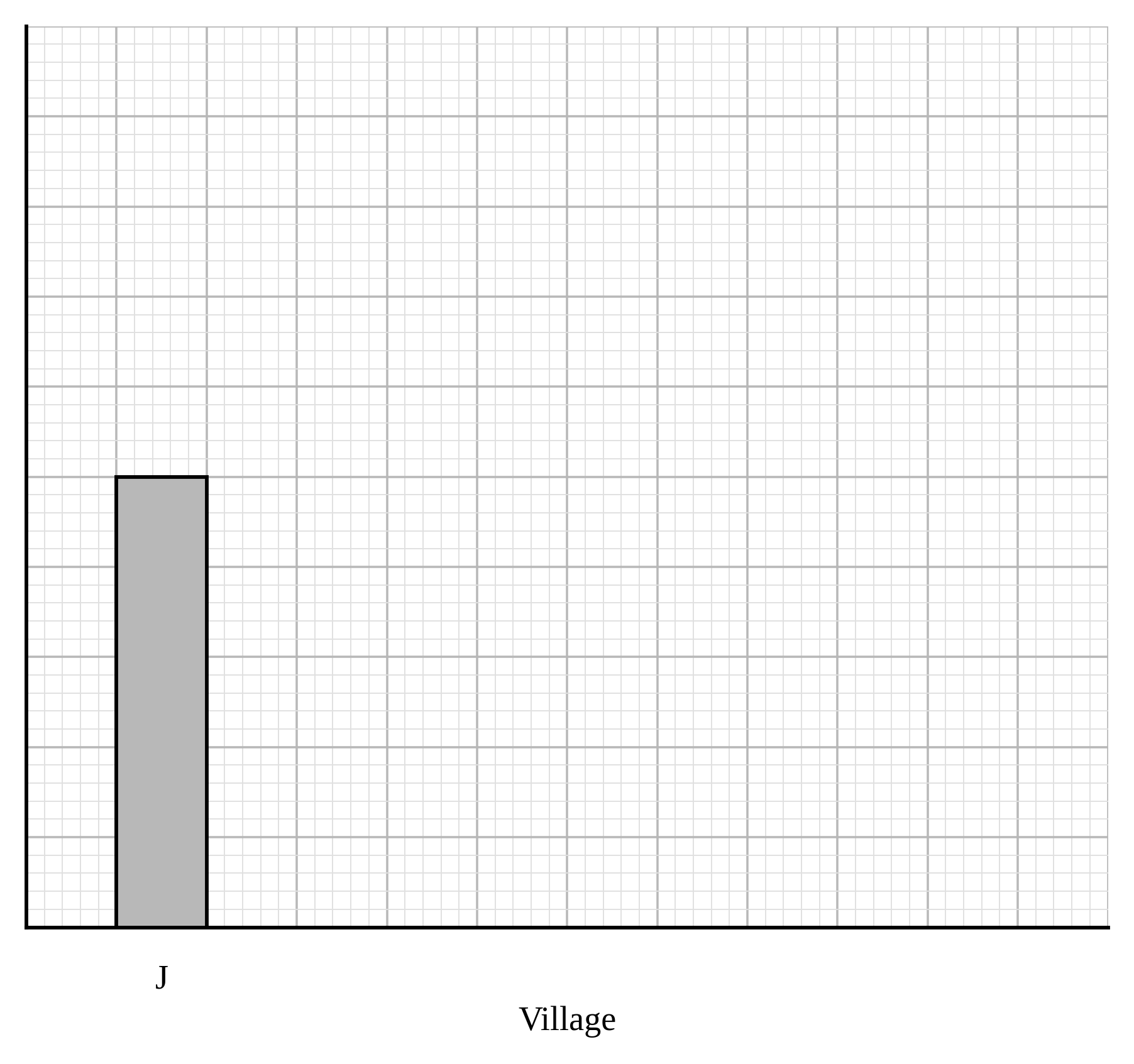
The figure is a grid for plotting the data in the table.
Figure: Grid for plotting the number of people with the disease in each of the four villages
a.[4]
Complete the figure. You should:
- label the y-axis
- add a suitable scale to the y-axis
- plot the data for villages K, L and M
- label each bar.
The bar for village J has been plotted for you.
b.[2]
Village M has a population of 3000 people. Village L has a population of 500 people. Which of these two villages has the higher percentage of people with the disease? Show your working.
c.[1]
Suggest one reason why the number of people with the disease is higher in some of these villages than in others.
3.1 Communicable diseases Questions
176 exam-style questions on AQA GCSE Biology 3.1 Communicable diseases, covering 3.1.1 Communicable (infectious) diseases, 3.1.2 Viral diseases, 3.1.3 Bacterial diseases, 3.1.4 Fungal diseases, 3.1.5 Protist diseases, 3.1.6 Human defence systems, 3.1.7 Vaccination, 3.1.8 Antibiotics and painkillers, and 3.1.9 Discovery and development of drugs. Each one has a worked solution and a mark scheme showing where the marks go.