y = mx + c GCSE Maths: Examples and Questions
y = mx + c GCSE maths explained with clear worked examples, common mistakes and exam-style questions to help you find gradients and equations confidently.
Why does this equation keep going wrong?
You recognise the equation, but the same mistakes keep returning: swapping the gradient and intercept, losing a negative sign, or counting squares in the wrong direction. In y=mx+cy = mx + cy=mx+c GCSE maths questions, mmm is the gradient and ccc is the yyy-intercept. The equation describes a straight line: ccc tells you where it crosses the vertical axis, while mmm tells you how it moves.
Imagine a student who remembers those definitions but still gets questions wrong. Their turning point is not another memory trick. It is connecting each letter to something they can actually see on the graph.
Your quick checklist
- Identify ccc, the value of yyy where x=0x = 0x=0.
- Identify mmm, the change in yyy divided by the change in xxx.
- Keep negative signs attached to their numbers.
- Substitute a point to check your equation.
What does y=mx+cy = mx + cy=mx+c mean?
The letters xxx and yyy describe the coordinates of points on the line. Every point on that line satisfies its equation.
The gradient, mmm, measures steepness and direction. Moving from left to right, a positive gradient means the line rises; a negative gradient means it falls. A horizontal line has gradient 000.
The constant, ccc, is the yyy-intercept. This works because, on the yyy-axis, x=0x = 0x=0. Substituting gives:
y=m×0+c=cy = m \times 0 + c = cy=m×0+c=cThat distinction matters: the intercept is the value ccc, while the crossing point has coordinates (0,c)(0,c)(0,c).
Our hypothetical student had been treating the equation as a label to memorise. Now it becomes an instruction: locate the intercept, then use the gradient to move along the line.
Finding the gradient without guessing
For two points on a line, calculate:
m=change in ychange in x=y2−y1x2−x1m = \frac{\text{change in }y}{\text{change in }x} = \frac{y_2-y_1}{x_2-x_1}m=change in xchange in y=x2−x1y2−y1Choose a starting point and an ending point, then use that same order in both subtractions. Reversing only one subtraction changes the sign incorrectly.
On a graph, choose points whose coordinates you can read accurately. Check the axis scales rather than assuming each square represents one unit. MathsGenie's Gradient of a Line lesson supports this part of the method.
y=mx+cy = mx + cy=mx+c worked examples
Reading an equation and sketching its line
Consider:
y=−2x+3y = -2x + 3y=−2x+3Identify the gradient. The coefficient of xxx is −2-2−2, so m=−2m = -2m=−2.
Identify the intercept. The constant is 333, so c=3c = 3c=3. The line crosses the yyy-axis at (0,3)(0,3)(0,3).
Use the gradient. Moving one unit right means moving two units down. Another point is therefore (1,1)(1,1)(1,1).
Check that point. Substituting x=1x = 1x=1 gives:
y=−2(1)+3=1y = -2(1) + 3 = 1y=−2(1)+3=1Plot the two points and draw a straight line through them, extending beyond them. The line should fall from left to right.
Finding an equation from two points
A straight line passes through (1,5)(1,5)(1,5) and (3,9)(3,9)(3,9). Find its equation.
Find the gradient:
m=9−53−1=42=2m = \frac{9-5}{3-1} = \frac{4}{2} = 2m=3−19−5=24=2Write what you know:
y=2x+cy = 2x + cy=2x+cSubstitute either given point. Using (1,5)(1,5)(1,5):
5=2(1)+c5 = 2(1) + c5=2(1)+cTherefore c=3c = 3c=3, giving:
y=2x+3y = 2x + 3y=2x+3Check the other point:
2(3)+3=92(3) + 3 = 92(3)+3=9The equation fits both points. Notice that neither original point was the intercept. Substitution found it without needing to extend a sketch.
Rearranging before identifying the gradient
Find the gradient and intercept of:
2y=6x−82y = 6x - 82y=6x−8The equation is not yet in the required form because the coefficient of yyy is not 111.
Divide every term by 222:
y=3x−4y = 3x - 4y=3x−4Now m=3m = 3m=3 and c=−4c = -4c=−4. Reading the original equation as though its gradient were 666 would ignore the division needed on both sides.
You now have a repeatable method: rearrange if necessary, identify or calculate the gradient, find the intercept, then check a point.
Use MathsGenie's Equation of a Line lesson and Question Bank practice to repeat that method without having to assemble your own questions.
Common mistakes and how to catch them
Swapping the gradient and intercept
In y=4x−7y = 4x - 7y=4x−7, the gradient is 444, not −7-7−7. Ask which number multiplies xxx: that is mmm once the equation is correctly arranged.
Ignoring an invisible coefficient
In y=x+5y = x + 5y=x+5, the gradient is 111. In y=−x+5y = -x + 5y=−x+5, it is −1-1−1. A missing written number does not mean the gradient is missing.
Dividing in the wrong order
Gradient is vertical change divided by horizontal change. Writing the fraction before inserting numbers can prevent the two from being reversed.
Assuming every line fits the formula
A horizontal line can be written as y=cy = cy=c, with m=0m = 0m=0. A vertical line has an equation such as x=4x = 4x=4 and cannot be written as y=mx+cy = mx + cy=mx+c with a finite gradient.
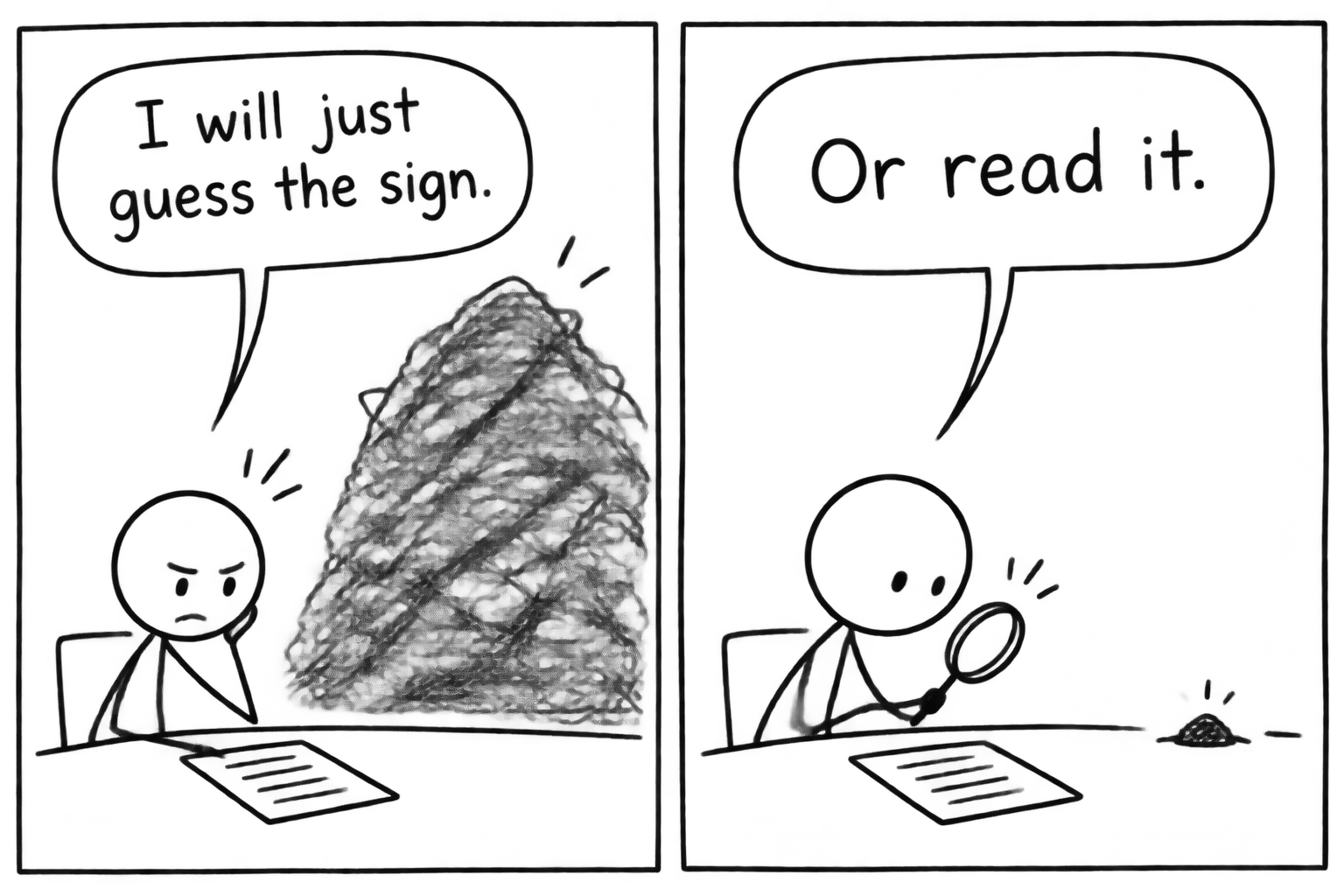 A stick-figure student discovers that reading a negative sign is more useful than guessing it
Exam-style y=mx+cy = mx + cy=mx+c questions
Try these before looking at the answers. Write your working, particularly when calculating a gradient or finding an intercept.
- Identify: State the gradient and yyy-intercept of y=−3x+7y = -3x + 7y=−3x+7.
- Rearrange: Find the gradient and yyy-intercept of 3y=6x+123y = 6x + 123y=6x+12.
- Construct: Find the equation of the line with gradient −2-2−2 passing through (3,1)(3,1)(3,1).
- Calculate: Find the equation of the line through (2,1)(2,1)(2,1) and (6,9)(6,9)(6,9).
These are original practice questions, not quotations from an exam paper. For further topic practice, MathsGenie provides an Equation of a Line question booklet and AQA Equation of a Line questions.
Answers and checks
Identify: m=−3m = -3m=−3 and c=7c = 7c=7. The intercept point is (0,7)(0,7)(0,7).
Rearrange: Dividing every term by 333 gives y=2x+4y = 2x + 4y=2x+4, so m=2m = 2m=2 and c=4c = 4c=4.
Construct: Substitute the point into y=−2x+cy = -2x + cy=−2x+c:
1=−2(3)+c1 = -2(3) + c1=−2(3)+cTherefore c=7c = 7c=7 and the equation is y=−2x+7y = -2x + 7y=−2x+7.
Calculate:
m=9−16−2=2m = \frac{9-1}{6-2} = 2m=6−29−1=2Using (2,1)(2,1)(2,1) gives 1=2(2)+c1 = 2(2) + c1=2(2)+c, so c=−3c = -3c=−3. The equation is y=2x−3y = 2x - 3y=2x−3.
Make the method stick
Return to our hypothetical student. What changes is not that straight-line graphs suddenly become effortless. Each mistake now has somewhere to be checked: the coefficient, the intercept, the subtraction order or the substituted point.
After an incorrect answer, identify which step failed. Then attempt a fresh question without copying the solution. That is a more useful test than recognising a method while it is already written in front of you.
Turn understanding into reliable answers
You want to recognise the gradient and intercept without losing marks to the same small mistakes. Knowing the method is the beginning; applying it independently is what makes it dependable. Your turn: start with MathsGenie's Equation of a Line lesson, then practise the method in the Question Bank.