Will Grade 9s Be Easier or Harder to Get?
Will grade 9s be easier or harder to get? Understand GCSE maths changes, grading standards and what parents can do to support confident revision at home.

Policy baseline: November 2025. Review annually against new DfE and Ofqual publications, and before choosing resources for a new exam cohort. This article concerns GCSEs in England.
GCSE reform does not automatically make grade 9s easier or harder to get. The difficulty of a paper and the standard required for the top grade are different things: Ofqual’s approach is designed to maintain grading standards when papers vary in difficulty.
If you are asking, “will grade 9s be easier or harder to get?”, you probably want something more practical than a policy explanation. Should your child change how they revise? Will their current textbooks become outdated? Could a change announced today affect their exams?
The answer starts with separating three things: what students learn, how they are assessed, and how their marks become grades. Headlines about GCSE maths changes often blur these together.
What parents need to know
Keep this checklist beside any reform headline:
- Check the cohort. First teaching of a new qualification is different from its first exams.
- Check the status. A review recommendation, government commitment and final assessment rule are different stages.
- Check the specification. Your child needs resources matching the qualification they are actually taking.
- Separate marks from standards. A lower grade boundary does not necessarily mean an easier qualification.
You can use the GCSE maths revision overview to identify your child’s exam board before discussing revision resources with their teacher.
Will grade 9s be easier or harder to get after reform?
There is no sound basis for promising either outcome simply because GCSEs are being reformed.
Ofqual explains that grade boundaries reflect differences in paper difficulty so that the standard of work needed for a grade remains stable. Its publication Looking ahead to results day for GCSE and level 1/level 2 vocational and technical qualifications, published in August 2024, makes this distinction explicit.
A paper that feels more accessible may require more marks for a particular grade. A demanding paper may have a lower boundary. Neither change, by itself, tells you that the standard has risen or fallen.
For a parent, this changes the useful question. Instead of asking whether next year’s boundary will be kinder, ask whether your child can demonstrate their understanding reliably across unfamiliar questions.
That is something their teacher can assess. A future boundary is something nobody can give you with certainty before the exams have been marked.
Why last year’s percentage is not a promise
A previous grade boundary helps interpret performance on that particular past paper. It does not establish a permanent percentage needed for grade 9.
Ofqual’s Grade boundaries: the problems with predictions explains why predicting boundaries is unreliable: it is difficult to know precisely how students will experience a paper compared with earlier papers.
Use past-paper results to identify patterns across several assessments. One result just above an old boundary is encouraging evidence, but it is not a guarantee.
What the Curriculum and Assessment Review actually says
The Curriculum and Assessment Review’s final report, Building a world-class curriculum for all, was published in November 2025. The government published its response that month.
For maths, the review highlights fluency and the importance of giving pupils sufficient opportunity to develop understanding and tackle challenging, non-routine problems. That does not support the assumption that reform means removing mathematical challenge.
The government response sets out plans for a revised national curriculum to be published in 2027, with first teaching from September 2028. It also describes updated GCSEs being introduced for first teaching in phases from 2029 onwards.
These are implementation plans, rather than evidence that a future grade 9 will be easier to obtain. They also show why a headline about a new curriculum should not prompt an immediate change to an existing GCSE revision programme.
First teaching is not the first examination
“First teaching” means when schools begin teaching a qualification. It does not mean students sit its final exams that same year.
Before buying replacement books or changing revision priorities, ask the school which specification applies to your child and whether any confirmed assessment changes affect their exam series.
The guide to GCSE maths topics by exam board and tier provides a useful starting point for that conversation. The school’s confirmation should determine which checklist your child follows.
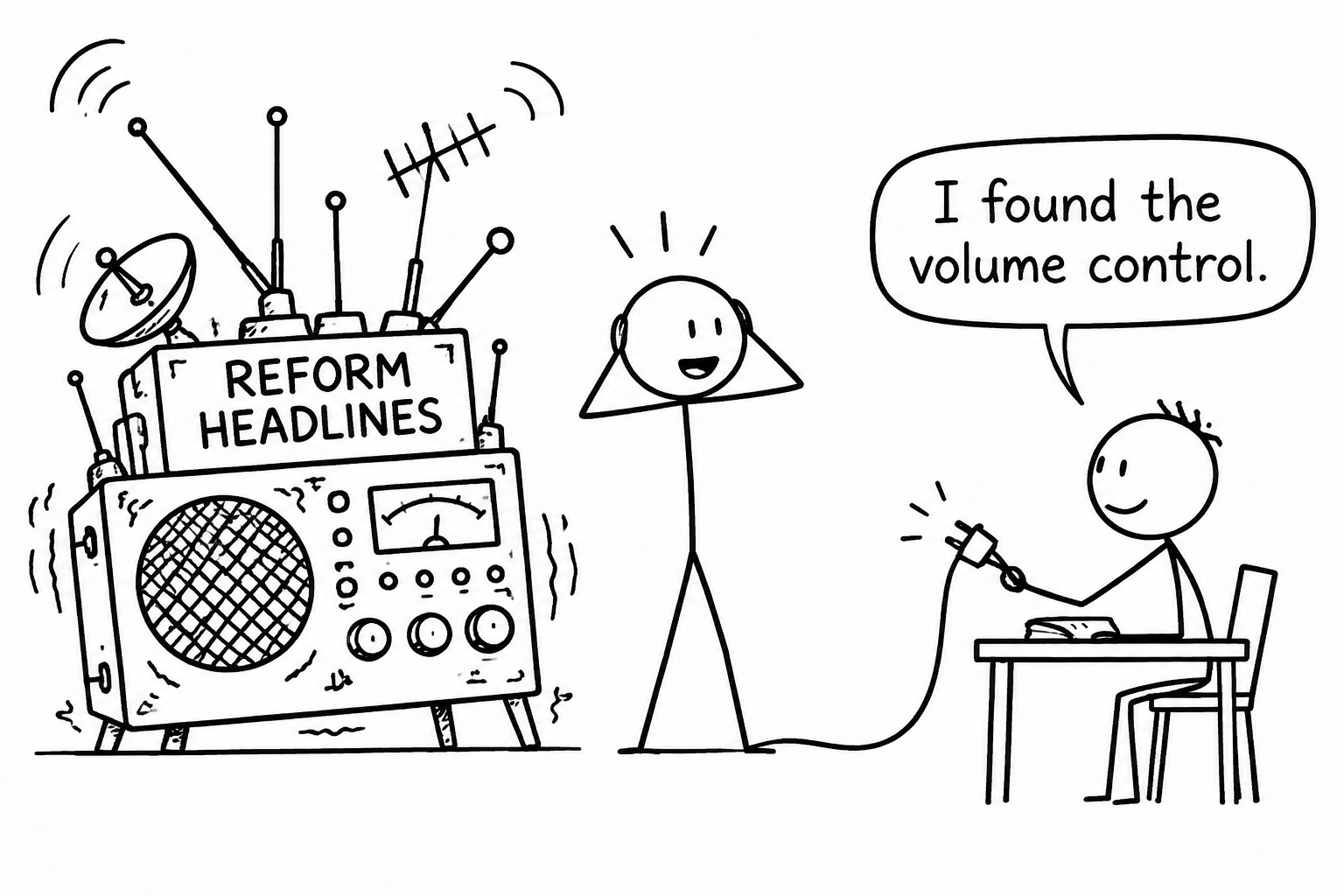 Stick-figure parent and teenager turn down a noisy radio labelled reform headlines
A practical plan for supporting a grade 9 ambition
You cannot control future boundaries. You can help your child build a revision routine that responds to evidence.
Confirm the qualification and tier
Ask for the exam board, specification and intended tier. Under current GCSE maths arrangements in England, foundation tier has a maximum grade of 5; a grade 9 requires higher tier.
Ofqual’s GCSE maths: choosing the ‘right’ tier explains the foundation ceiling. Tier entry should be discussed with the teacher, taking account of your child’s attainment and readiness.
Find the reason behind lost marks
Look through a recently marked assessment together, with your child’s agreement. Separate gaps in knowledge from incorrect methods, misread questions and incomplete explanations.
This makes the next revision session specific. “Improve algebra” is difficult to act on. Identifying a particular algebraic method that repeatedly breaks down gives your child a manageable starting point.
Repair, practise and revisit
For each priority topic, revisit the explanation, attempt questions independently, check the marking guidance and return to the topic later without notes. Then include it in mixed practice, where the question does not announce which method to use.
MathsGenie’s guide to the order of GCSE maths topics can help you understand why strengthening earlier knowledge matters before tackling more demanding material.
Start with Maths Genie Lessons for your child’s current specification to turn the gaps you have identified into a focused starting point.
Review progress without predicting a grade every week
Ask what your child can now complete independently that they could not do previously. Look for fewer repeated errors, clearer reasoning and stronger performance across several assessments.
If their board is Edexcel, the Edexcel GCSE maths lessons offer a board-specific route through topics. For other boards, select the appropriate lessons rather than assuming every resource matches.
Common mistakes parents can avoid
Treating a recommendation as an immediate rule change. The review identifies what should improve; implementation requires further decisions. Always check whether an announcement applies to your child’s cohort.
Assuming less assessment means less demanding maths. Exam length, assessment design and the standard required for a grade are separate questions. A proposal about one does not settle the others.
Chasing only the hardest questions. Grade 9 ambitions still depend on secure knowledge throughout the specification. Repeated errors in familiar work deserve attention alongside challenging problems.
Turning every practice result into a forecast. A single assessment can reveal useful gaps without becoming a verdict on your child’s eventual grade.
Turn reform uncertainty into a clear next step
Your goal is to help your child prepare confidently for the qualification they will actually sit. Knowing which gaps matter is the beginning; following them with consistent, relevant practice is the next step. Start your child’s revision with Maths Genie Lessons for their current specification.