

Will Calculator Rules Change in the New GCSE?
Will calculator rules change in the new GCSE? A dated parent guide to Ofqual rules, reform timelines and what students should practise now for exams.
Last updated: 3 November 2026. This guide will be reviewed as the Department for Education and Ofqual publish further GCSE reform details.
No calculator rule change has been announced for the new GCSE Maths qualification in England. If your child is preparing for the current GCSE, they should continue revising for both calculator and non-calculator assessment.
That is the definitive answer to the parent asking, “Will calculator rules change in the new GCSE?” The nuance is that GCSE reform is still developing. The Curriculum and Assessment Review has reported, and the government has set an implementation direction, but the detailed subject content and assessment rules for a replacement GCSE Maths specification have not yet been published.
In other words, future reform is real. A new calculator policy is not yet part of it.
The answer at a glance
For parents deciding what their child should practise now:
- No official change to GCSE Maths calculator rules has been confirmed.
- Current Ofqual rules require a substantial non-calculator element.
- Students taking the current specification should prepare for their existing exam-board format.
- The Curriculum and Assessment Review did not itself replace current GCSE specifications.
- Any future change would need to appear in official subject content, Ofqual conditions and exam-board specifications.
- Mental arithmetic, written methods, estimation and confident calculator use all remain important.
You can check the resources for your child’s current board on the GCSE Maths revision page.
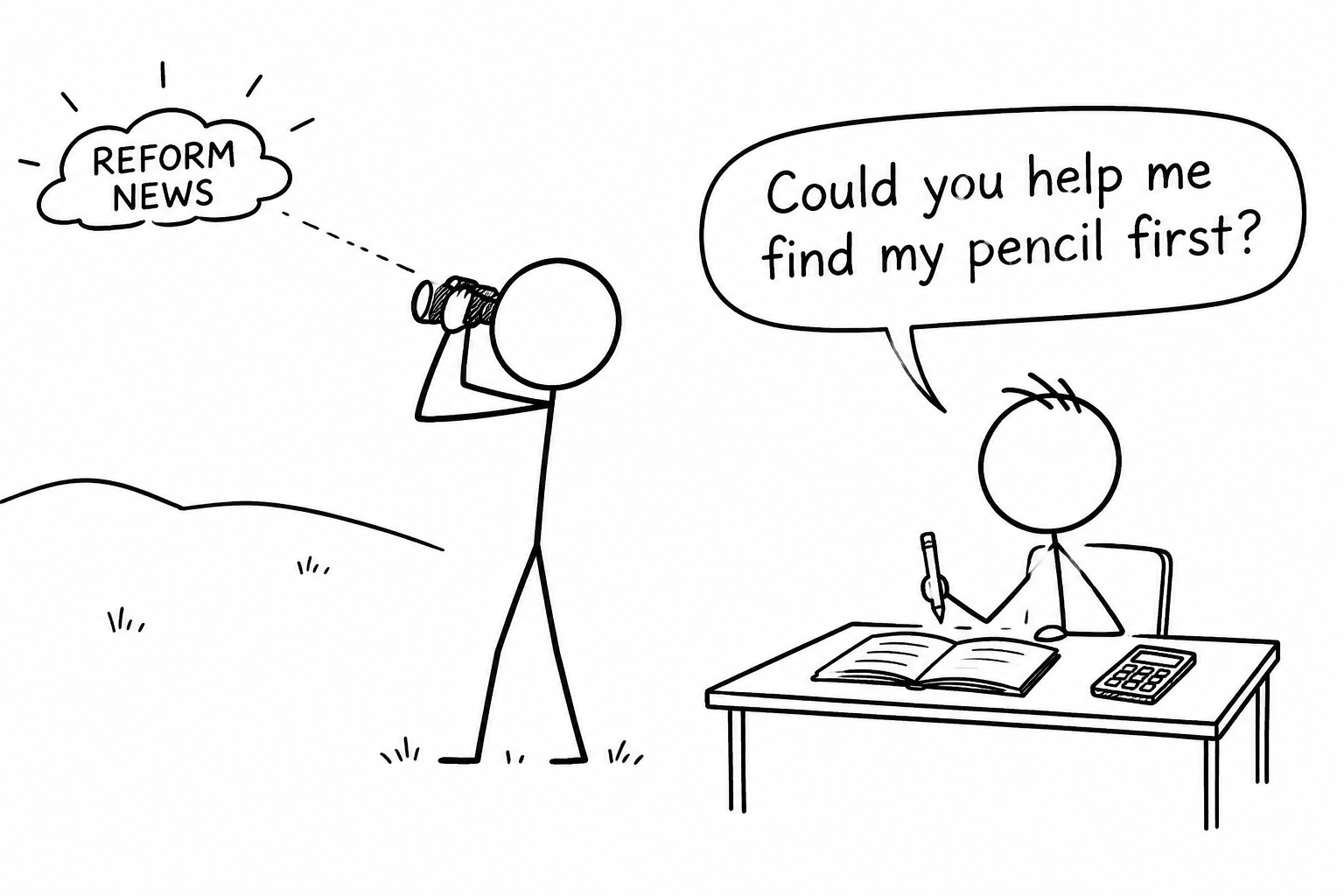 A parent searches the horizon for reform news while a student asks for help finding a pencil
What are the calculator rules now?
For GCSE Mathematics qualifications regulated by Ofqual in England, awarding organisations must ensure that between 33%33\%33% and 50%50\%50% of the total marks are completed without access to a calculator.
Exam boards turn that regulatory requirement into their own paper structures. In familiar specifications such as Edexcel, AQA and OCR, students normally sit three papers, with one designated as non-calculator. Other specifications can organise assessment differently, so parents should check the board and specification used by the school rather than assuming every GCSE has an identical timetable.
The important principle is stable: a student cannot treat the calculator as a substitute for number sense.
They still need to be able to:
- calculate accurately using written methods;
- work confidently with fractions, decimals and percentages;
- simplify expressions and manipulate algebra;
- estimate before accepting an answer;
- recognise when a calculator display needs rounding or interpreting;
- show enough working to make a method clear.
A calculator paper is not simply an easier version of a non-calculator paper. Questions can involve more demanding numbers precisely because a calculator is available. Students must know what calculation to enter, which result matters and whether that result is reasonable.
What do the GCSE reform publications actually say?
This is where understandable concern can turn into unnecessary certainty.
The Curriculum and Assessment Review published its final report in November 2025. The government then published its response. These publications set a broad direction for curriculum renewal, but they did not announce that GCSE Maths would become entirely calculator-based, entirely non-calculator, or follow a newly defined split.
The government’s stated implementation plan is for a new full national curriculum to begin teaching from September 2028. Its response also says that some revised GCSEs are intended to be ready for first teaching in 2029, with the remainder following in 2030.
That timetable does not tell us which group GCSE Maths will enter, nor does it settle the design of its papers. Before parents can rely on a new calculator rule, several things would normally need to become public:
- revised GCSE Mathematics subject content from the Department for Education;
- proposed or final assessment conditions from Ofqual;
- consultation decisions where applicable;
- accredited specifications from exam boards;
- sample assessment materials showing the paper structure.
Until those documents exist, claims that calculators are definitely being removed or permitted throughout should be treated as speculation.
Which students could eventually be affected?
The practical question is not simply whether reform is coming. It is whether it reaches your child’s cohort.
A student already following the current GCSE course should revise the specification their school is teaching. Exam arrangements do not normally change because a broad curriculum report has appeared. Schools and exam boards need confirmed content, approved specifications and preparation time.
For a younger child, the picture is less settled. If they may begin GCSE courses around the planned reform period, their school will eventually confirm which specification applies. Parents do not need to predict that decision now.
The calm approach is to ask the school three specific questions:
- Which exam board and specification is my child following?
- Is the school expecting this cohort to remain on the current qualification?
- Which papers permit a calculator under that specification?
Parents can also compare current content using the GCSE Maths topics by exam board and tier guide or open the dedicated Edexcel GCSE Maths revision resources where relevant.
A sensible revision plan while reform develops
The safest response to uncertainty is not to wait. It is to build skills that remain useful under either assessment model.
Practise without a calculator
Set aside regular short sessions for arithmetic, fractions, percentages, standard form, algebraic manipulation and estimation. The aim is not speed at any cost. It is reliable reasoning.
For example, if a calculator produces an answer close to 600600600 when the estimate was close to 606060, the student should pause. Estimation acts like a mathematical smoke alarm. It does not solve the entire problem, but it warns when something has gone wrong.
Practise calculator decisions
Students should also learn when brackets are needed, how to enter fractions and powers, and when to keep an exact value rather than round too early. A student calculating with π\piπ should usually retain the calculator value until the final step unless the question says otherwise.
Use the actual specification
Revision should follow the exam board and tier being sat, not rumours about a future qualification. Foundation and higher tier overlap, but they do not assess every topic in the same way. The MathsGenie GCSE lessons allow families to select the relevant subject and exam board.
Once you know the board and tier, use those current-specification lessons to turn this checklist into focused revision rather than trying to reconstruct the course from reform headlines.
Check progress with current questions
A balanced weekly routine could include one non-calculator topic session, one calculator session and one mixed set of exam questions. Mark the work carefully and record whether errors came from knowledge, method, arithmetic or calculator entry.
That distinction matters. Buying a different calculator will not repair a misunderstanding of ratio. More mental arithmetic will not help if the student does not know which trigonometric ratio to select. Good revision identifies the actual problem.
Common mistakes parents and students make
Treating reform proposals as current rules
A review recommendation, government response and final exam-board specification are not the same document. Only confirmed arrangements for the qualification being taken should shape immediate revision.
Abandoning non-calculator practice
Even on calculator papers, number sense helps students detect entry errors and interpret answers. Under the current Ofqual framework, non-calculator assessment is also an explicit part of the qualification.
Assuming every board has the same paper structure
The regulated percentage does not force every awarding organisation to arrange papers identically. Check the exact specification and school guidance.
Practising calculator buttons without mathematics
Students sometimes become quick at entering an expression but remain unsure what the expression should be. Calculator fluency and mathematical understanding must develop together.
Changing revision because of a headline
GCSE changes attract attention because they concern large numbers of families. But a headline about long-term reform should not displace preparation for the paper in front of your child. Current MathsGenie GCSE resources remain organised around the specifications students are actually taking.
Keep revision tied to the current GCSE
The gap for most families is not knowing that both skill sets matter. It is maintaining regular practice when reform news makes the destination seem uncertain. Your child’s present specification remains the reliable map, and fixed exam dates mean postponing revision only reduces the time available.
Start the MathsGenie Lessons for your child’s current GCSE specification.















