When Will GCSE Maths Change? Parent Guide
When will GCSE Maths change? See the 2029-2030 reform timeline, what remains undecided, and how parents can support revision now with confidence.
Last reviewed: 3 November 2026. This guide covers GCSE Maths in England and will be updated as the DfE and Ofqual publish further decisions.
GCSE Maths will not be replaced before September 2029, and pupils taking their exams under the current specification should continue preparing for it. The Department for Education intends to introduce reformed GCSEs in two phases, with some subjects first taught in 2029 and the remainder in 2030. It has not yet publicly confirmed which phase will include GCSE Maths.
That is the straight answer to when will GCSE Maths change. The important nuance is that “first teaching” is not the same as “first examination”. A pupil already working towards the present qualification will not suddenly receive a different paper because reform is being discussed.
For a parent searching through announcements, consultations and alarming headlines, this distinction matters. Policy can be changing while your child’s revision target remains exactly the same.
The GCSE Maths change checklist
Here is what parents need to know as of November 2026:
- Reformed GCSEs in England are intended to begin first teaching in 2029 and 2030.
- The phase containing GCSE Maths has not yet been confirmed publicly.
- The DfE is reviewing GCSE Maths content, but no final replacement specification has been published.
- Ofqual has confirmed formula sheets for the lifetime of the current GCSE Maths qualifications.
- Pupils following the present course should revise the current specification set by their exam board.
- Schools and exam boards will receive detailed transition arrangements before a new qualification begins.
For now, parents can use the GCSE Maths revision hub to select the relevant exam board and current course.
What the official GCSE reform timeline says
Imagine a parent opening several browser tabs after hearing that “GCSEs are changing”. One says the new curriculum begins in 2028. Another mentions GCSE reform from 2029. A third discusses formula sheets from 2028. All three can be accurate because they refer to different things.
The government response to the Curriculum and Assessment Review, published in November 2025, set out this broad sequence:
- The refreshed national curriculum is planned for first teaching from September 2028.
- Reformed GCSEs will follow in phases.
- Some GCSEs are intended for first teaching in 2029.
- The remaining GCSEs are intended for first teaching in 2030.
The later GCSE timetable is designed to allow qualifications to follow the revised curriculum rather than arrive before it. However, neither the Curriculum and Assessment Review nor the government response assigned GCSE Maths publicly to a specific phase.
A qualification first taught in 2029 would normally reach its first full examination cohort later, after pupils have completed the course. Ofqual has said current GCSE Maths examinations may continue up to 2030 or 2031, depending on when the reformed subject is introduced, with resit opportunities continuing afterwards where required.
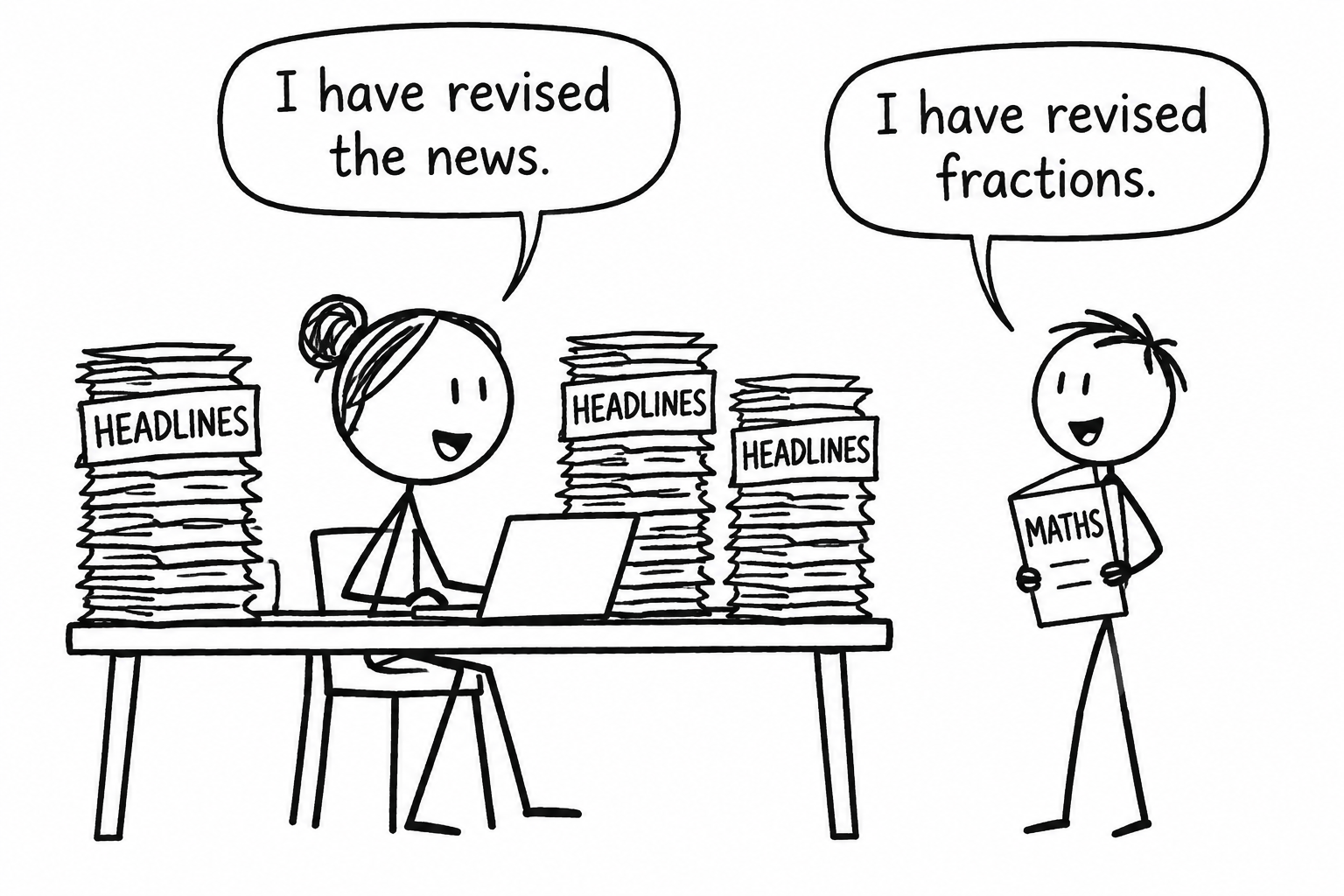 A parent revises GCSE headlines while a teenager calmly revises fractions
What could change in the new GCSE Maths?
The DfE has said it will review the Key Stage 4 curriculum and GCSE Maths content to ensure they remain fit for purpose. Its response points towards targeted, modest adjustments rather than a complete reinvention of school maths.
Areas under consideration include:
- whether content should place greater emphasis on depth of understanding;
- how earlier number knowledge should be sequenced;
- the role of non-routine problem solving;
- whether pupils should have to memorise particular formulae;
- how assessment time can be reduced across a pupil’s complete GCSE programme.
These are policy directions, not a finished new GCSE Maths specification. There is currently no confirmed list of added or removed topics, no final assessment structure and no published sample paper for the reformed qualification.
Parents should be cautious when encountering claims that particular topics have definitely been removed. Until the DfE confirms subject content and Ofqual completes the relevant regulatory work, such lists are speculation.
The present course still covers established areas including number, algebra, ratio and proportion, geometry and measures, probability, and statistics. Our guide to GCSE Maths topics by exam board and tier helps parents see how this content is organised now.
What should your child revise now?
The safest plan is also the simplest: revise the qualification the school is teaching.
Check the exam board and tier
Ask the school whether your child follows Edexcel, AQA, OCR or another specification, and whether they are currently entered for foundation or higher tier. Tier decisions can change, so treat the school’s latest information as authoritative.
Follow the current topic list
Use school assessments and marked work to identify gaps. Then match those gaps to current-specification lessons rather than resources labelled vaguely as “future GCSE” or “new reform”. The best order for learning GCSE Maths topics explains why secure number, ratio and algebra skills often make later topics easier.
Practise applying formulae
Ofqual confirmed in May 2026 that formula sheets will be provided from 2028 for the lifetime of the current GCSE Maths qualifications, including relevant resit opportunities. This does not make formula practice unnecessary. Pupils still need to recognise the correct formula, substitute accurately and interpret the result.
Keep revision close to classroom teaching
A practical weekly routine is to revisit one taught topic, complete questions without notes and correct mistakes carefully. Parents do not need to teach the method themselves. Their most useful role is often helping the pupil maintain a regular routine and ask for support when the same error keeps returning.
If organising all of that feels heavy, start with the MathsGenie GCSE Maths lessons for the specification pupils are learning now.
How parents can judge future announcements
When another GCSE reform headline appears, ask four questions:
- Is this a proposal, consultation, decision or final specification?
- Does it apply to England, rather than another UK qualification system?
- Does the date mean first teaching or first examination?
- Will it affect my child’s cohort?
This filter turns a vague announcement into something useful. It also prevents a Year 11 pupil from abandoning current revision because a future course may be different.
Parents who want to understand how present assessments work can review the Edexcel GCSE Maths past papers. The purpose is not to predict reform, but to see the format their child is preparing to face.
Common mistakes parents should avoid
Waiting for the new specification. No pupil should pause revision while future content is being developed. The school’s current specification remains the target.
Confusing curriculum reform with an immediate exam change. The national curriculum and GCSE qualifications have connected but separate implementation dates.
Assuming a formula sheet removes the need to learn methods. A supplied formula helps with recall. It does not choose the formula, perform the calculation or explain the answer.
Buying resources simply because they say “new GCSE”. Check the publication date, exam board and specification reference. A prominent label is not evidence that it matches a future qualification.
Treating every child as part of the same transition cohort. The effect depends on when GCSE Maths is placed in the reform programme and when the pupil begins the course.
Keep revision focused on the exam your child will sit
Knowing the reform timeline removes one worry, but progress still depends on following the course consistently. Your child does not need to prepare for an unpublished qualification; they need clear teaching for the current one. Start the MathsGenie GCSE Maths lessons for the specification your child is learning now.