What to Revise in September of Year 13 Maths
What to revise in September of Year 13 Maths: follow a practical weekly plan to repair Year 12 gaps, keep pace with lessons and build confidence early.
September can make Year 13 Maths feel larger than it really is. New material is arriving, Year 12 topics are fading, and the final exams suddenly seem close enough to matter.
If you are deciding what to revise in September of Year 13 Maths, the answer is not the entire course. Focus on three priorities: repair the Year 12 knowledge needed for current lessons, consolidate each new topic promptly, and establish a weekly routine you can sustain.
Imagine a hypothetical student called Maya. Her first list says only “revise maths”. It contains everything and therefore tells her nothing. A useful September plan replaces that vague instruction with specific topics, scheduled sessions and corrections from marked questions.
Your September priorities at a glance
Use this checklist throughout the month:
- Audit your Year 12 knowledge without relearning everything.
- Prioritise algebra, trigonometry and introductory calculus.
- Revisit essential statistics and mechanics methods.
- Consolidate new classroom content within the same week.
- Complete practice questions and mark them carefully.
- Keep a short error log with specific corrections.
- Protect a realistic routine rather than planning daily marathons.
The principles in the MathsGenie maths revision timetable guide still apply at A Level: define each task, include marking time and leave space for school, other subjects and rest.
Where September fits into Year 13 revision
September is a bridge month. You are no longer simply revising Year 12, but you have not covered enough Year 13 content to make full papers the centre of your work.
A Level Maths is cumulative. Advanced differentiation still depends on confident algebra. Integration becomes harder if powers, exponentials or trigonometric identities require constant reference to notes. Mechanics may use calculus, while statistics builds on probability and distributions.
Teaching order varies between schools and exam boards, including Edexcel, AQA, OCR and Eduqas. Check your specification and follow your teacher's sequence. The GCSE to A Level Maths curriculum guide explains how pure maths, statistics and mechanics fit together.
Your September goal is readiness, not completion. Use topic questions and short mixed assessments now. Full past papers and predicted papers become more useful after you have covered more of the course.
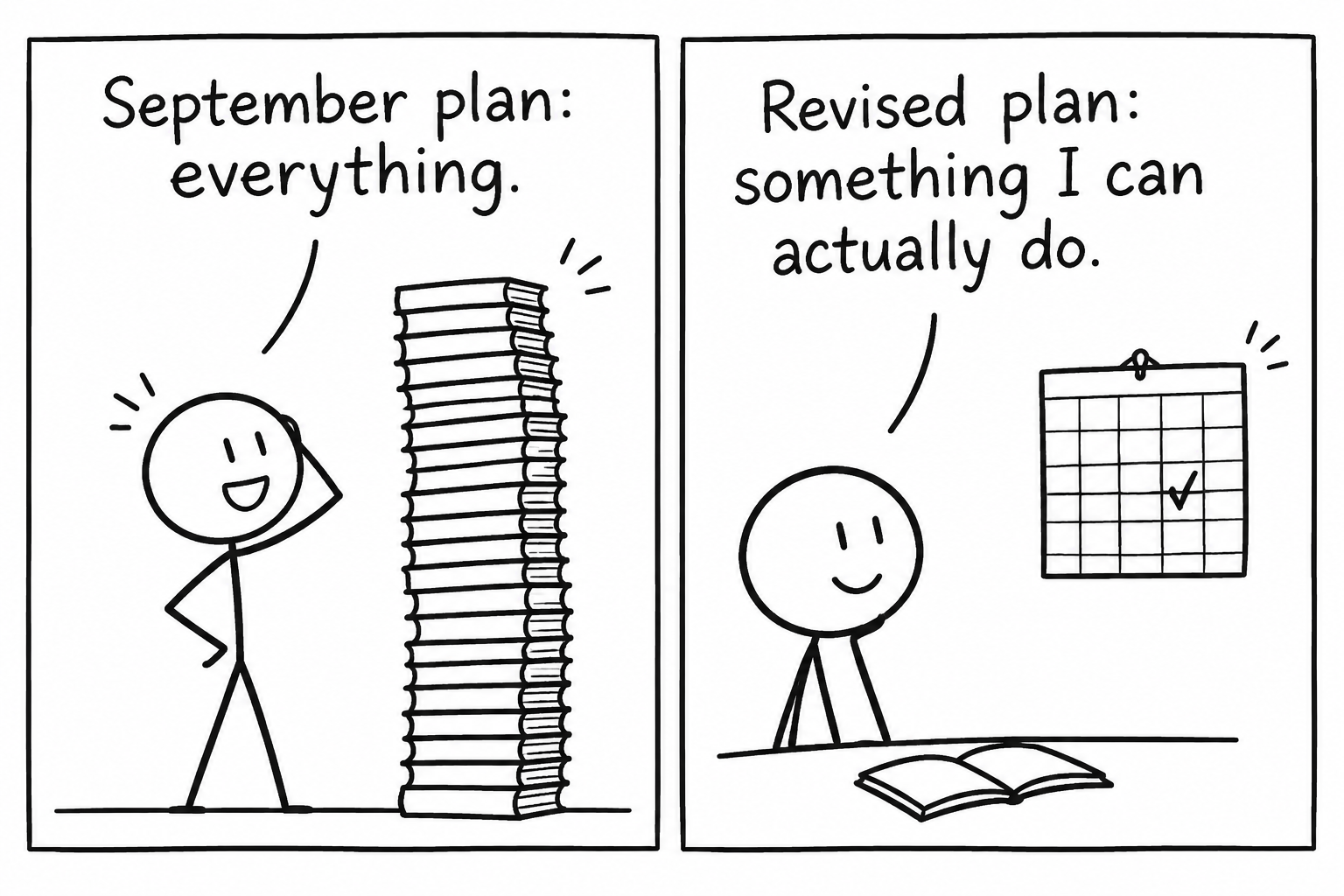 A student replaces an impossible September revision plan with a realistic calendar
Start with a Year 12 diagnostic
During the first week, complete a short audit across pure maths, statistics and mechanics. The Edexcel AS Level Maths revision hub provides a useful map, although you should compare it with your own exam board's specification.
Test each area with a few questions rather than judging it by familiarity. Classify every topic:
- Secure: you can select and complete the method independently.
- Uncertain: you understand it but make errors or need prompts.
- Weak: you cannot identify or complete the method.
Begin with uncertain topics. They often improve quickly and may remove several obstacles from current lessons. Maya might discover that integration is not the real problem; rearranging algebraic expressions is what slows her down. Her task then becomes precise and manageable.
Which Year 12 topics should you revise first?
Algebra and functions
Algebra is the working language of A Level Maths. Review indices, surds, quadratics, inequalities, functions, transformations, partial fractions and algebraic division where required by your specification.
You should manipulate relationships such as
am×an=am+n a^m \times a^n = a^{m+n} am×an=am+nand recognise when an expression needs rearranging before another method becomes visible.
Trigonometry and calculus
Review radians, graphs, identities and equations. Practise selecting an identity, rearranging it and checking whether solutions lie in the required interval.
For calculus, revisit differentiation of powers, tangents and normals, stationary points, integration of standard powers and definite integration for areas. Remember that an indefinite integral requires a constant:
∫xn dx=xn+1n+1+C,n≠−1 \int x^n\,dx = \frac{x^{n+1}}{n+1}+C, \qquad n \ne -1 ∫xndx=n+1xn+1+C,n=−1The MathsGenie A Level Maths lessons can rebuild a method before you attempt independent questions.
Statistics and mechanics
Review probability, statistical distributions and interpreting data. For mechanics, revisit modelling assumptions, constant acceleration, forces and Newton's laws. The goal is to recover the notation, vocabulary and standard decisions that Year 13 work assumes.
A weekly September revision template
Four focused sessions outside lessons can create a sustainable week. Adjust them around your timetable.
| Session | Main purpose | Suggested task |
|---|---|---|
| First | Current Year 13 topic | Review the lesson and answer questions without notes |
| Second | Year 12 prerequisite | Repair one skill connected to current teaching |
| Third | Statistics or mechanics | Alternate the strand and complete exam-style questions |
| Fourth | Mixed review | Reattempt errors, take a mini test and set new priorities |
Each session should include brief retrieval, independent practice and marking. Spend less time rewriting notes and more time producing answers you can check. If you become stuck, use the MathsGenie A Level video lessons, then attempt a fresh question independently.
Place these sessions in the MathsGenie Revision Planner so they have a realistic position alongside lessons and other subjects.
How to revise each topic effectively
Recall the method from memory before opening your notes. Write the essential formula or explain when the method applies, then answer practice questions independently.
Mark your work promptly. A mark scheme reveals which stages, statements and conclusions examiners expect. For each error, record whether the cause was missing knowledge, incorrect method selection, algebra, calculator use or incomplete notation.
Avoid writing only “careless error”. A note such as “lost the negative sign when differentiating” gives you something concrete to monitor. Use the Edexcel A Level Maths revision hub to find revision lessons, practice questions and assessment material.
Common September revision mistakes
Trying to revise all of Year 12
This creates work without identifying what matters. Use diagnostic questions to choose a few high-value topics.
Ignoring current Year 13 lessons
Revision should support new learning. Consolidate classroom material while it is still recent.
Completing questions without marking them
Unmarked practice can repeat the same misunderstanding. Mark schemes and video solutions turn answers into feedback.
Starting full papers too early
Papers may contain substantial content you have not learned. Topic questions and mini tests are usually more informative in September.
Building an impossible timetable
A plan that fills every evening will struggle to survive a busy week. Four defined sessions with some flexibility are more valuable than an ideal schedule you abandon.
Turn September into a routine
By the end of September, you do not need to be ready for every final exam question. You need a clear picture of your Year 12 gaps, a reliable way to consolidate Year 13 lessons and a rhythm that can continue through autumn.
Choose the topics you need to repair, place them beside your current lessons, and build the week in the MathsGenie Revision Planner.