

What to Revise in October of Year 13 Maths
What to revise in October of Year 13 Maths: prioritise Year 12 gaps, current topics and weekly practice with a calm, practical four-week revision plan.
October creates a strange kind of pressure. Year 13 has only just begun, yet the final exams no longer feel distant. New topics arrive quickly, Year 12 knowledge is assumed, and every unfinished exercise can feel like evidence that you are behind.
The answer to what to revise in October of Year 13 Maths is not the whole specification. Your priorities are to secure the Year 12 skills needed for current lessons, practise the Year 13 topics being taught now, and establish a weekly routine you can sustain. Full papers and intensive exam preparation can wait. October is about building foundations before the pace increases.
Imagine a hypothetical student called Sam. At the start of the month, Sam writes “revise maths” on four evenings. The plan looks serious but says nothing about what to do. By half-term, several sessions have been postponed because each one feels too large. A better October revision plan replaces vague ambition with specific, repeatable work.
Your October revision checklist
By the end of October, aim to have:
- identified three to five Year 12 weaknesses that affect current work;
- reviewed the Year 13 topics covered so far at school;
- completed targeted questions without relying constantly on notes;
- started an error log containing mistakes and corrected methods;
- revisited each important topic after a gap;
- completed at least one mixed mini test under timed conditions;
- planned November using evidence from your October work.
The A Level Maths revision hub is a useful pillar for this process. It brings together board-specific revision resources, past papers, mark schemes and practice materials, so your plan can lead directly to useful work rather than another search for resources.
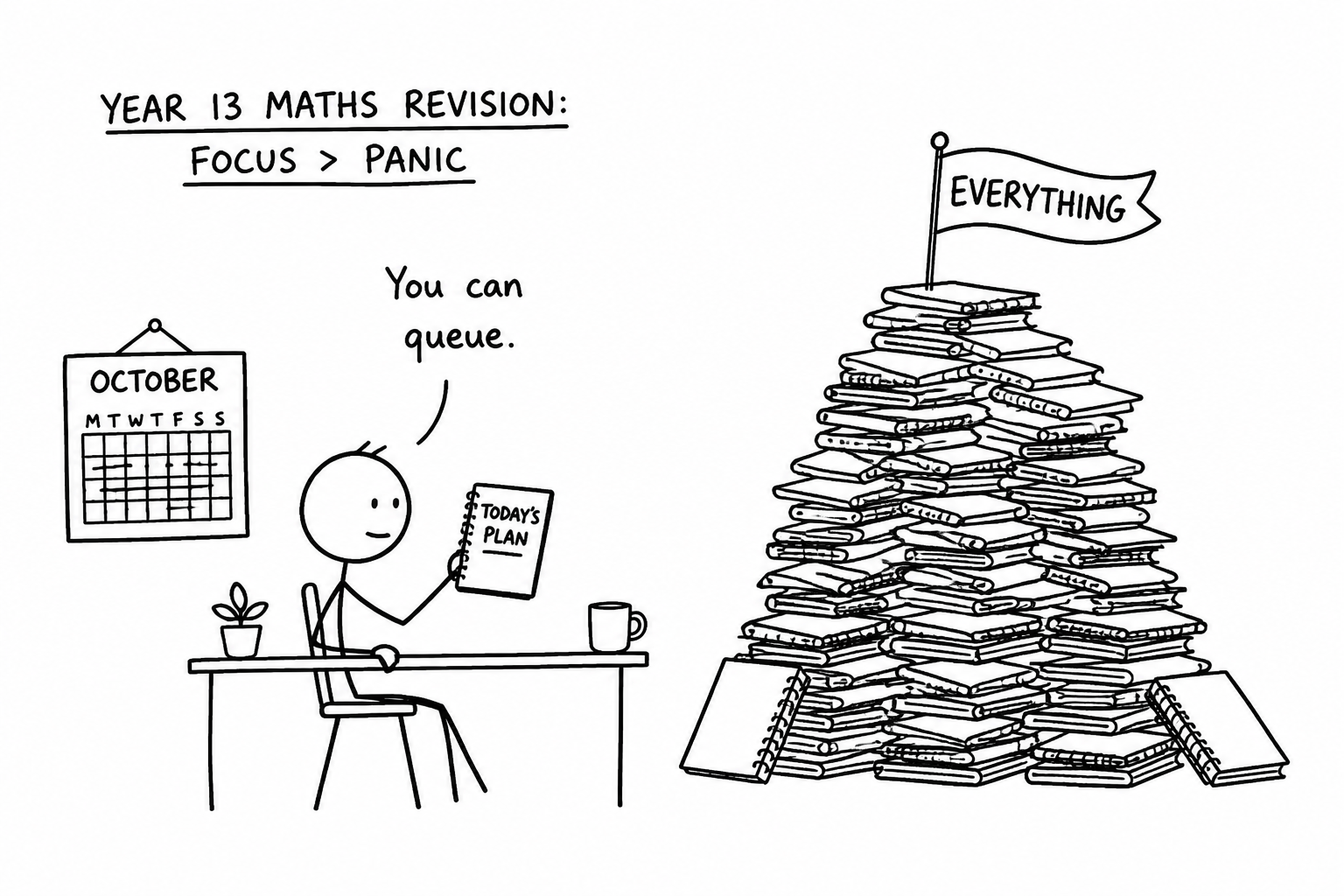 A student calmly queues revision topics behind October's priorities
Where October fits into Year 13 maths revision
October is early enough to repair foundations, but late enough for weaknesses to begin affecting new material. This makes it a bridge month.
A Level Mathematics includes pure mathematics, statistics and mechanics, although paper structures and topic ordering vary between Edexcel, AQA and OCR. Schools also teach the specification in different sequences. Your class may be working on differentiation while another is studying sequences or moments. A useful plan must therefore follow your school timetable and exam board rather than an invented national order.
You can find the correct resources through the Edexcel A Level Maths page, AQA A Level Maths page or OCR A Level Maths page.
October is not usually the moment to complete full papers every weekend. You have probably not covered all the Year 13 content, so a raw paper mark may tell you more about what has not been taught than what you understand. Topic questions, mixed Year 12 practice and selected past-paper questions are usually more informative now.
What to revise in October of Year 13 Maths
Repair Year 12 knowledge that Year 13 depends on
Do not revise every Year 12 chapter equally. Look for prerequisite knowledge that is slowing down current lessons.
High-value areas often include:
- algebraic manipulation, indices and surds;
- quadratics, functions and graphs;
- trigonometric identities and equations;
- differentiation and integration fundamentals;
- exponentials and logarithms;
- vectors;
- probability and statistical distributions;
- forces, motion and constant acceleration.
This is a diagnostic list, not a compulsory October syllabus. Start with your recent classwork, homework and assessments. If an error in a Year 13 problem came from weak algebra, revise the algebra. If the difficulty was interpreting a mechanics model, prioritise modelling and diagrams.
Sam initially chooses topics by discomfort. The hardest-looking chapter gets the most time. A better approach is to choose by consequence: which weakness appears most often and blocks the most current work?
Consolidate the Year 13 topics taught this week
New learning fades quickly when it is only seen in a lesson. Give each current topic a short consolidation session within a few days.
Use this sequence:
- recall the main definitions, conditions and methods without notes;
- check what you missed using a revision lesson or class materials;
- complete a small set of focused practice questions;
- mark the work carefully;
- correct each error without copying the mark scheme;
- schedule another attempt several days later.
The correction is where much of the improvement happens. A red cross merely records the past. A corrected solution changes what you can do next time.
Keep pure, statistics and mechanics visible
Pure mathematics can consume the entire week because it often receives more lesson time and supplies methods used elsewhere. However, statistics and mechanics also need regular contact.
A sensible October balance is to make current school content the main priority, then include one shorter applied session each week. Alternate statistics and mechanics if time is limited. This prevents a strand from disappearing for a month and becoming expensive to relearn later.
Begin exam practice in small pieces
You do not need to avoid exam questions simply because full papers are premature. Use selected questions on topics you have already covered. Work without notes, respect the command words, and compare your reasoning with the mark scheme.
MathsGenie's free resources include practice materials alongside A Level past papers and mark schemes. In October, select questions deliberately rather than treating every paper as a mock. Save untouched full papers for later stages when they can provide a fairer measure of exam readiness.
A weekly October revision template
Use this structure around lessons, homework and other A Levels. The session lengths are suggestions, not rules.
Monday: current pure topic
Spend about 40 minutes recalling this week's method and answering focused questions. Finish by writing down one step that still feels uncertain.
Wednesday: Year 12 repair
Use 30-45 minutes on one prerequisite weakness. Keep the target narrow, such as logarithm laws or resolving forces, rather than “all of mechanics”.
Friday: statistics or mechanics
Complete a short applied session. Alternate strands each week unless one is currently being taught or assessed.
Weekend: mixed test and review
Complete a 45-minute mixed mini test using topics you have already met. Mark it, classify the mistakes and redo two unsuccessful questions without help. Then choose the next week's Year 12 repair topic from the evidence.
Keep one evening unallocated. A plan without spare capacity breaks as soon as schoolwork expands, illness interrupts the week or another subject needs attention.
You have the weekly structure; if setting it up by hand feels like another task, build your October schedule in the Revision Planner and give the plan somewhere practical to live.
How to use the four weeks of October
Week one: diagnose
Review recent assessments, homework and class notes. Choose a small number of weaknesses and establish your baseline routine. Do not spend the week producing elaborate notes.
Week two: repair
Target the Year 12 skill with the greatest effect on your present work. Continue consolidating new Year 13 lessons rather than pausing the current course to revisit the past.
Week three: mix
Combine familiar and recent topics. Mixed practice makes you decide which method is needed, which is closer to the thinking required in an exam than completing a page of identical questions.
Week four: test and adjust
Complete a mini test, mark it and compare the outcome with week one. Ask which errors came from knowledge, method, algebra, interpretation or carelessness. Carry unresolved priorities into November.
For broader planning principles, the Maths revision timetable guide explains how to combine lessons, questions, marking and realistic weekly scheduling. Although written around GCSE revision, its central planning method transfers well to A Level: diagnose, practise, mark and revisit.
Common October revision mistakes
Trying to finish the entire course
This creates shallow coverage and unnecessary anxiety. Follow the content already taught and repair the prerequisites that support it.
Rewriting notes instead of answering questions
Notes can clarify a method, but fluency develops through retrieval and practice. Most sessions should produce attempted questions, corrections or a test result.
Ignoring mistakes after marking
Recording a score is not the same as learning. Explain why each error happened, write a complete correction and attempt a similar question later.
Using full papers too early
A full paper containing untaught material gives distorted feedback and consumes a valuable future resource. In October, use topic-based or selected past-paper questions.
Planning every available hour
An overloaded plan makes one missed session feel like failure. Leave room for homework, rest and unexpected demands. Consistency matters more than a perfect-looking timetable.
Build your October schedule
Sam's progress changes when the plan stops being a list of intentions and becomes a set of named sessions. Knowing what to revise is only the first step; following it through a busy Year 13 week is the real challenge. Your exams have fixed dates, so each planned week now protects time you will need later.
Build your four-week October schedule in the MathsGenie Revision Planner.















