

What to Revise in March of Year 13 Maths
What to revise in March of Year 13 Maths: prioritise weak topics, practise mixed questions and follow a weekly plan that builds towards exam season now.
March can feel awkward in Year 13 Maths. Lessons may still be covering new content, mocks have exposed gaps, and final exams are becoming harder to ignore.
So, what to revise in March of Year 13 Maths? Prioritise weak Year 12 foundations, demanding Year 13 topics and regular mixed exam practice. Use papers to diagnose problems, then repair them before attempting another. You do not need to finish every available paper this month.
The aim is to leave March knowing what is secure, what needs work and exactly what your next revision session should cover.
Your March revision checklist
Build your plan around:
- a diagnostic paper or substantial mixed question set
- a ranked list of weaknesses across pure maths, statistics and mechanics
- short retrieval sessions on Year 12 foundations
- focused practice on current Year 13 content
- weekly timed mixed questions
- marking, corrections and later attempts without notes
Familiar questions can make revision feel comfortable. Your checklist should also include questions that reveal what you cannot yet do independently.
How March fits into A Level revision
Think of March as a bridge between learning the course and preparing for complete exam papers. Move through three stages: diagnose, repair and mix.
A worksheet labelled “integration by parts” tells you which technique to use. A mixed question set makes you choose. Both matter, but they train different skills.
Use the MathsGenie Edexcel A Level Maths revision hub for revision lessons and resources. Students following AQA, OCR or Eduqas should match resources to their own specification and assessment structure.
What to prioritise during March
Repair the foundations behind harder questions
A difficult integration question may expose an algebra weakness rather than an integration weakness. Check where your working first goes wrong before deciding what to revise.
Include short sessions on rearranging expressions, factorising, fractions, indices, functions, logarithms, trigonometry and basic calculus. Choose from this list using evidence from your mistakes, rather than revising everything equally.
These foundations are not topics you have left behind. They remain tools for solving Year 13 problems.
Secure demanding Year 13 pure topics
Priorities may include further differentiation and integration, differential equations, numerical methods, parametric equations, vectors, sequences and series, proof and advanced trigonometry.
Select one weak topic, review its method briefly and attempt questions without notes. Mark your work, identify the first incorrect step and try a similar question independently.
The A Level Maths question bank provides practice to support this process. Avoid watching a solution before giving yourself a genuine opportunity to choose a method.
Keep statistics and mechanics visible
Pure maths can absorb the timetable unless applied topics have protected sessions.
For statistics, revisit probability distributions, hypothesis testing, the normal distribution and interpreting answers in context. Where your specification includes a large data set, retrieve its relevant variables and context using the correct board materials.
For mechanics, check modelling assumptions, kinematics, forces, moments and variable acceleration where required. State your positive direction before forming equations, then check that signs remain consistent.
Use the A Level exam booklets for focused past-paper questions before moving to complete papers.
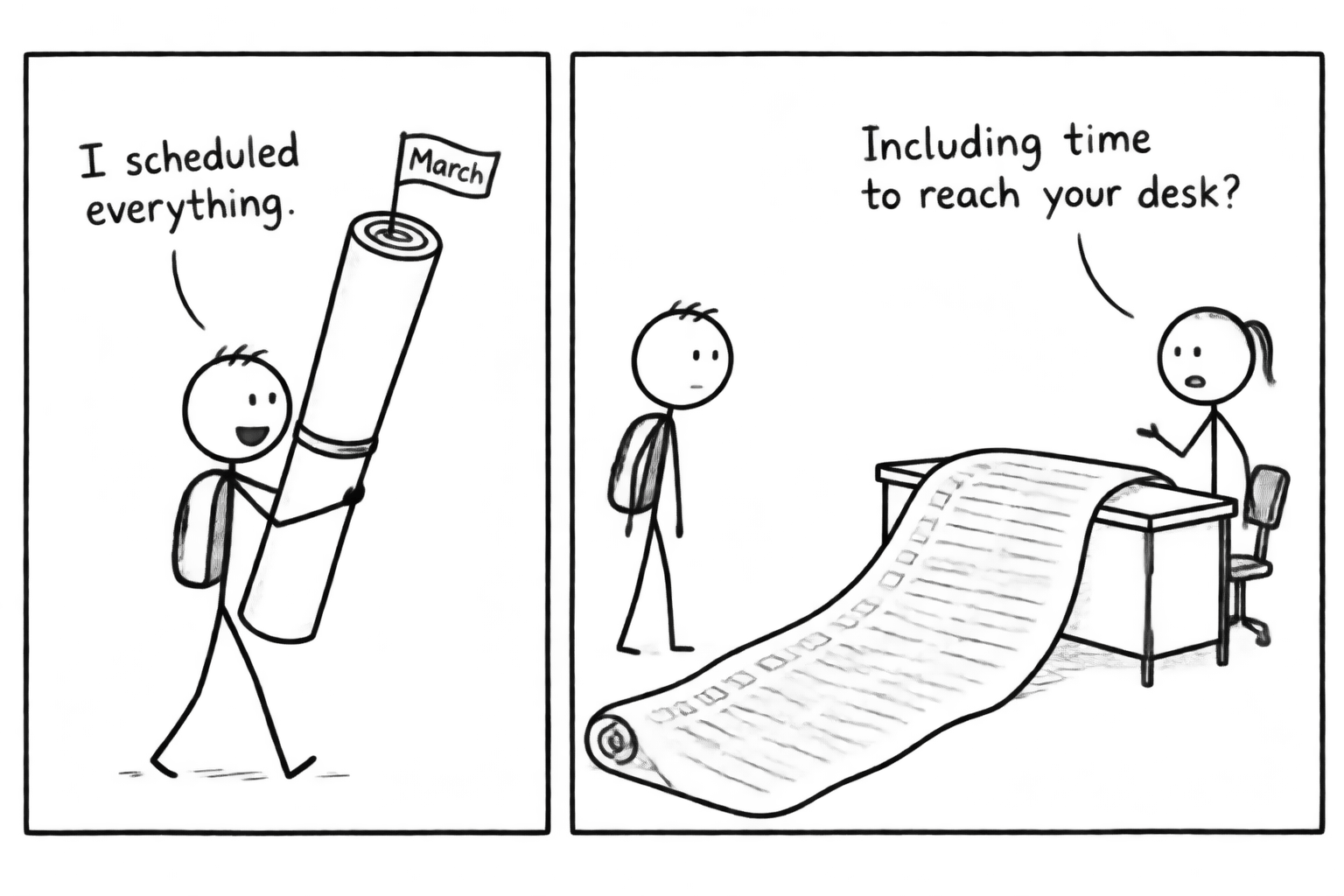 A stick-figure student discovers that an enormous March timetable has blocked the route to their revision desk
A weekly March revision template
Imagine a student trying to fit every chapter into one week. The timetable looks reassuring, but leaves no room to correct mistakes. A better plan repeats a manageable pattern.
Early week: retrieve and repair
Begin with a short set on older algebra, trigonometry or calculus. Mark it immediately. Use the next session for a demanding Year 13 topic, ending with questions completed without notes.
Midweek: applied practice
Give statistics or mechanics a focused session, alternating the main emphasis while keeping both visible through shorter questions. Reach exam practice rather than spending the whole session rewriting notes.
Late week: mix and review
Complete questions without topic labels. At the weekend, attempt a timed paper section and allow enough time for corrections. Record whether each error involved knowledge, method selection, algebra, calculator use, interpretation or communication.
Leave space for other A Levels and rest. The MathsGenie Revision Planner can help organise sessions. The revision timetable guide and one-month revision planning guide offer scheduling principles you can adapt from GCSE to A Level depth.
How to use past papers in March
Start with one diagnostic paper or substantial mixed assessment. Let the errors determine your priorities. During the month, combine topic practice with timed sections, then attempt another broad assessment to check progress.
Use the Edexcel A Level Maths past papers and mark schemes if they match your course. Consult video solutions when available after attempting the question, not instead of attempting it.
Predicted papers and mini tests can provide additional practice, but they cannot guarantee exam content. Keep specification coverage and past-paper evidence central to your choices.
Common March revision mistakes
- Treating every topic equally: give more time to weaknesses that repeatedly cost marks.
- Replacing practice with notes: keep summaries brief and finish sessions with marked questions.
- Recording only a score: identify why marks were lost and revisit the question later.
- Repeating full papers without repairs: use focused questions between assessments to change the outcome.
- Planning every spare hour: leave room for homework, other subjects and recovery.
Finish March with a workable next step
Progress does not mean feeling confident about every chapter. It means having clearer evidence and acting on it.
Choose one weakness, complete a focused MathsGenie revision lesson and question set, then schedule a later check. Build your March revision schedule around that repeatable process. A manageable plan turns revision from a nightly decision into work you know how to begin.















